
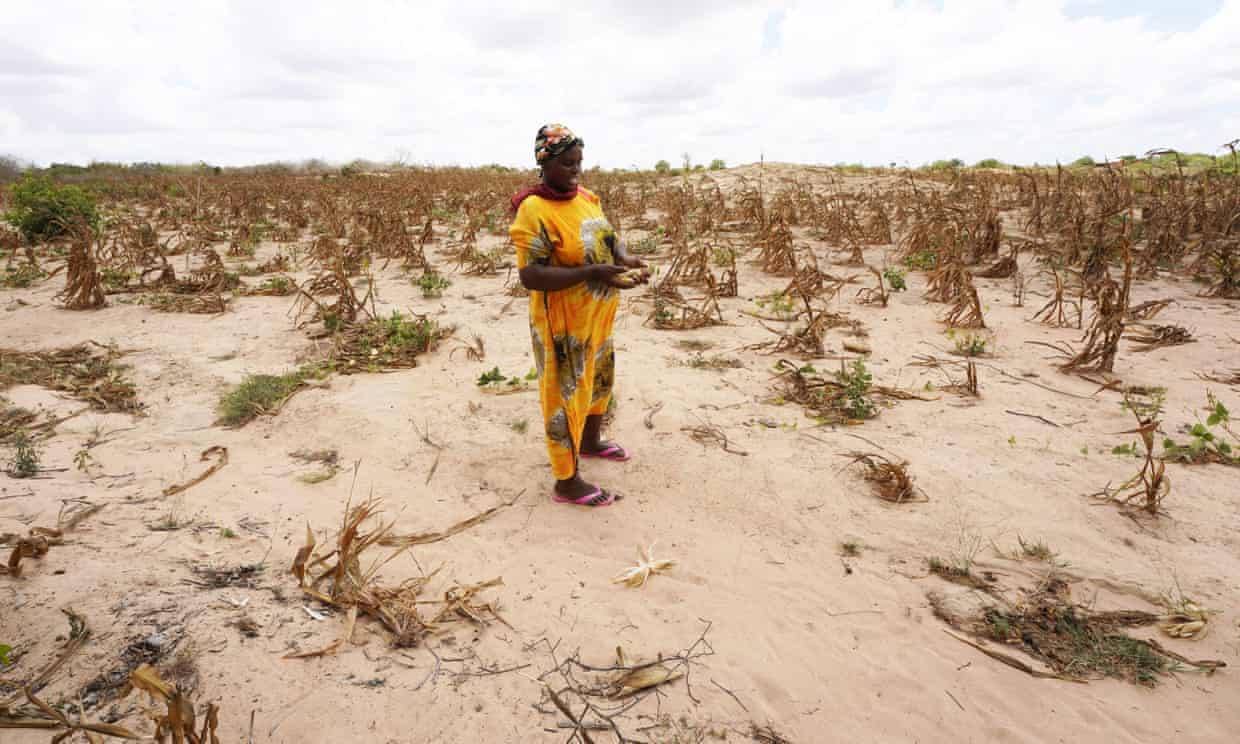
Withered maize in Kilifi county, Kenya, in March 2022. The Horn of Africa is experiencing its worst drought in 40 years (Photograph: Dong Jianghui Xinhua/Xinhua/Alamy)
I recently walked the parched earth of north-east Kenya and heard heartbreaking accounts of families slipping back into poverty. Across Africa, water shortages are expected to displace[1] up to 700 million people this decade. The Horn of Africa is experiencing its worst drought[2] in 40 years, with more than 50 million people suffering from hunger, unsure where their next meal is coming from.
While some parts of the continent are gripped by drought, places such as South Sudan and my homeland, Nigeria, are experiencing devastating flash floods that sweep away homes, businesses and livelihoods. And up to 116 million[3] Africans will face severe risks from rising sea levels this decade.
As we approach the United Nations climate change conference, Cop27[4], in Egypt, we are living on borrowed time. Global emissions are at record levels and rising, while worsening climate chaos is wreaking havoc across our continent.
The pre-Cop27 event I attended in October in the Democratic Republic of the Congo (DRC) put a spotlight on Africa’s specific climate vulnerabilities. But delegates also focused on the vast opportunities that ambitious joint climate action could create to drive progress across the sustainable development goals (SDGs). And so they should.
The Democratic Republic of the Congo is a country brimming with immense potential and innovative climate solutions. It is home to most of the world’s second-largest rainforest, and has major deposits of cobalt, copper and aluminium – the minerals required for the key transformations we need for renewable energy and digital economies. The Congo basin has the ability to absorb around 1.2bn tonnes of carbon dioxide a year – 4% of global emissions.
However, African nations cannot fight the climate crisis, protect their rich rainforests and safeguard their biodiversity alone. The international community must stand in solidarity with Africa and help to provide the significant resources needed. Africa requires $2.8tn by 2030 to play its part in limiting global heating to 1.5C and to address the impacts of climate change. Yet the whole continent received only $30bn[5] of global climate finance in 2020.
Ministers at the pre-Cop meeting in DRC made it clear that African countries need finance urgently to build resilience and adapt to the devastating impacts of a crisis they did nothing to cause. They called on developed countries to deliver on their promises, starting with the pledge made at last year’s Cop26 climate conference in Glasgow to double adaptation finance to at least $40bn annually.
The failure of developed countries to honour their commitments is not just an injustice and a failure of global solidarity. It contributes to the serious tensions and divisions that are preventing global action on a host of other issues, from peace and security to human rights. As the late Archbishop Desmond Tutu said: “Exclusion is never the way forward on our shared paths to freedom and justice.”
African countries need support from both public and private sources of finance, especially from the multilateral development banks. Vulnerable countries cannot make the shift to renewables and provide access to energy for all unless these banks overhaul their operating models. Governments are their shareholders and must use their influence to get the banks to step up.
Many developing countries, including 15 in Africa, are heading into our current cost of living crisis while facing debt distress or default. They need fiscal space to invest in climate action and the SDGs. While some countries need comprehensive assistance to restructure their debt, the international community should also look at innovative solutions, including debt-for-climate adaptation and debt-for-nature swaps.
The renewables revolution on the African continent will fail unless it expands access to energy. Some 600 million Africans still lack access to electricity. Achieving universal access will require massive investment in renewables, creating millions of jobs and driving economic development and prosperity. But it cannot add to the debt burden of African countries. African countries need a new generation of partnerships with donors, multilateral development banks and private financiers. The Just Energy Transition Partnerships – with a focus on phasing out coal and speeding up the deployment of renewables – are one innovative model.
Climate action and the renewables revolution are not luxuries or add-on extras on the African continent. They are indivisible from building peace, security, stability and prosperity.
The DRC itself has endured nearly three decades of conflict and fragility, and up to 5,000 children become soldiers each year. In DRC and elsewhere, climate change is exacerbating conflict by causing flooding, deforestation and drought, deepening poverty and competition for resources.
I was encouraged by the frank dialogue between governments in Kinshasa. This is crucial to building trust – a prerequisite for joint climate action. But much more is needed to turn these murmurs of solidarity into gusting winds of change.
The people of Africa need action. At Cop27 and beyond, they need concrete plans to deliver finance at scale, ensure a just transition to renewables, build climate resilience and address the loss and damage caused by this crisis.
-
Amina J Mohammed is the deputy secretary-general of the United Nations and chair of the UN Sustainable Development Group, and a former minister of environment of Nigeria
-
Do you have an opinion on the issues raised in this article? If you would like to submit a response of up to 300 words by email to be considered for publication in our letters[6] section, please
This email address is being protected from spambots. You need JavaScript enabled to view it. [7].
References
- ^ displace (www.climate-refugees.org)
- ^ drought (www.theguardian.com)
- ^ up to 116 million (www.interregional.com)
- ^ Cop27 (www.theguardian.com)
- ^ only $30bn (techeconomy.ng)
- ^ letters (www.theguardian.com)
- ^
This email address is being protected from spambots. You need JavaScript enabled to view it. (www.bing.com)
Newer articles:
- Uganda: PM Nabbanja Named Among 100 Most Influential African Women - 07/11/2022 00:56
- UNHCR's Grandi urges world leaders not to forget displaced people at COP27 - 07/11/2022 00:01
- Ethiopia grants postgraduate Scholarships for South Sudanese Students - 05/11/2022 12:31
- Children in Ngolembo receive a boost to their education, thanks to United Nations Mission in South Sudan (UNMISS) - 05/11/2022 12:00
- ‘Govt cannot investigate journalist Allen’s death’- Deputy Minister - 05/11/2022 05:11
Older news items
- Sudanese factions break deadlock with talks over draft constitution - 05/11/2022 03:12
- Two thirds of South Sudan population risk severe hunger in 2023 - U.N - 04/11/2022 05:45
- More than a million hit by flooding in South Sudan - UN - 04/11/2022 05:28
- South Sudan: Conflict and climate crisis drives rising hunger - 04/11/2022 04:48
- UN says tribal clashes in Sudan kill 359 people since July - 04/11/2022 00:42
Latest news items (all categories):
- Ramaphosa presses Kiir to implement peace deal ahead of South Sudan’s first elections - 09/10/2026 12:19
- South Sudan steps up Ebola alert after Kenya case - 09/10/2026 12:17
- Laotian man deported by U.S. to South Sudan leaves for Laos after year in detention - 09/10/2026 12:14
- Bullet and blast injuries … and a constant need for blood: inside South Sudan’s overwhelmed trauma wards - 09/10/2026 12:10
- MTN South Sudan and Regulator Pledge Cooperation to Expand Connectivity - 09/10/2026 12:01
Random articles (all categories):
- South Sudan: Peace Deal Is a 'Result of External Pressure' - 09/01/2016 05:46
- Vietnamese “blue beret” soldiers save life of UN peacekeeper in South Sudan - 11/06/2021 07:54
- South Sudan: UN urges role of women in drafting constitution - 08/05/2013 00:53
- Support South Sudan peace deal because there is no plan B: UNMISS head - 08/03/2019 20:52
- South Sudan official calls for political solutions to boundaries dispute - 03/12/2019 07:40
Popular articles:
- Who is the darkest person in the world, according to Guinness World Record? - 25/10/2022 02:34 - Read 150842 times
- School exam results in South Sudan show decline - 01/04/2012 17:58 - Read 28207 times
- Top 10 weakest currency exchange rates in Africa in 2023 - 19/07/2023 00:24 - Read 25314 times
- No oil in troubled waters - 25/03/2014 15:02 - Read 24541 times
- NDSU student from South Sudan receives scholarship - In-Forum - 29/09/2012 01:44 - Read 22502 times
