
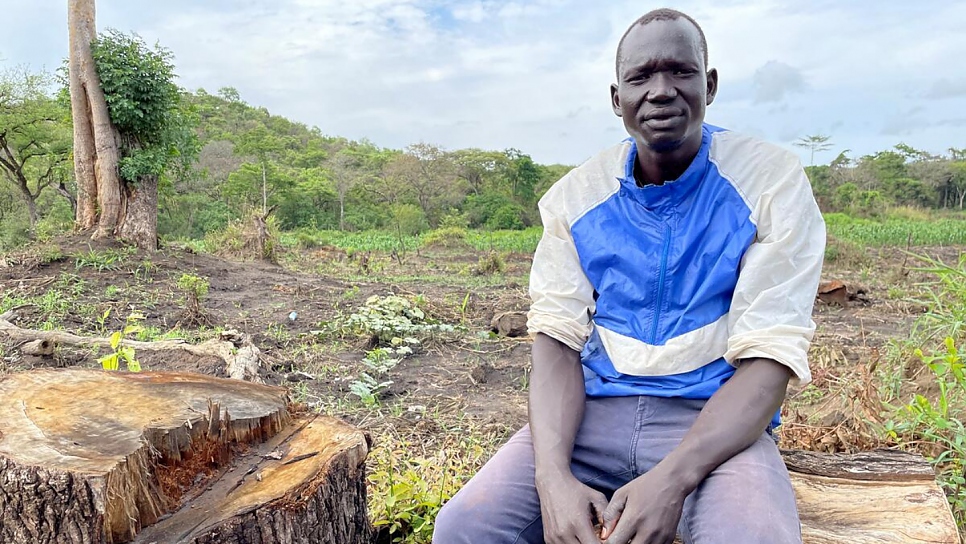
Returned refugee Mwaka Paul, 33, takes a break from clearing the land for planting (© UNHCR/Tim Gaynor)
With wet season rains just days away, a group of farm workers race to clear tree stumps, cut up branches and dig the soil across a broad tract of bush in this remote corner of South Sudan, close to the border with Uganda.
Working with a purpose, they hope to grow crops at sufficient scale to lift themselves and their community out of a hand-to-mouth existence of grinding poverty in one of the world’s poorest and most conflict-affected countries.
“If you don’t feel hope, you don’t do the work. [But] if you see something in the future, then you run to get it,” says returned refugee Mwaka Paul, explaining the energy that ripples through the farm six kilometres down a dirt track south of Magwi Town.
Paul, 33, is a member of the Can-Coya farming community comprising returned refugees and local residents who are on a mission to turn their lives around.
The fast-growing group, whose name means “Poverty Keeps Me Awake” in Acholi, began cultivating cabbages, tomatoes, pumpkins, bananas and spinach last year on a plot of four acres of gently sloping land bordered by a stream, and this year aim to plant 250 acres.
They started out with 31 members, but this growing season, have grown to 54, half of them returned refugees. They are looking to add maize, groundnuts and onions this time around, and sell their crops in Juba, the nation’s capital and principal market, where prices are higher.
“The idea,” says group chairman Odong Anthony, “is to work together and eradicate poverty … and stop importing food.”
“If you work alone, it’s hard. If you join hands, it’s easy.”
To scale up fast, they need help, Anthony says, and persuading more refugees to return from the diaspora to work alongside them is key. He says word is getting back to the camps in Uganda a few miles across the border, where many acquire useful skills and knowledge.
“Our message (to them) is ‘you are welcome,’” says the 45-year-old, as the group set down their hand tools in a clearing to break for lunch cooked over an open fire. “If you work alone, it’s hard. If you join hands, it’s easy.”
Among recent returnees with specialist skills is Alice Ayo Matata, 30, who learned to grow seedlings in a nursery, harden them off and transplant them. Since coming home a year ago, she is also keen to share her knowledge of animal husbandry and beekeeping with the community, some of whose members forage for wild honey in the nearby forest, using smoke to pacify the bees.
“I know how to do it, and I can teach people,” she says.
Meanwhile Mwaka, who came back from Uganda in 2010 and has since gained a degree in economics and has studied accountancy, believes his practical knowledge can help the group as it grows.
“If we manage to cultivate and have our supplies taken to the market, it needs an accountant. Someone who knows how money is supposed to be kept, how money is supposed to be used, to make good records,” he says. “That knowledge can help all the cooperative.”
Currently, members make the daily trip to the farm from Magwi on foot, by bicycle and motorbike. But they are building a house out of mud bricks in the centre of the plot, to have a presence around the clock, guarding against theft and even raids by monkeys from the forest across the boundary stream.
Amid a soundtrack of thrumming insects, birdsong and laughter, is Grace Abalo, a widowed mother of seven children, who returned to South Sudan two months previously. She relishes the energy and sense of a shared purpose.
“When I work in a group, I feel that we can get something done,” says Grace. “It feels good to be home.”
There are currently around 2.3 million refugees from South Sudan scattered across five neighboring countries. More than 500,000 refugees have now returned to South Sudan since 2018, some 110,000 of them to Eastern Equatoria State, where the group is based.
UNHCR, the UN Refugee Agency, is helping those who return voluntarily to live a safe and dignified life through support for peacebuilding, governance and livelihoods in Magwi County and other “pockets of hope” in the country.
It is currently helping the Can-Coya community to incorporate as a cooperative, and is also providing tractors, assistance with irrigation, hand tools and training to members, to help them transition from subsistence living to a market economy.
While Magwi County is currently largely secure, the country as a whole remains fragile since achieving independence in 2011. It continues to be impacted by outbreaks of deadly inter-communal violence, as well as political challenges and the impacts of climate change.
Despite the uncertain picture, the project has already delivered tangible gains for the group that its members feel demonstrate that they are moving in the right direction.
“What’s exciting is that I can provide for my children. My children are going to school, there is food, I can buy them clothes, get them medical care,” says Alice, taking a break from clearing branches. “I feel proud to be here and proud to be home,” she adds.
“I feel proud to be here and proud to be home.”
Anthony himself recognizes the significant challenges that South Sudan faces. But he believes that the farming collective offers a lesson about the benefits of unity that the country as a whole can learn from.
“There are different groups coming together (here) from different communities for one goal: production,” he says. “That is peace in action. Why wait?”
This story is part of a series about the “Pockets of Hope” initiative in South Sudan.
Newer articles:
- Displaced women in South Sudan work to hold back floodwaters - 31/10/2022 09:14
- South Sudan’s lifts Covid-19 restrictions, travelers to present vaccination cards - 31/10/2022 05:28
- Women's clinic in South Sudan a casualty of distracted world - 31/10/2022 03:46
- Payam administrators’ forum concludes in Aweil with a call to deliver services - 31/10/2022 02:50
- Agricultural crops in Sudan threatened by pests, prices, and herders - 31/10/2022 00:36
Older news items
- Young woman accused of adultery faces being stoned to death in Sudan - 28/10/2022 02:35
- Over 150M children in Africa gripped by poverty, climate disaster: Report - 28/10/2022 01:45
- Security Council: Sudan and South Sudan (SC/15083) - 28/10/2022 00:54
- Conflict hinders aid delivery to flood-hit South Sudan's Upper Nile - 27/10/2022 09:20
- To Help Reduce Criminality, United Nations Mission in South Sudan (UNMISS) Hands Over a Police Post in Remote Kuarjena - 27/10/2022 08:43
Latest news items (all categories):
- Juba commissioner denies chasing foreigners - 07/10/2026 14:36
- Australia: 19-year-old from South Sudan arrested over a wild joy ride - 07/10/2026 14:33
- South Sudan’s aid crisis deepens as food stocks run low - 07/10/2026 14:29
- South Sudan’s Juba warns foreigners against running small-scale businesses - 07/10/2026 14:25
- Peace Dialogues foster social cohesion in Nyirol County after persisting tensions - 07/10/2026 14:23
Random articles (all categories):
- US pushes UN to consider arms embargo on South Sudan - 07/03/2018 20:09
- Attacks on South Sudan health facilities, workers increasing - 23/04/2018 15:05
- Salva Kiir Promotes Rumoured Successor Bol Mel to Full General - 16/09/2025 18:40
- جنوب السودان و شمالة زاوج رجلاً ناضج مع فتاة قاصرة - 07/02/2011 00:00
- South African court attacks government over 'disgraceful' flight of al-Bashir - 15/03/2016 10:34
Popular articles:
- Who is the darkest person in the world, according to Guinness World Record? - 25/10/2022 02:34 - Read 150703 times
- School exam results in South Sudan show decline - 01/04/2012 17:58 - Read 28190 times
- Top 10 weakest currency exchange rates in Africa in 2023 - 19/07/2023 00:24 - Read 25305 times
- No oil in troubled waters - 25/03/2014 15:02 - Read 24533 times
- NDSU student from South Sudan receives scholarship - In-Forum - 29/09/2012 01:44 - Read 22492 times
