
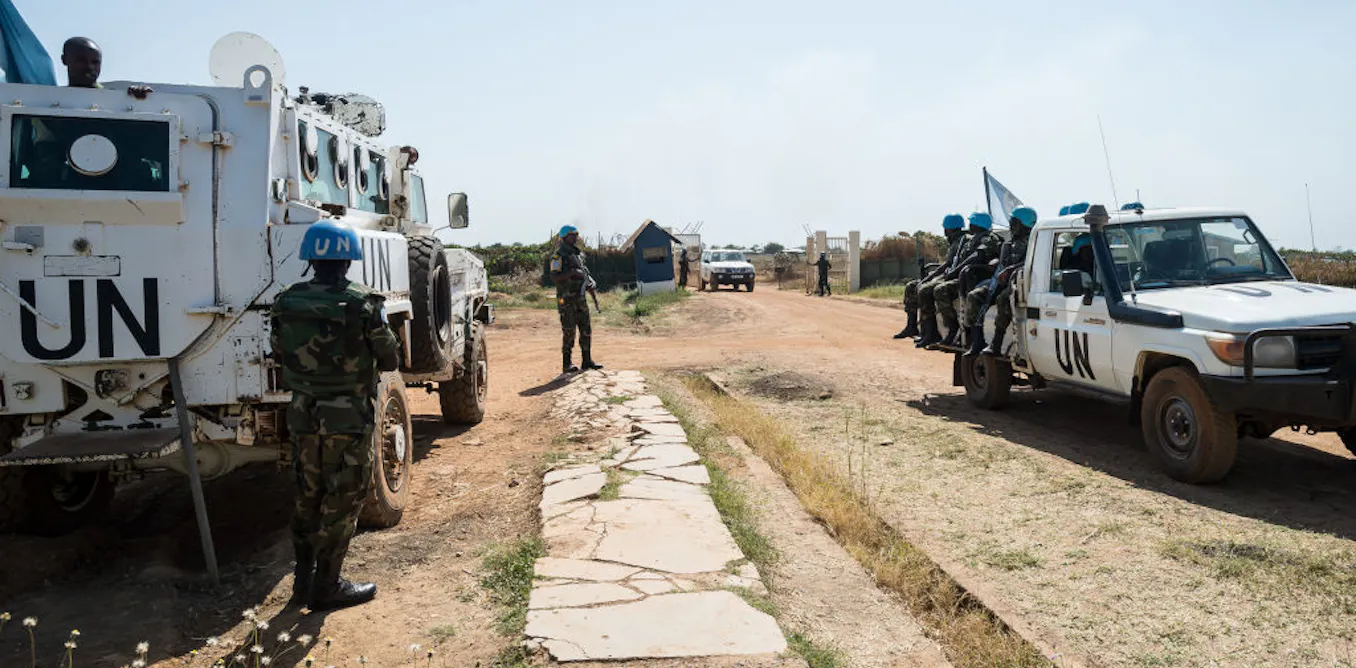
Armed United Nations mission guards in Malakal (GettyImages)
A long-running state of insecurity has recently intensified[1] in Unity State – one of South Sudan’s 10 states – resulting in many innocent lives being lost[2].
The security crisis is being stoked by many factors. One is fighting between sections of the civilian population, caused by cattle raiding[3], among other things. Another is armed confrontation between government forces and insurgents like the South Sudan People’s Movement/Army[4]. This is a group of disgruntled soldiers who were recently discharged from the military and are agitating for new government roles.
Broadly, the crisis speaks volumes of the fragility of South Sudan as a state. It is the consequence of weak political institutions in the country, not just Unity State. It is my view that the national government of South Sudan and Unity State government should work together to address the crisis in an effective way.
Such a way may involve disarming young people, which has worked elsewhere in the country, for example in the Lakes State. It is the use of arms by civilians to fight each other that has made the situation much worse.
The role of states
The roles of states as regional institutions are relevant in the scheme of things. South Sudan is made up of 10 states and three administrative territories. States were created under the country’s transitional constitution in 2011[5].
Of the three administrative territories, two – Pibor an Ruweng – were created by the national executive government. The third – Abyei, in the north of the country – was created under the 2005 comprehensive peace agreement[6] as a disputed territory between South Sudan and Sudan. Abyei’s status remains unresolved.
Each state has a legislative assembly (one chamber of parliament). Its members are drawn from the government and opposition parties as parties to the 2018 revitalised peace agreement[7]. This agreement has been incorporated into the transitional constitution.
The responsibilities and functions of state governments include maintaining peace and good order, protecting and promoting human rights and freedoms, and undertaking their own economic and infrastructure development.
States have not been able to achieve these essential goals due to lack of resources. Aside from generating their own revenue, states are supposed to receive a share from the petroleum money – public money – under the transitional constitution[8]. The constitution is, however, silent on how much money each state should receive. That leaves the national government to decide.
The petroleum producing areas – Upper Nile and Ruweng – are allocated 2% of the net petroleum revenue. But reports suggest they do not receive the amount[9] due to them annually.
Security problems
States have been hampered by security problems since at least independence in 2011. Reports have identified communal conflicts [10]as the main cause. These stem from longstanding land disputes and cattle raids.
A proliferation of arms has made the conflicts worse. It is estimated [11]that every young person in the villages has a gun.
The Unity State governor has acknowledged this problem[12], and urged the national government to lend him support to disarm young people.
These conflicts have deepened divisions in the country, weakening the government’s effort to implement peace.
State power under the transitional constitution
Key to understanding the security crisis is perhaps the division of state power under the country’s transitional constitution.
The transitional constitution outlines the powers and functions of government institutions in South Sudan. In particular, it provides for the powers and functions of the two chambers of the national legislature – the national legislative assembly and the council of states.
The national legislature has the overall power to enact laws and to supervise the national executive government. The second chamber – the council of states – has 100 members representing the states.
The council’s role has come under scrutiny recently. This came after its decision to impeach[13] the governor of Unity State, Nguen Monytuil, for the crisis.
But President Kiir Mayardit has overruled[14] the council’s decision, saying it was unconstitutional. The president has the power to sack a state governor[15] if a crisis has occurred in the governor’s state that threatens South Sudan’s territorial integrity.
While the president acted appropriately in this matter, the national government is not doing enough to help Unity State resolve the security crisis. Like the rest of the states, Unity State has limited capacity and resources to deal with matters of security decisively.
Next steps
There are obvious measures the government could take. One is total disarmament of young people throughout the country. To make this more effective, parliament should enact a law to make possession of arms by civilians a criminal offence that carries serious penalties.
This approach has been applied in some states in South Sudan, such as Lakes State. And it is working. Lakes State used to be the most violence-stricken place in the country. But its security has improved significantly since its governor, Rin Tueny, started disarmament in 2021.
The same approach is being trialled in Warrap State, another violence-hit territory. It is still too early to tell whether it is working.
Lastly, the power arrangement in the country as set out in the transitional constitution needs to be revised. It’s this arrangement that is partly to blame for the power overreach by the council of states. In one sense, it gives the council a supervisory role over states. This is justifiably what encouraged the council to interfere in the affairs of Unity State government.
This problem will need to be fixed in a new constitution to be drafted for the country. That constitution must be founded on a balance of power between the national and state governments with a focus on allowing state governments to operate independently, politically.
This is arguably the most effective way to constrain the national government from interfering in the political affairs of states.
References
- ^ intensified (www.eyeradio.org)
- ^ many innocent lives being lost (peacekeeping.un.org)
- ^ cattle raiding (crisis24.garda.com)
- ^ South Sudan People’s Movement/Army (radiotamazuj.org)
- ^ transitional constitution in 2011 (www.constituteproject.org)
- ^ 2005 comprehensive peace agreement (peacemaker.un.org)
- ^ 2018 revitalised peace agreement (docs.pca-cpa.org)
- ^ transitional constitution (constitutionnet.org)
- ^ do not receive the amount (suddinstitute.org)
- ^ communal conflicts (acleddata.com)
- ^ It is estimated (www.saferworld.org.uk)
- ^ acknowledged this problem (radiotamazuj.org)
- ^ impeach (paanluelwel.com)
- ^ overruled (paanluelwel.com)
- ^ power to sack a state governor (www.constituteproject.org)
Newer articles:
- New leishmaniasis treatment shows effectiveness in Eastern Africa - 29/09/2022 00:01
- African Union Launches Push for Universal Ratification of Anti-Graft Convention - 29/09/2022 00:00
- South Sudan: Health ministry, WHO install Ebola surveillance teams at border points with Uganda - 28/09/2022 03:03
- Report exposes U.N. camp abuses, but research shows justice is elusive - 28/09/2022 02:00
- Sudan traditional wind instrument trumpets harvest time - 28/09/2022 01:11
Older news items
- UN boss seeks ‘urgent report’ after South Sudan sex abuse allegations - 27/09/2022 08:18
- Resolutions to Curb Cattle-Related Tensions Agreed on at Rumbek Forum Organized by United Nations Mission in South Sudan (UNMISS) - 27/09/2022 04:58
- South Sudan: Concept of Operations Map, September 2022 - 26/09/2022 10:21
- SPLM-IO launches secretariat in Bor - 26/09/2022 02:34
- UN: South Sudan peace process needs urgent attention to prevent violence escalating - 26/09/2022 01:19
Latest news items (all categories):
- IGAD and South Sudan Strengthen National Coordination for the Implementation of the Building Women’s Economic Resilience for Sustainable Peace Project - 03/08/2026 18:53
- South Sudan plans interoperable birth registration, digital ID systems - 03/08/2026 18:50
- South Sudan Oil & Power Returns as South Sudan’s Premier Investment Platform - 03/08/2026 18:04
- Kenya: Mudavadi meets South Sudan foreign minister as Juba gears up for landmark elections - 03/08/2026 16:52
- A Long Road Home: Jal’s Journey Through Conflict and Separation - 03/08/2026 16:41
Random articles (all categories):
- Pride of War Overshadowing Humility of Peace Between the Sudan and South Sudan - 08/04/2012 23:38
- Sudan: a country ensnared by poverty, inequality and underdevelopment - 31/03/2014 01:26
- Opinion | How do we make an election possible in South Sudan? - 24/03/2022 02:58
- JICA set to launch Juba water project next year - 21/02/2022 02:38
- HIV in South Sudan Army Twice National Rate - 06/05/2013 22:08
Popular articles:
- Who is the darkest person in the world, according to Guinness World Record? - 25/10/2022 02:34 - Read 148275 times
- School exam results in South Sudan show decline - 01/04/2012 17:58 - Read 27915 times
- Top 10 weakest currency exchange rates in Africa in 2023 - 19/07/2023 00:24 - Read 25000 times
- No oil in troubled waters - 25/03/2014 15:02 - Read 24323 times
- NDSU student from South Sudan receives scholarship - In-Forum - 29/09/2012 01:44 - Read 22279 times
