
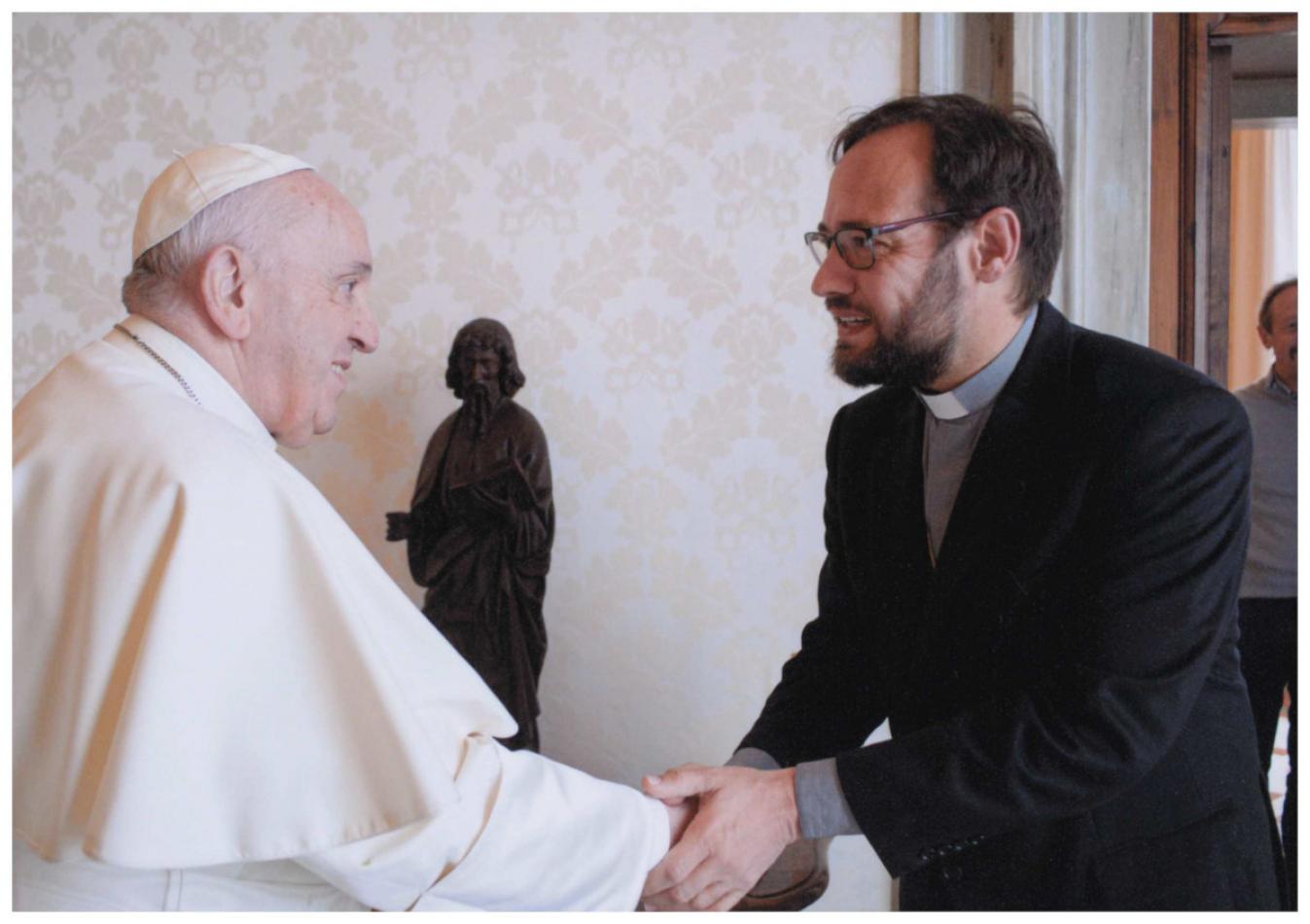
Pope Francis meets Bishop-designate Christian Carlassare at the Vatican March 14, 2022. The meeting took place almost one year after Carlassare was shot following his appointment as the new bishop of Rumbek, South Sudan. (Credit: Vatican Media.)
ROME – Looking ahead to Pope Francis’s upcoming visit to South Sudan and recent actions by the country’s leadership to fully implement an ongoing peace process, one bishop who experienced the violence plaguing the nation firsthand has said he is hopeful in the steps being taken.
“I look at South Sudan with optimism,” Bishop Christian Carlassare of Rumbek told reporters during an April 21 media roundtable, saying one “significant step forward” in the country’s peace process came April 12, when South Sudanese President Salva Kiir finally succeeded in forming a unified national army.
After a recent flare-up in fighting prompting increased pressure from international partners and donors, Kiir and his rival, vice president, Riek Machar, met April 8 and submitted a list of officers from Machar’s Sudan People’s Liberation Movement/Army in Opposition (SPLM/A-IO) to be integrated into the national security forces.
Until now the formation of a unified army has been one of the most difficult requirements to fulfill of a 2018 peace agreement.
Kiir and Machar signed the agreement in September 2018, ending a violent 5-year feud, however, the implementation of that agreement has been slow, and opposing forces taking issue with different aspects of the agreement have frequently clashed over how to share power.
Carlassare, a Comboni missionary who has been serving in South Sudan for nearly 20 years, said there are also groups who, when they feel marginalized or that they are losing power, will attack villages, steal resources, and instill fear in order “to get attention.”
Political and military leaders in South Sudan have expressed confidence that the recent unification of forces will be a big help in stopping ceasefire violations in different parts of the country, however, some details still have to be worked out, including training and the exact ratio of troops from each side.
“It wasn’t easy to form this unified army, but it’s very important” in terms of fostering peace,” Carlassare said.
Though not directly involved in South Sudan’s national peace process, Carlassare knows firsthand the tensions that still run deep in South Sudanese society after years of violent conflict, split largely along tribal and clan lines.
Named as the new bishop of Rumbek last March, he was shot just two weeks after his appointment when two gunmen entered his compound April 26, just after midnight, and shot him in the legs.
He survived the attack and was sent to Juba, and then Nairobi, in Kenya, for several months before returning to his native Italy. After six surgeries and nearly a year of rest and physical therapy, Carlassare has returned to Rumbek and has now been formally installed as its bishop.
Carlassare said he is able to walk normally but must still perform physical therapy to keep his muscles and circulation healthy.
The attack “was not only a physical wound, but in the heart…As a person I was hurt for personal interests,” he said, saying there is still a lot of reconciliation needed and as bishop, he is trying to meet with different groups and individuals to understand their fears and their needs.
He said he is going forward “not closing my eyes to what happened,” but with forgiveness and a desire to heal.
A trial is currently underway for the culprits of the attack, which appears to have been tribally motivated, as the diocesan administrator, who belonged to the area’s Dinka tribe, was passed up for Carlassare, a foreigner.
According to Carlassare, this sense of tribalism still runs deep in South Sudanese society and is one of the many challenges the country faces in achieving and maintaining a lasting peace.
The government, “now seems strong in its position,” but still struggles to maintain relations with all opposing groups, he said, because it has “worked to weaken the opposition and destabilize it. This doesn’t always work well.”
“Tensions have decreased, but they reappear, unfortunately,” he said. Despite recent steps by the government and opposition, such as forming a unified army, and despite efforts by the Church, including the Community of Sant’Egidio, to assist in negotiations, “We still have had violence in these months.”
“Everyone talks about peace, there is no open war, but there is violence that is still concerning,” he said, noting that weapons are still easily accessible, and tensions are still present, especially among the displaced who, to escape violence, fled their own villages and have taken refuge in nearby areas predominately represented by other tribes.
Environmental issues are also a factor, he said, as is the need for disarmament and reconciliation among different tribes and clans.
“Differences between clans and tribes shouldn’t be a problem, a community must be created where people can live in peace and safety without those conflicts,” he said, and highlighted the role of the Church in promoting peace, unity, and reconciliation.
The Church in South Sudan, especially through the work of missionary orders, has long been a frontrunner in providing essential social services such as healthcare and sanitation, education, the empowerment of women and girls, and projects aimed at development, he said.
Carlassare stressed the importance of “sensitizing” the population to the importance of these efforts and garnering their support, “Otherwise we build a castle of paper which is very fragile and can fall at any moment.”
On the whole, the Church, while a minority, is trusted by the people and is seen as “a Samaritan church, close to the people,” which doesn’t focus on divisions, “but always seek unity, reconciliation and peace. This is the point of the diamond for South Sudan,” he said.
“The challenges are a lot,” Carlassare said, but as a Church, “We try to be hope.”
Speaking of Pope Francis’s upcoming July 5-7 visit to South Sudan as part of a broader tour of Africa that will also include a stop in the Democratic Republic of the Congo, Carlassare said the pope is well-liked by the people, and that this affection goes across confessional or denominational bounds.
The people, he said, “see in the pope a figure who recalls to human dignity, unity, reconciliation, peace,” and his visit is “a great joy” for the country.
Carlassare said he is not worried about security during the papal visit, as Pope Francis will only visit the capital city of Juba, meaning most pilgrims and faithful who wish to see the pope will come to him.
There will be different groups arriving from all over by plane, by car, and on foot, he said, noting that some groups are planning to walk for days on rough roads as a pilgrimage to meet the pope.
However, “I am confident in the security of the country,” Carlassare said, adding, “there will be a complete welcome of this figure, and there won’t be big risks of this person…I am confident. The logistics will be difficult, but Africa has shown, we can do anything.”
Follow Elise Ann Allen on Twitter: @eliseannallen[1]
References
- ^ @eliseannallen (twitter.com)
Newer articles:
- Neck and Neck: Ankara and Moscow in the New 'Race for Africa' - 23/04/2022 10:26
- GFF yet to confirm venue for Gambia, South Sudan AFCON clash - 23/04/2022 00:52
- Chagrin Falls Middle School students raising funds to provide water to South Sudan - 23/04/2022 00:01
- South Sudan: Humanitarian Access Snapshot (March 2022) - 22/04/2022 04:54
- Opinion | South Sudan peace deal needs new firm timelines, matrix of implementation - 22/04/2022 02:32
Older news items
- Analysis-Under military's watch, Sudan's former ruling party making a comeback - 22/04/2022 01:09
- Women and girls in South Sudan battle mounting sexual violence amid conflict and climate crises - 21/04/2022 11:00
- Is East Africa the continent’s next petroleum province? - 21/04/2022 01:48
- Sudan anger over racist slur caught on air at Bashir trial - 21/04/2022 01:47
- South Sudan opposition unhappy over army positions - 21/04/2022 00:54
Latest news items (all categories):
- Canada helping to fund South Sudan vote despite growing repression - 05/10/2026 15:10
- UNMISS patrol reaches remote Ibba communities amidst heavy rains, insecurity, and growing health threats - 05/10/2026 15:07
- WFP Strongly Condemns Attack on Trucks in South Kordofan, Killing One Driver - 05/10/2026 15:03
- Advancing Women’s Land Rights through building capacity of customary institutions in Magwi County, South Sudan - 02/10/2026 13:18
- AU calls for release of political detainees ahead of South Sudan elections - 02/10/2026 13:15
Random articles (all categories):
- S.Sudan asks govt officials to return stolen money - Boston.com - 04/06/2012 15:24
- Only wicked men rejoice each time women and children are massacred - 18/01/2012 09:50
- China donates $1.5 million to South Sudan to enhance Ebola prevention - 26/10/2018 02:26
- South Sudan imposes ageing aircraft laws for pax ops - 15/04/2019 13:10
- Rebels boycott South Sudan peace talks over who attends - 23/06/2014 19:29
Popular articles:
- Who is the darkest person in the world, according to Guinness World Record? - 25/10/2022 02:34 - Read 150615 times
- School exam results in South Sudan show decline - 01/04/2012 17:58 - Read 28188 times
- Top 10 weakest currency exchange rates in Africa in 2023 - 19/07/2023 00:24 - Read 25299 times
- No oil in troubled waters - 25/03/2014 15:02 - Read 24530 times
- NDSU student from South Sudan receives scholarship - In-Forum - 29/09/2012 01:44 - Read 22487 times
