


The 2019 Sochi summit drew almost all of Africa's heads of state (republic.com.ng)

Malians waved the Russian flag during anti-French protests in May last year (Yahoo)
Russia has been expanding its influence in Africa in recent years and after the invasion of Ukraine, it will be expecting its new-found allies to provide support, or at least remain neutral, in international bodies such as the UN.
From Libya to Mali, Sudan, the Central African Republic (CAR), Mozambique and elsewhere, Russia has been getting more involved - often militarily with help fighting rebels or jihadist militants.
At the UN Security Council, Kenya, currently a non-permanent member, made its opposition to Russian action in Ukraine very clear.
But there has not yet been a loud chorus from other countries backing Kenya's position. The continental body, the African Union, expressed "extreme concern" about what was going on, but was muted in its criticism of Russia.
South Africa, which is a partner of Russia in the Brics group, has called on the country to withdraw its forces from Ukraine but said it still held out hope for a negotiated solution.
On the other hand, CAR President Faustin-Archange Touadéra has been reported as backing Russia's decision to recognise the Ukrainian regions of Donetsk and Luhansk as independent states.
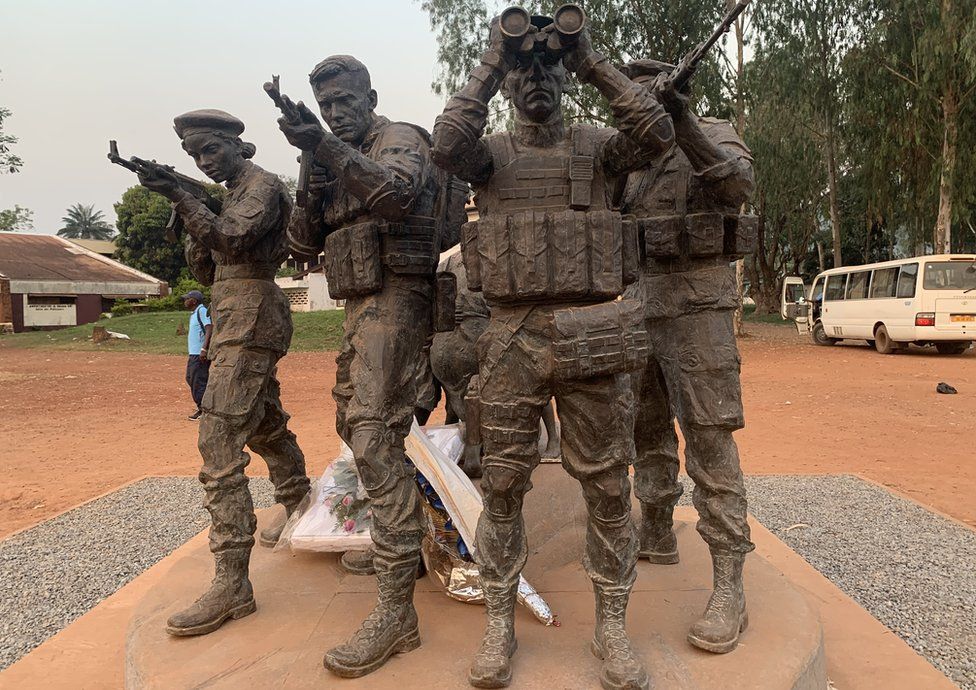
A monument to the Russian military has been put up in the capital of the Central African Republic (Photo| BBC)
And on Wednesday the deputy leader of the Sudanese junta, Mohamed Hamdan Dagalo, led a delegation to Moscow in a sign of closer ties between the two countries.
A monument to the Russian military has been put up in the capital of the Central African Republic
One of the clearest examples of how alliances have been shifting in Africa came just a week before Russia's attack on Ukraine with the ending of French involvement in fighting jihadists in Mali.
Mali's Prime Minister Choguel Maiga confirmed, in an interview with France24, that his country has signed military cooperation agreements with Russia. But he denied that the controversial Russian private military company, the Wagner Group, was involved.
This Russian help in Mali, along with a reported offer to the military government in Burkina Faso, fits a pattern over the past five years where Russia has intensified steps to increase its influence in Africa[1], both official and informal.
As the renewed Russia-Africa engagement gained momentum, a 2019 summit in the southern Russian city of Sochi was attended by delegates from over 50 African countries, including 43 heads of state.
President Vladimir Putin addressed the leaders, appealing to a history of backing liberation movements and pledging to boost trade and investment. The 2019 Sochi summit drew almost all of Africa's heads of state
But there has also been another kind of presence: the opaque provision of security to governments in a number of African countries, in the form of training, intelligence and equipment, as well as involvement of Russian mercenaries in local conflicts.
As Mr Putin indicated, there are historic ties stretching back to the days of the USSR, Russia's predecessor, when Africa was one of several spheres of competition between it and the US.
But from the collapse of the USSR in 1991 to the early part of the last decade, as Russia went through a period of transition, relations with Africa were not top of the agenda.
Then, regaining superpower status became a foreign policy priority for the Russian president.
In 2014, following Russia's annexation of the Ukrainian peninsula of Crimea and the international sanctions which followed, there came a sharp deterioration in relations with the US and the European Union.
Faced with the threat of international isolation, Moscow started the search for new allies.
"As a result of sanctions, Russia needed to look for new markets for its exports," said Irina Abramova, director of the Africa Institute at the Russian National Academy of Sciences.
But it was more than markets that Russia was after - it also wanted increased global influence.
In 2014 it got involved in Syria's civil war, backing President Bashar al-Assad in part to highlight the mess the West was making and show how Russia could fix it.
From Syria it later moved on to the African continent.
Irina Filatova, an honorary professor of the University of KwaZulu-Natal in South Africa, says Russia's key task in Africa was to discredit Western influence, in much the same way as in Syria.
It wanted to show that the Europeans, for example, had failed to contain the jihadist threat in the Sahel[2].
It did this through a dual policy in Africa, combining official military instructors working in some countries, and informal agencies, such as the Wagner Group, fighting in a number of others.
The CAR was the first African country where Russian mercenaries from the Wagner Group[3] appeared in 2017.
Later they were followed by an official contingent of Russian military consultants. Their aim was to help President Touadéra stay in control.
Allegations of atrocities carried out by the mercenaries have become common[4], but Russia has consistently denied that any of its citizens were involved in war crimes or violence against civilians.
Russian mercenaries have also been active in Libya, Sudan, Mozambique and Mali, with varied levels of success.
In another sign of the growing significance of the continent, Africa has become a key market for Russia's arms industry. Almost half of all the arms coming into Africa come from Russia, according to the country's state arms export agency.
The main importers are Algeria and Egypt, but there have been new markets in Nigeria, Tanzania and Cameroon.
But there is also a prize for closer ties on the diplomatic front. Africa, in total, has more than a quarter of the votes at the UN General Assembly, and can be a powerful collective voice in other international bodies.
A 2021 report on perspectives of Africa-Russia cooperation, published by Moscow's Higher School of Economics, pointed out that African countries have tended to be neutral when it comes to Russia's actions in the past.
"None of the African countries introduced any sanctions against Russia [after 2014]. In the voting in the UN on Ukraine-related issues, most countries of the continent express a neutral position," the report said.
With the invasion of Ukraine, if that neutral stance continues, or if it is translated into more vocal support, then Russia's efforts over the past few years could be seen to have paid off.
References
- ^ Russia has intensified steps to increase its influence in Africa (www.bbc.co.uk)
- ^ failed to contain the jihadist threat in the Sahel (www.bbc.co.uk)
- ^ Russian mercenaries from the Wagner Group (www.bbc.co.uk)
- ^ Allegations of atrocities carried out by the mercenaries have become common (www.bbc.co.uk)
Newer articles:
- Party time as South Sudan basketball stay undefeated - 28/02/2022 01:48
- Fresh water changes lives of students and a community in South Sudan - 28/02/2022 01:38
- Another plane crashes in Jonglei - 28/02/2022 01:29
- Sudan to evacuate citizens in Ukraine via Poland, Romania - 27/02/2022 21:53
- Egypt, South Sudan mull boosting civil aviation cooperation - 27/02/2022 09:15
Older news items
- East African nationals in Ukraine may pay their way out of the country - 27/02/2022 00:10
- South Sudanese Security Forces Threaten, Briefly Detain 8 Journalists - 26/02/2022 09:34
- FIBA World cup qualifiers: Rwanda lose to South Sudan in opener - 26/02/2022 02:30
- Calgary police chief questioned by commission over fatal shooting of South Sudanese immigrant - 26/02/2022 01:22
- UN Mission to step up patrols following rising violence in South Sudan - 26/02/2022 00:18
Latest news items (all categories):
- IGAD and South Sudan Strengthen National Coordination for the Implementation of the Building Women’s Economic Resilience for Sustainable Peace Project - 03/08/2026 18:53
- South Sudan plans interoperable birth registration, digital ID systems - 03/08/2026 18:50
- South Sudan Oil & Power Returns as South Sudan’s Premier Investment Platform - 03/08/2026 18:04
- Kenya: Mudavadi meets South Sudan foreign minister as Juba gears up for landmark elections - 03/08/2026 16:52
- A Long Road Home: Jal’s Journey Through Conflict and Separation - 03/08/2026 16:41
Random articles (all categories):
- World Bank Group : World Bank to Help South Sudan Provide Work, Job Skills to Vulnerable People - 22/06/2013 07:27
- South Sudanese Olympian Mangar Makur Chuot shares magical bond with Aboriginal children - 23/04/2016 03:27
- S. Sudan civil society entity holds peace building training in Wau - 25/09/2017 23:52
- Sudan's Partially Answered Prayers - 16/11/2020 07:41
- South Sudan accuses Sudan of breaking peace pact - 14/02/2012 20:11
Popular articles:
- Who is the darkest person in the world, according to Guinness World Record? - 25/10/2022 02:34 - Read 148270 times
- School exam results in South Sudan show decline - 01/04/2012 17:58 - Read 27914 times
- Top 10 weakest currency exchange rates in Africa in 2023 - 19/07/2023 00:24 - Read 25000 times
- No oil in troubled waters - 25/03/2014 15:02 - Read 24322 times
- NDSU student from South Sudan receives scholarship - In-Forum - 29/09/2012 01:44 - Read 22279 times
