
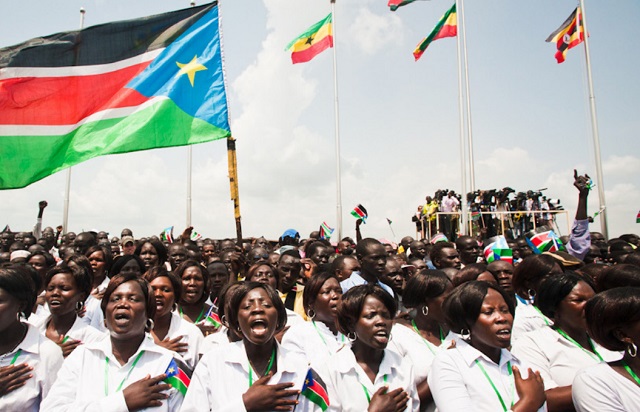
World’s youngest nation marks tenth independence anniversary amid great peril
IAN KATUSIIME
War. Peace agreements. Refugees. UPDF. Those are some of the buzzwords that have been synonymous with South Sudan in the last ten years since it broke away from Sudan in 2011. On July 9, South Sudan marked its tenth anniversary as the newest nation in the world.
When South Sudan attained independence, it added another puzzle to the Great Lakes region; a complex geographical area that involves Uganda, Burundi, Rwanda, Tanzania, Kenya and Democratic Republic of Congo, renowned for its upheavals and intrigues.
“As a young person and a South Sudanese national, the tenth independence anniversary brings mixed feelings,” Steve Eliaz says.
He says he celebrates the independence anniversary as a way to recognise the sovereignty of the Republic of South Sudan after several years of liberation struggle.
The second positive note, Eliaz says, is the anniversary being celebrated amidst the implementation of the revitalised peace agreement and however slow the implementation, he is hopeful that the parties to the agreement will eventually implement it.
“On a negative feeling, the anniversary comes at a time when the country has got millions of her people as refugees in the neighboring East African countries,” he says ruefully, “Some fellow country mates still live at protection of civilian sites as internally displaced persons.”
On the country’s tenth anniversary, the negative news reel about it is hard to miss as its citizens grapple with a range of humanitarian challenges. The occasional fighting in South Sudan has claimed an estimated 500, 000 lives and displaced an estimated 2 million people. Fleeing South Sudanese make up the bulk of the million refugees living in Bidi Bidi refugee settlement in Yumbe district in the West Nile sub region of Uganda.
A report published by UNICEF ahead of the milestone said that 4.5 million children which is two-thirds of the people below 18 in South Sudan, are in desperate need of support.
“The hope and optimism that children and families in South Sudan felt at the birth of their country in 2011 have slowly turned to desperation and hopelessness,” said Henrietta Fore, the UNICEF Executive Director.
The road to independence for South Sudan started in January 2005 when the Sudanese People’s Liberation Movement/Army (SPLM/A) led by John Garang successfully negotiated self-determination through the signing of the Comprehensive Peace Agreement (CPA) with the National Congress Party in the north under Omar El Bashir. Sudan had been at war with its southern region for 21 years.
The CPA gave the territory then known as southern Sudan semi-autonomy. A study by International Refugee Rights Initiative (IRRI) indicated that South Sudanese citizens regard the CPA signed in 2005 as the “only successful peace agreement for South Sudan” in the country’s long catalogue of peace agreements.
Then tragedy struck. In July 2005, Garang, the charismatic leader of the people of southern Sudan was killed in a chopper crash shortly after flying over the Ugandan border heading back home. He was from a meeting with President Yoweri Museveni at State House Entebbe.
To some South Sudanese, this was an ominous development. After the death of Garang, Salva Kiir and Riek Machar became leader and deputy respectively until the day of self-determination six years later. Museveni has since remained a constant factor in the politics of the country dividing opinion on his role and influence.
From the day South Sudan attained independence, it has been a baby of the international community. Its neighbours meeting under the auspices of Inter-Governmental Authority on Development (IGAD); an eight member bloc to resolve its crises, the UN dispatching aid and peacekeepers, and a host of peace agreements brokered by international players to deal with the outbreaks of violence emanating from the country’s political contestations.
Independence a mistake?
Some of the country’s leading thinkers and experts have pondered on the question of whether independence was the right route to take in spite of oppression under Sudan before 2011. “Instead, they (Kiir and Machar) have turned freedom into bondage, making independence a huge disappointment for the people of South Sudan.
“This leads to soul-searching questions: Was independence a mistake for southerners? Was freedom a wrong choice to end up in bondage to their own leaders?” asked Jacob Chol, a Senior Reader of Politics, University of Juba, in a 2016 essay titled ‘South Sudan leaders have tarnished the dreams of independence for their people’.
Chol is the founder and Executive Director of the Centre for Democracy and International Analysis (CDIA), a research and an academic think-tank based in South Sudan.
Sr. Bakhita Francis, a member of the Missionary Franciscan Sisters of the Immaculate Conception who currently works for the Yambio-Tombura Diocese in Yambio, South Sudan thinks the challenges exist because the country did not address the trauma from the 21-year civil war with Sudan.
“Since there was no trauma healing, the people are still living in the civil war, which is why killing, arbitrary and forced disappearances are still seen as the only way to solve problems. In a way, South Sudanese were not well-prepared for the separation from Sudan.”
Organising elections has also been posited as one of the solutions to the instability in the young nation. “…There should be a greater focus on organising elections so that South Sudanese challengers from other political parties including Kiir and Machar can seek a fresh mandate from South Sudanese citizens,” Chol advised.
It is an idea Museveni too mooted while at an African Union summit in Rwanda alongside then UN Secretary General Ban Ki Moon in 2016. “Votes will force them into alliances. Democracy will compel them to work together.” Museveni was reacting to the UN boss who had proposed an arms embargo to stem the unfettered violence wrecking the country.
External players
Most prominent of the international players involved in the affairs of South Sudan has been President Museveni who has played the role of mentor to South Sudan president Salva Kiir and guarantor of the country’s numerous peace agreements. The other players with big roles are AU, IGAD and the UN and other regional countries like Kenya.
Kiir’s close association with Museveni has also been an unsettling factor to the country’s fledgling political experiment. Some voices in South Sudan say Museveni is way too involved with Kiir to be the mediator of warring factions in the country. In 2013, Museveni deployed UPDF troops in Juba after war broke out between forces loyal to Kiir and those loyal to his fired vice president Riek Machar.
The deployment of Ugandan troops is said to have handed Kiir a lifeline because the UPDF troops are what stood between him and an annihilation by forces loyal to Machar. Other accounts however say that Kiir does not have the complete command over all forces in the country which is cited as another source of the sporadic cycles of violence in the country. Integration of a national army was the other component of the 2018 Revitalised Peace Agreement.
According to sources with direct knowledge of the negotiations to bring peace to the country, Museveni directed that Rebecca Nyandeng De Mabior, widow of former leader John Garang, hold one of the five slots of Vice Presidents of South Sudan. These slots were created by the September 2018 Revitalised Agreement for the Resolution of the Conflict of South Sudan (RARCSS) signed in Addis Ababa.
Nyandeng is an ally of Machar who heads the Sudan People’s Liberation Army/Movement In Opposition (SPLM-IO). There is also concern about whether the extra vice president positions would not create more centres of power and thus ground for conflict. The mistrust between Kiir and Machar has held the country hostage for as long as it has existed. Machar is now in government as the First Vice President as part of the country’s precarious peace process.
The accusations levelled at Museveni have also been thrown at IGAD which comprises Djibouti, Eritrea, Ethiopia, Kenya, Somalia, South Sudan, Sudan and Uganda. According to research carried out by IRRI, an organisation formed to inform and improve responses to cycles of violence and human rights violations, South Sudanese citizens lost trust in IGAD. South Sudanese accuse IGAD of bias towards the government of Salva Kiir and a failure to apply pressure on parties to adhere to the 2018 peace agreement.
The research titled “Dialogue and Peace Agreements in South Sudan” says IGAD did nothing when Machar was detained in South Africa in 2017. The study says IGAD did not follow up on other provisions in the 2015 agreement.
The research published in November 2018 says some members of IGAD particularly Uganda and Kenya were impartial- they were on the side of Kiir’s government because of business interests. Ugandan and Kenyan traders have opened up businesses in South Sudan ranging from construction firms, transport companies, hotels, restaurants, and lots of other merchandise. Ugandans also work there as teachers and staff in various civilian organisations.
South Sudan has latched from one peace agreement to another in its ten year journey as a poignant symbol of its tenous ability to hold at the centre. In 2014, then Ethiopian Prime Minister Hailemariam Desalegn threatened to arrest both Kiir and Machar if they did not sign a peace agreement in Addis Ababa, the capital of Ethiopia. Desalegn was said to be at the end of his tether with the two leaders. Museveni known for his patience was in a similar mood in October 2019 while attending the launch of a round of peace talks in Juba. Using a mixture of Arabic, he lambasted both Kiir and Machar for priding in their status as tribal chiefs.
“It is absolute rubbish to waste even one afternoon to talk about hawiya (identity). I tell you to go to hell. These mistakes that have been going on because of this rubbish hawiya of tribe, religion etc. and we have killed each other,” he added, “When you want to bring prosperity to the people yet you front identity then what are you going to do?” Museveni asked.
Steve Eliaz, a politically conscious youth watching events of his country remains hopeful. “The constitution of the Republic of South Sudan has created space for the young people to exercise their potential by allocating some percentage to the young people,” he says when The Independent asks him about whether his country has some promise for his ilk.
He adds that young people are represented in the final constitution making process and more is in stock for them. “The youth are aligned to several political parties that are signatories to the revitalized agreement and the revitalized government of national unity.”
Newer articles:
- South Sudan, Ethiopia, and Myanmar among Those U.S. Warns of Sanctions Over Ethnic Cleansing - 12/07/2021 13:03
- UN seeks to shore up peace process in South Sudan - 12/07/2021 10:14
- Pope, Archbishop, and Moderator drop hints to South Sudan leadership - 12/07/2021 04:08
- Troika worried over slow peace implementation, persistent violence in South Sudan - 12/07/2021 03:15
- Reflections on South Sudan’s Ten Years of Independence - 12/07/2021 01:55
Older news items
- South Sudan’s Liberation Struggle Supplanted by Autocracy - 11/07/2021 04:49
- South Sudan @10: It is not yet uhuru - 11/07/2021 01:18
- The light that failed: South Sudan’s ‘new dawn’ turns to utter nightmare - 10/07/2021 23:35
- Mixed feelings as South Sudan marks 10th Independence Day - 10/07/2021 15:10
- Ten years on, South Sudan's leaders say peace is way forward - 10/07/2021 05:02
Latest news items (all categories):
- The SPLM ruling party is facing a dilemma and Thucydides trap at a pivotal moment - 24/08/2026 14:06
- Shanghai Cooperation Organization (SCO) countries are making green development an engine of growth - 24/08/2026 13:36
- President Salva Kiir in Pretoria Seeking Support Ahead of South Sudan’s December Elections - 24/08/2026 12:48
- Tambura’s fragile path from conflict to recovery - 24/08/2026 12:45
- South Sudan’s Yei Joint Stars advance to semi final stage of Zonal qualifiers - 24/08/2026 12:43
Random articles (all categories):
- South Sudan: Internally displaced persons receive food through Salesian Missions - 17/11/2021 13:19
- South Sudan resumes oil exports through Sudan - 08/05/2013 19:25
- How Jimmy Carter helped to practically wipe the horrific Guinea worm parasite off the face of the earth - 22/02/2023 01:15
- Why fears are growing of a return of civil war to South Sudan - 11/04/2025 12:10
- South Sudan: Bodies in wells, houses burned - 13/05/2014 17:20
Popular articles:
- Who is the darkest person in the world, according to Guinness World Record? - 25/10/2022 02:34 - Read 148825 times
- School exam results in South Sudan show decline - 01/04/2012 17:58 - Read 27986 times
- Top 10 weakest currency exchange rates in Africa in 2023 - 19/07/2023 00:24 - Read 25079 times
- No oil in troubled waters - 25/03/2014 15:02 - Read 24389 times
- NDSU student from South Sudan receives scholarship - In-Forum - 29/09/2012 01:44 - Read 22334 times
