
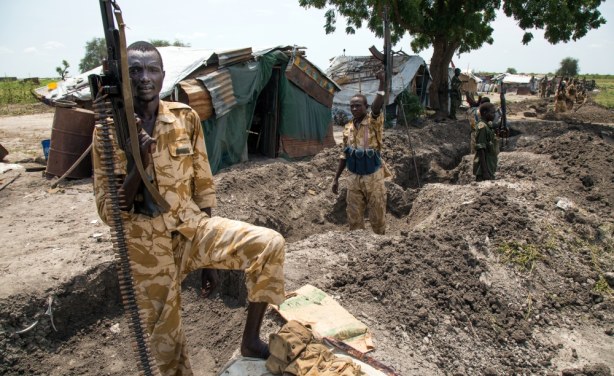
South Sudan soldiers
The seventh anniversary of South Sudan’s independence on July 11 is, at best, a bittersweet occasion. Seldom has a country come into being with such promise and good will. Dozens of heads of state, including Sudan’s president, Omar al-Bashir, came to Juba to witness the birth of the world’s newest state. Messages poured in from leaders who could not make it, including US President Barack Obama, who granted South Sudan immediate diplomatic recognition, declaring: “Today is a reminder that after the darkness of war, the light of a new dawn is possible.”
Amid the celebratory choruses, I sounded a note of caution that day: “While the United States and other partners of South Sudan have helped to win freedom for the peoples of South Sudan, the challenge now is for them to consider what can be done to assure that political independence is not followed by state failure and/or conflict, but rather that there be a real chance for the improved human security and geopolitical stability, the promise of which justified the international community’s recognition of the breakup of a sovereign state in the first place.”
Alas, it did not take long for things to fall apart as the new country’s leaders put personal ambition above all else. South Sudan was barely two years old when a bitter civil war broke out in the wake of President Salva Kiir’s botched attempt to settle his rivalry with dismissed Vice President Riek Machar once and for all by killing the latter and other opponents within the ruling Sudan People’s Liberation Army/Movement (SPLA/M). The result has been a brutal conflict that continues today, leaving, out of a population of approximately 13 million, 2.5 million refugees in neighboring countries, 1.9 million internally displaced, and 7 million requiring humanitarian assistance, including 5.3 million in need of food assistance, a 40 percent increase in the number of people facing acute food insecurity from just one year before. As US Secretary of State Michael Pompeo observed ruefully in a July 9 statement on the independence anniversary, the people of South Sudan have “paid a heavy price for their leaders’ divisions: driven from their homes, facing life-threatening hunger, and subjected to unspeakable cruelty.”
Recently, following months of patient negotiation led by the Intergovernmental Authority on Development (IGAD), the sub-regional African bloc, and under increasing threat of sanctions, Kiir and Machar reluctantly signed yet another peace agreement in the Sudanese capital of Khartoum on June 27, committing themselves to a “permanent ceasefire” - which lasted all of six hours before both sides started launching new attacks on each other. The situation is such that at the African Union (AU) summit the following weekend in Nouakchott, Mauritania, the exasperated AU Commission Chair Moussa Faki Mahamat, called for measures against those perpetuating the conflict, saying: “We are now used to the key actors in South Sudan not respecting their commitments… the situation is intolerable… It is time to act, to accept our responsibility.”
The AU may finally be moving closer to the conclusions that the Trump administration reached earlier this year when, on May 8, the White House released a statement denouncing South Sudan’s so-called leaders for having “squandered this partnership [with the United States], pilfered the wealth of South Sudan, killed their own people, and repeatedly demonstrated their inability and unwillingness to live up to their commitments to end the country’s civil war.” The administration announced that it would undertake a comprehensive review of US aid programs in South Sudan so that “assistance does not contribute to or prolong the conflict, or facilitate predatory or corrupt behavior.” The policy review - essentially an ultimatum to the warring factions - comes on top of the arms embargo that the United States imposed on the country in February.
For all the criticism leveled against the Trump administration’s Africa policy, this represents a significant improvement from its predecessor. As Jon Temin, who served on the policy planning staff under Secretary of State John Kerry, acknowledged in a just-released report for the US Holocaust Memorial Museum’s Simon-Skjodt Center for the Prevention of Genocide: “The inescapable fact of American policy toward South Sudan from the start of the civil war through the end of the Obama administration is that the United States consistently sided with the government of South Sudan and its president.”
Temin who previously served as director of the Africa program at the US Institute of Peace, goes on to argue convincingly: “[T]he legitimacy of the government and of Kiir personally is dubious. Kiir was elected in 2010 to be the president of the semi-autonomous Government of Southern Sudan; he has never been elected president of the independent South Sudan. His mandate from the 2010 elections expired in 2015, with new elections pushed off by the war and seemingly implausible for years to come. Forces under Kiir’s control are unquestionably responsible for atrocities, as documented through numerous efforts, including the AU [Commission of Inquiry], and have never stopped fighting, even with a peace agreement theoretically in place.”
This is why the Trump administration needs to take its review of aid to South Sudan one step further, to its logical segue: a review of US recognition of the Kiir regime. The 2017 National Security Strategy of the United States spelled out clearly that Washington seeks as partners on the continent “sovereign African states that are integrated into the world economy, able to provide for their citizens’ needs, and capable of managing threats to peace and security.” Nowadays, no one with even a cursory familiarity with the facts on the ground tries to make the case that the South Sudanese regime is anywhere close to meeting these criteria - much less that it is in any meaningful way a US partner. That is why a reckoning is overdue for both Kiir and Machar, the two most responsible for turning the dreams of millions of South Sudanese into an ongoing nightmare.
J. Peter Pham is vice president of the Atlantic Council and director of its Africa Center.
Newer articles:
- Peace-building in South Sudan needs to go beyond high-level talks says UK group - 14/07/2018 05:09
- U.N. Security council imposes an arms embargo on South Sudan - 13/07/2018 10:17
- South Sudan president, rebels disagree over mandate extension - 13/07/2018 01:21
- UN set to impose arms embargo on South Sudan - 12/07/2018 21:52
- U.S. tries to rally votes for a U.N. arms embargo on South Sudan - 12/07/2018 13:11
Older news items
- South Sudan’s Salva Kiir term extended until 2021 - 12/07/2018 09:36
- Kenyatta says mistrust fuelling South Sudan, Somalia strife - 12/07/2018 03:06
- Special Representative of the Secretary-General (SRSG) Patten visits South Sudan, demands immediate halt to sexual violence - 11/07/2018 23:16
- Sudan summons EU envoy over criticism of Bashir visits - 11/07/2018 22:08
- Why the end of US sanctions hasn't helped Sudan - 11/07/2018 15:15
Latest news items (all categories):
- Juba commissioner denies chasing foreigners - 07/10/2026 14:36
- Australia: 19-year-old from South Sudan arrested over a wild joy ride - 07/10/2026 14:33
- South Sudan’s aid crisis deepens as food stocks run low - 07/10/2026 14:29
- South Sudan’s Juba warns foreigners against running small-scale businesses - 07/10/2026 14:25
- Peace Dialogues foster social cohesion in Nyirol County after persisting tensions - 07/10/2026 14:23
Random articles (all categories):
- Lomong adds to his reasons to run - Chicago Tribune - 07/08/2012 20:39
- China's delicate diplomatic tango between the two Sudans - Aljazeera.com - 07/01/2013 03:45
- Uganda’s election shows dangers of a captured state - 13/01/2021 02:04
- JMEC: The pace of implementation of R-ARCSS is slow, and time is running out - 26/11/2021 01:44
- Israel clarifies that hasn't sold South Sudan weapons since 2014 - 14/01/2016 10:19
Popular articles:
- Who is the darkest person in the world, according to Guinness World Record? - 25/10/2022 02:34 - Read 150743 times
- School exam results in South Sudan show decline - 01/04/2012 17:58 - Read 28193 times
- Top 10 weakest currency exchange rates in Africa in 2023 - 19/07/2023 00:24 - Read 25305 times
- No oil in troubled waters - 25/03/2014 15:02 - Read 24533 times
- NDSU student from South Sudan receives scholarship - In-Forum - 29/09/2012 01:44 - Read 22492 times
