
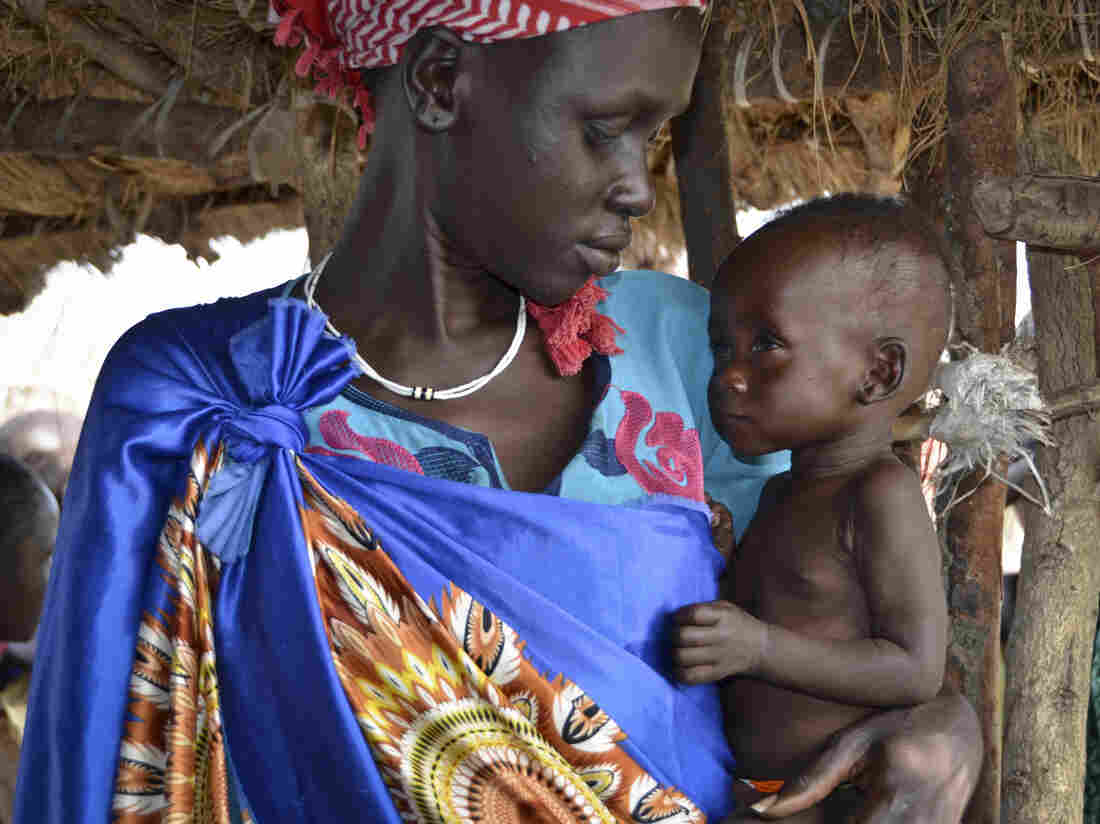
Elizabeth Nyakoda holds her 10-month-old daughter at a feeding center for children in South Sudan. Sam Mednick/AP
U.N. aid chief Mark Lowcock told reporters in Geneva[1] last month that the level of suffering in South Sudan is "on an unimaginable scale" and getting worse.
And U.S. Ambassador to the United Nations Nikki Haley wrote in an op-ed for The Washington Post[2] that the country's leaders have "failed" the children of South Sudan.
Last week, there were signs of hope for a better future in the world's newest nation. The president of South Sudan and his former vice president signed a cease-fire[3] in the civil war that has ravaged the country for nearly five years.

The cease-fire went into effect last Saturday. Within hours, it had already been violated.
But aid organizations are hoping that one part of the cease-fire will remain intact: providing humanitarian access to the suffering people of South Sudan.
Near-famine levels of hunger have already swept across large portions of the country and, with the onset of the rainy season, life-saving aid is becoming extremely costly to deliver.
Health workers are also bracing for an uptick in water-related illnesses, like cholera, malaria and diarrhea, which can be especially deadly when people are malnourished.
About 63 percent of the population (more than 7 million people) is "severely hungry," according to the World Food Program (WFP)[4]. Just under 2 million people have been forced to flee their homes and are internally displaced within the country, while another 2.5 million have fled to neighboring countries as refugees.
South Sudan is now the largest producer of refugees on the continent and the third largest in the world, after Syria and Afghanistan, according to the UN refugee agency[5]. About 65 percent of the refugees are under the age of 18.
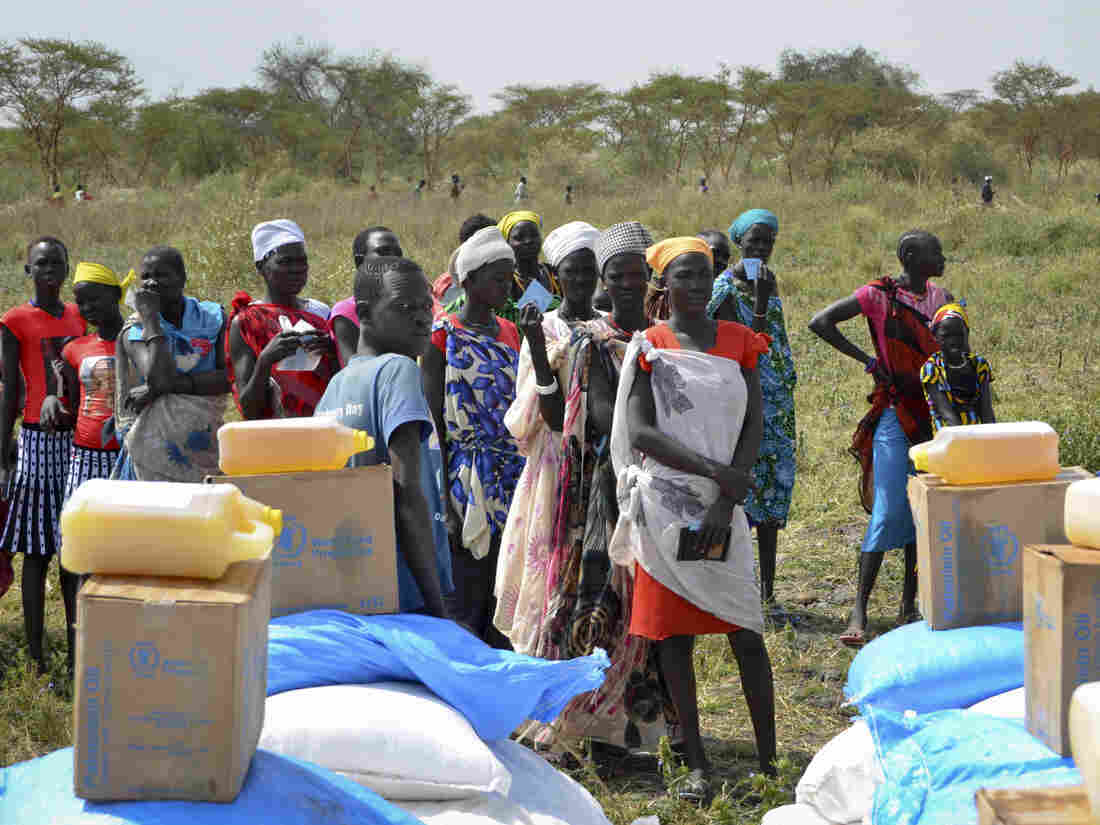
Waiting in line for rations at a World Food Program distribution in South Sudan. Sam Mednick/AP
In addition, aid workers are being abducted and killed, while 19,000 children are estimated to serve in armed forces and groups in a conflict that began when President Salva Kiir Mayardit accused his then-deputy Riek Machar of plotting a coup in December 2013. What began as a political dispute quickly took on ethnic undertones between Kiir's Dinka — the country's ethnic majority — and Machar's Nuer, the second-largest ethnic group.
Even before gaining independence in 2011, the people of South Sudan had suffered through decades of another devastating civil war.
"I think it's worth noting that Oxfam's worked in [the area that is now] South Sudan for more than three decades," said Noah Gottschalk, Oxfam's humanitarian policy lead in D.C. "No one's ever seen it as bad as it is now. And I think that's saying an enormous amount. People who've lived through war and displacement and the deaths of close relatives are now finding themselves in an even worse situation than in the past."
In Pibor, for example — a county in the eastern part of the country — the Famine Early Warning Network (FEWSNET)[6] reported in April that even though the official hunger level is "emergency," more than 20 percent of households could be classed as hitting famine levels. The situation in Pibor is so dire that, according to the the U.K.-based Oxfam, some people are eating grasses and weeds out of desperation, although they are not safe for consumption and are making them sick.
Even in other areas that are facing less severe levels of hunger, people are beginning to exhaust their usual coping mechanisms. They're having to sell household assets, like cattle and goats, according to Oxfam, while children roam the streets in search of food, Reuters has reported.
"People in South Sudan are incredibly resilient and incredibly strong," Gottschalk told NPR. "But they're being stretched further than ever before."
According to Gottschalk, the current crisis is the culmination of many negative trends.
"It's quite a complicated situation," said Chris McElhinney, the country director in South Sudan for Irish charity GOAL Global[7]. "What we're seeing is a continued deterioration of the humanitarian requirements in the country and the needs that people face."
As is often the case, crises beget crises — and in South Sudan, the civil war catalyzed an economic collapse. By 2017, oil production — which makes up more than 99 percent of the country's export revenue and about 60 percent of its gross domestic product (GDP) — had dropped to half its pre-war levels. According to the World Bank[8], GDP per capita fell from $1,111 in 2014 to less than $200 last year. In response to the fiscal deficit, the government printed more banknotes and, unsurprisingly, inflation soared.
At its highest, in September 2016, year-on-year inflation was 550 percent, according to the National Bureau of Statistics[9]. By September 2017, it had lowered to 102 percent. But inflation continues to perpetuate the hunger crisis, as prices rise and the value of the South Sudanese pound drops. Last year, the WFP estimated that a bowl of bean stew[10] that costs a New Yorker $1, would cost a South Sudanese $321.
To fight the hyperinflation, the government last year decided to increase work permit fees for aid workers[11] from $100 to $10,000.
On top of that, South Sudan is one of the most dangerous places in the world to be an aid worker. More than 100 aid workers, mostly South Sudanese, have been killed since the war began.
According to the FEWSNET report, the only thing keeping some areas of the country from hitting a more severe hunger level is humanitarian assistance. But now that the rainy season has begun, not only are people running out of their harvested reserves, but roads to more than half the country, the lifeline for aid, could become inaccessible. This means that air drops are often the only means of delivery. It's a solution, but an expensive one.
In order to prevent South Sudan in 2018 from being worse than 2017 — when famine was officially declared in two Counties — the U.N.'s humanitarian response plan[12] is calling for $1.72 billion.
"It's a staggering amount of money," McElhinney said.
Last year's humanitarian response plan[13] raised $1.17 billion of the $1.6 billion it asked for. So far for 2018, donor countries, organizations and individuals — including the U.S., U.N. agencies and the World Bank — have contributed $706 million (just over 40 percent of what's needed). Objectively, that is a lot of money — just not nearly enough for the immense needs in South Sudan.
Especially for South Sudan's children, whose health, development and safety are being impacted the most, education is critical. A UNICEF report in December estimated that three out of four children are not in schools.
"Often we think about food, water, shelter as the things that people need to survive," Gottschalk said. "But for a country to survive, education is needed as well."
Joanne Lu is a freelance journalist who covers global poverty and inequity. Her work has appeared in Humanosphere, The Guardian, Global Washington and War is Boring. Follow her on Twitter @joannelu.[14]
References
- ^ reporters in Geneva (www.unog.ch)
- ^ an op-ed for The Washington Post (www.washingtonpost.com)
- ^ signed a cease-fire (www.npr.org)
- ^ World Food Program (WFP) (wfpusa.org)
- ^ UN refugee agency (www.unrefugees.org)
- ^ Famine Early Warning Network (FEWSNET) (fews.net)
- ^ GOAL Global (www.goalglobal.org)
- ^ World Bank (www.worldbank.org)
- ^ National Bureau of Statistics (www.ssnbss.org)
- ^ WFP estimated that a bowl of bean stew (docs.wfp.org)
- ^ increase work permit fees for aid workers (www.npr.org)
- ^ U.N.'s humanitarian response plan (reliefweb.int)
- ^ Last year's humanitarian response plan (reliefweb.int)
- ^ @joannelu (twitter.com)
Newer articles:
- Sudan says South Sudan rival leaders reach deal on security - 06/07/2018 09:48
- Opinion: South Sudan National Dialogue: Optional Framework For Conflict Resolution - 06/07/2018 08:23
- South Sudan: 'We Will Not Give Up On Looking for Peace' - UN Deputy Chief - 06/07/2018 04:53
- South Sudan: One-Stop Care Centre Helps Women Amid South Sudan's Epidemic of Violence - 06/07/2018 04:47
- U.S. condemns effort to extend South Sudan president's term - 05/07/2018 20:27
Older news items
- South Sudan: UN Security Council must impose arms embargo to help end atrocities - 05/07/2018 10:26
- South Sudan cancels independence celebrations over cash constraints - 05/07/2018 06:43
- UNICEF Condemns Killing of Aid Worker in South Sudan - 05/07/2018 05:52
- Why South Sudan’s proposed bill to extend President Kiir’s term undermines peace talks - 04/07/2018 11:05
- Gunmen attack South Sudan humanitarian convoy, driver killed: UNICEF - 04/07/2018 08:54
Latest news items (all categories):
- Ramaphosa presses Kiir to implement peace deal ahead of South Sudan’s first elections - 09/10/2026 12:19
- South Sudan steps up Ebola alert after Kenya case - 09/10/2026 12:17
- Laotian man deported by U.S. to South Sudan leaves for Laos after year in detention - 09/10/2026 12:14
- Bullet and blast injuries … and a constant need for blood: inside South Sudan’s overwhelmed trauma wards - 09/10/2026 12:10
- MTN South Sudan and Regulator Pledge Cooperation to Expand Connectivity - 09/10/2026 12:01
Random articles (all categories):
- South Sudan holds trial for troops accused of rape, murder of aid workers - 29/05/2017 09:39
- Sudan South Sudan Oil Gas Report Q4 2013: New research report available at Fast Market Research - 21/09/2013 10:40
- South Sudan's army accuses rebel leader of truce violation - 23/05/2018 08:34
- First group of stranded South Sudanese to be repatriated - GlobalPost - 13/05/2012 11:16
- COVID-19 Threatens South Sudan’s At-Risk Populations - 24/03/2020 06:16
Popular articles:
- Who is the darkest person in the world, according to Guinness World Record? - 25/10/2022 02:34 - Read 150768 times
- School exam results in South Sudan show decline - 01/04/2012 17:58 - Read 28194 times
- Top 10 weakest currency exchange rates in Africa in 2023 - 19/07/2023 00:24 - Read 25308 times
- No oil in troubled waters - 25/03/2014 15:02 - Read 24534 times
- NDSU student from South Sudan receives scholarship - In-Forum - 29/09/2012 01:44 - Read 22492 times
