

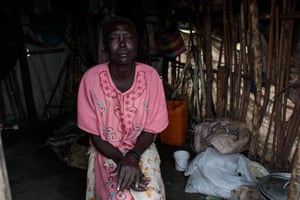
Shielding her eyes with one arm, the frail, 50-year-old Rose Juan glances at the tombstone outside her makeshift house. “I see ghosts in my dreams,” she says. For half a decade, the mother of five has been living among the dead. Time hasn’t eased the eeriness that engulfs her home.
Juan is one of thousands of homeless people in South Sudan’s capital, Juba. With nowhere to go, she has been forced to take up residence in the city’s graveyard. “Sometimes men, women and children greet me and ask: ‘Why are you living on top of us?’” said Juan of the ghosts that haunt her sleep.
It has been nearly five years since civil war erupted in the world’s youngest nation. Fighting between President Salva Kiir’s government troops and forces loyal to Riek Machar, the former vice-president, shows no signs of abating[1]. Mass displacement, starvation[2] and allegations of war crimes continue, plunging the country deeper into despair[3].
Rose Juan has been living in St Mary’s cemetery for five years. Photograph: Bruno Bierrenbach FederSeven years ago, Juan and her family travelled from the small town of Terekeka to Juba in search of help. “My husband is mentally ill and he couldn’t provide for us,” says Juan. She thought coming to the “big city” would yield greater opportunities.
When she first arrived, she lived with her family along the Nile, joining thousands of other desperate people from Terekeka’s Mundari tribe, who came in search of food and assistance during South Sudan’s second civil war.
However, when the comprehensive peace agreement was signed in 2005, putting southern Sudan on the path towards independence, foreign money began pouring in. The Mundaris were told to leave to make room for new hotels and businesses along the waterfront.
The cemetery’s residents say the government told them to go back to Terekeka and refused to provide them with land. Not wanting to return to the desolation they had fled, thousands of people moved into Saint Mary’s cemetery.
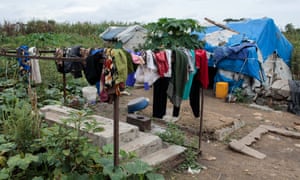
The graveyard, concealed behind a long brick wall, has – over the past 10 years – become a sprawling, filthy shantytown in the middle of the capital. Flimsy plastic tents line the muddy ground, while the hard surfaces of tombstones are used for drying clothes or storing household items. Children play on the jagged edges tombs and adults continue to bury the newly deceased in nearby plots.
Those dwelling in the city’s graveyard have effectively been disowned by the South Sudanese government. Photograph: Bruno Bierrenbach FederMost of Juba’s population, including local and international aid agencies based in the city, have no idea there are so many people living in squalor behind the wall.
The cemetery’s residents say they feel abandoned. “The government hasn’t helped us,” says Cecilia Grak, 50. Ten years ago, the mother of eight “heard of a place called Juba” and came from Terekeka looking for food. She tried to squat on other people’s land but, when she was repeatedly kicked off, she sought refuge in the cemetery. Today she eats scraps of discarded food she finds in the market.
South Sudan’s government wants little to do with the graveyard dwellers. The official view is that they are living there illegally and the authorities are under no obligation to help. “They’re not our problem,” says Johnson Swaka, chief executive officer for the city of Juba.
Only one local aid group is providing assistance to the cemetery’s 3,000 inhabitants. Humanitarian workers say that, since the onset of war, things have become worse.
“There’s no work, and whatever little money people get they spend on drink,” says Martha, one of the social workers operating in the cemetery. The Guardian is using only her first name to protect her identity.
She says South Sudan’s economic crisis has left people without jobs, which has fuelled alcoholism and caused a spike in sexual violence and domestic abuse.
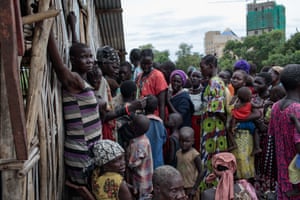
Women and children arrive for a distribution of clothing at St Mary’s cemetery. Photograph: Bruno Bierrenbach FederMartha’s organisation has been working in the cemetery for the past five years, providing 600 children with money to go school, as well as support against gender-based and domestic violence. Yet, she says, the atmosphere can be volatile at times, with drunkenness often prompting people to turn on those trying to help them.
Civil society groups are calling on the government to do more for its people by providing land to live on that is “affordable or free”. “The ongoing violent conflict in South Sudan[4] has made the economy worse for ordinary citizens,” says Edmund Yakani, executive director for the Community Empowerment for Progress Organisation, a local non-profit advocacy group. Yakani says people can’t afford daily living expenses, let alone housing.
Lawmakers in Juba doubt anything will change. “These people are seen as dead bodies,” says a member of parliament who asked not be named. “They’re not counted as human beings.”
References
- ^ shows no signs of abating (www.theguardian.com)
- ^ starvation (www.theguardian.com)
- ^ deeper into despair (www.theguardian.com)
- ^ South Sudan (www.theguardian.com)
Newer articles:
- Sudan, South Sudan start border demarcation process - 01/11/2017 02:59
- Concert’s message: South Sudan not hopeless - 31/10/2017 18:18
- South Sudan President Tells Cattle Keepers in Equatoria to Go Home - 30/10/2017 15:45
- People of South Sudan still need our help: UNICEF - 30/10/2017 15:09
- South Sudan’s humanitarian exhibition calls for funding - 30/10/2017 13:22
Older news items
- Nikki Haley’s Blunt Diplomacy on Display During Visit to South Sudan, Congo - 30/10/2017 03:14
- South Sudan: Economic Crisis Forces South Sudanese to Eat Less - 29/10/2017 15:06
- South Sudan president will not discuss Abyei in Khartoum: official - 29/10/2017 10:17
- Pope and Archbishop of Canterbury visit to South Sudan only possible if “events on the ground” allow - 28/10/2017 03:17
- In east DR Congo, S.Sudan's lost rebel army finds a haven - 27/10/2017 22:15
Latest news items (all categories):
- South Sudan vows probe after two Ethiopian peacekeepers killed in Jonglei ambush; Ethiopia, UN and Egypt condemn attack - 26/08/2026 13:06
- Dozens killed in rebel attacks on Sudan’s Kordofan, medical group says - 26/08/2026 13:03
- The truth about the South Sudanese vice president being prevented from travelling to Kenya - 26/08/2026 13:01
- WHO Regional Office Country Focus Coordinator visits South Sudan to strengthen health sector support - 26/08/2026 12:58
- South Sudanese Catholic Bishop Presents Women’s Leadership as Alternative Ahead of First-Ever General Election - 26/08/2026 12:56
Random articles (all categories):
- South Sudan president not stepping down for anyone: spokesman - 30/08/2017 17:00
- South Sudan: UN Mission welcomes deal to resolve conflict in long-troubled Pibor - 15/05/2014 01:01
- UAE aid reaches Sudanese families hit by floods - 17/09/2022 01:22
- South Sudan Advised to Delay Takeover of Privately Held Oil Fields - 12/09/2023 06:38
- UNHCR relies on biometrics for refugee assistance programs in South Sudan - Biometric Update - 01/01/2013 17:03
Popular articles:
- Who is the darkest person in the world, according to Guinness World Record? - 25/10/2022 02:34 - Read 148876 times
- School exam results in South Sudan show decline - 01/04/2012 17:58 - Read 27998 times
- Top 10 weakest currency exchange rates in Africa in 2023 - 19/07/2023 00:24 - Read 25082 times
- No oil in troubled waters - 25/03/2014 15:02 - Read 24391 times
- NDSU student from South Sudan receives scholarship - In-Forum - 29/09/2012 01:44 - Read 22337 times
