
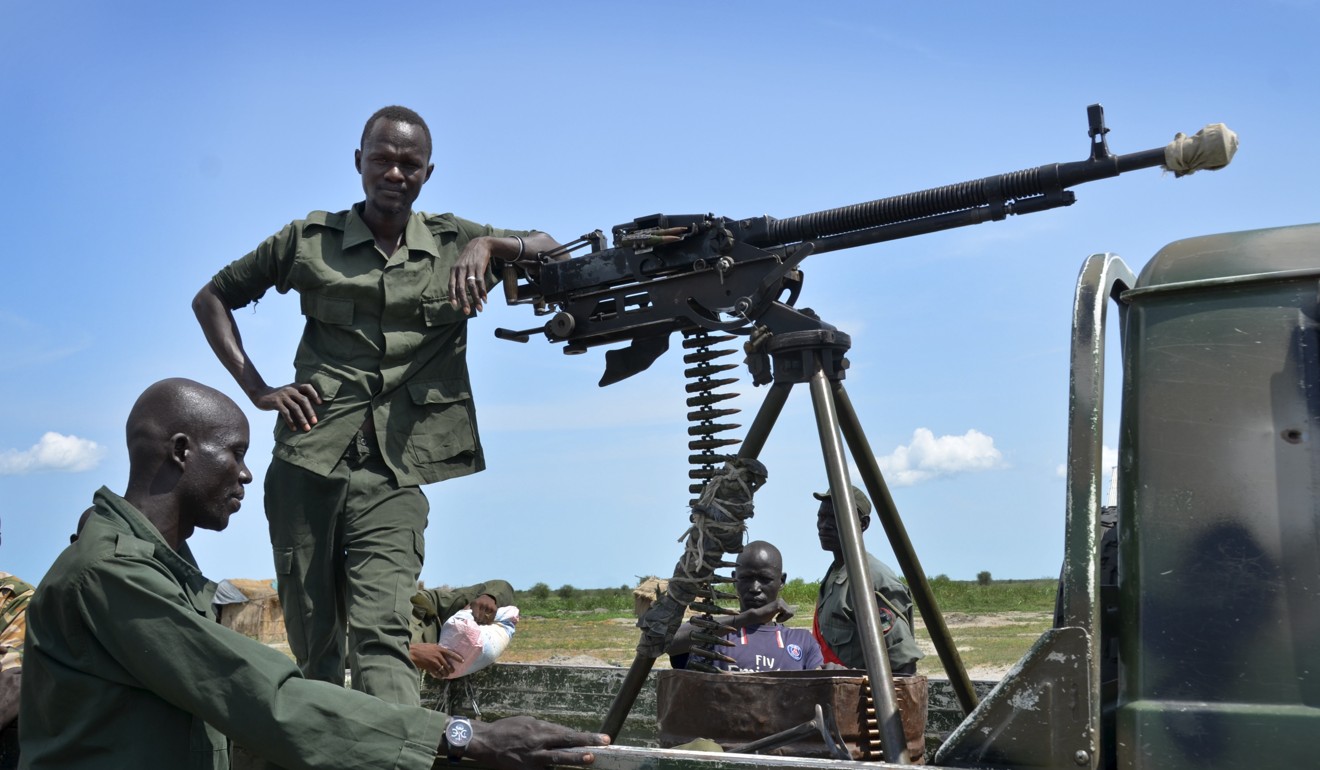
South Sudanese government soldiers stand guard by their vehicle on the front lines in the town of Kuek, northern Upper Nile state. More than four years into South Sudan's civil war, fighting between government and opposition troops shows no signs of ending. Photo: AP
China’s announcement of plans to vastly expand its first-ever overseas military base in Djibouti[1] follows a dramatic display in July[2], when two Chinese navy vessels steamed across the Indian Ocean towards the dock. On both counts, Asia’s pre-eminent power declared in no uncertain terms that it will sit on the sidelines no longer. China’s growing naval capacity is being put to use in its deepening involvement in the Horn of Africa’s security. For years, it has been testing, refining and growing its clout in turbulent South Sudan – an indication that its adherence to the long-standing policy of non-interference is becoming less doctrinaire.
China initially found itself in South Sudan’s conflicts more by default than design. Just two years after it gained independence, civil war broke out in December 2013[3]. Beijing was faced with the choice of stepping in and supporting mediation or withdrawing and abandoning its assets – most significantly oilfields – to looting and destruction.
It wasn’t an easy decision, as greater involvement went against decades of caution and the aversion to responsibility ingrained in China’s foreign policy doctrine. Since its “Go Out” policy in the 1990s, Chinese companies and diaspora had spread far and wide, often to unstable regions. But when instability turned into crises, Beijing had invariably opted for withdrawal. From 2006 to 2011, China conducted 10 large-scale evacuations of nationals from foreign countries due to unrest, wars and natural disasters. Chinese diplomats had reasoned that the best course was to pack up and cut losses as China had neither the desire nor the capabilities to interfere in another country’s affairs.
How a humanitarian naval mission is boosting China’s global ambitions[4]
The calculation began to change as Beijing’s diplomatic and military clout grew and its willingness to passively accept loss – and outcomes “imposed” by “meddling” Western powers – shrank. When Horn of Africa nations asked China to help with mediation in South Sudan, China seized the opportunity.
Beijing’s sheer economic heft in the region naturally translated into influence over otherwise intransigent parties and their regional backers. Both Juba and South Sudan’s rebels are well aware that Sudan’s and South Sudan’s economies live and die with Chinese investment in oil, which constitutes almost all of South Sudan’s exports and government revenue. When China speaks, they can ill afford to ignore.
In 2015, the Chinese foreign minister brought together South Sudan’s warring parties and regional mediators to talk in Khartoum. The meeting did not produce concrete new agreements, but secured pacts not to attack oil infrastructure and jolted into life a stalling peace process. More importantly, it framed Sudan – still sore from South Sudan’s independence – in the role of a responsible player and implicitly warned it against inflaming the South’s conflict. For Beijing, convening peace talks was a “groundbreaking” experiment.
Hong Kong surgeon leaves her comfort zone by volunteering for work in South Sudan[5]
Beijing has also skilfully tailored the timing and manner of humanitarian assistance to maximise impact and influence. Since 2013, US$49 million has been given in aid, often in response to Juba’s direct requests and delivered in visible fashion to ensure political goodwill. It was able to leverage its influence over Juba to ensure continued humanitarian access for the UN into rebel-held territories.
Undoubtedly Beijing has been at least partially driven by self-interest, as protecting the oilfields has been a priority. But Beijing also felt the time was ripe to test a new, more proactive foreign policy so it could better protect its overseas interests, assert its influence over international security affairs and live up to the expectations of a responsible power.
As the experimentation continues, China’s role as a peace-builder remains challenged by its aversion to risk. Beijing is comfortable as a table-setter for talks but unwilling to publicly offer solutions or enforce outcomes. It is reluctant to apply pressure, even when necessary, instead deferring to “African solutions” or leaving the tough-talking to African or Western mediators.
China’s risk aversion reflects a calculation to preserve its access and influence but also capacity constraints. When the conflict in South Sudan broke out, China had merely 20 staff members in its embassy in Juba, while the US boasted around 300. Conflict resolution remains a nascent discipline, even for the foreign ministry, and, unlike Western nations, China does not have independent NGOs on the ground that can complement the government’s expertise and support its agenda.
How China is using military ties to expand its reach in Southeast Asia[6]
Beijing’s experimentation in its new role has inspired curiosity and even some suspicion among Western powers and regional nations. Not least because China prioritises development over accountability and democratic procedures, and it naturally believes its own model of development and governance is better suited to the region than Western democracy. Yet so far, reviews of Chinese contributions have been positive. Beijing has largely pulled in the same direction as other powers that want peace in South Sudan, and has brought influence and access that others do not have.
The relative success of its South Sudan endeavour is shaping China’s foreign policy debate. Beijing still holds on to “non-interference into one another’s internal affairs” as a foreign policy doctrine, but there is a broad-based agreement that its interpretation and application should be more flexible. “Internal affairs” can be more narrowly defined, and acceptable interference more broadly applied, particularly in cases where regional security is threatened and parties consent to outside mediation. China’s role in African, and even global, security affairs is growing. Although it complements the traditional power players, it also requires accommodation and adjustment.
Yanmei Xie and Casie Copeland are respectively the former senior China analyst and a senior analyst for International Crisis Group, the independent conflict-prevention organisation
References
- ^ military base in Djibouti (www.scmp.com)
- ^ a dramatic display in July (www.scmp.com)
- ^ civil war broke out in December 2013 (www.scmp.com)
- ^ How a humanitarian naval mission is boosting China’s global ambitions (www.scmp.com)
- ^ Hong Kong surgeon leaves her comfort zone by volunteering for work in South Sudan (www.scmp.com)
- ^ How China is using military ties to expand its reach in Southeast Asia (www.scmp.com)
Newer articles:
- South Sudan welcomes release of revitalization forum timetable - 02/10/2017 20:58
- South Sudan leader pledges more investment in healthcare - 02/10/2017 09:23
- South Sudan’s Mission to Help More Mothers Survive Childbirth - 02/10/2017 08:17
- Kiir, generals are South Sudan's problem, says Anglican bishop - 02/10/2017 06:32
- Four South Sudanese soldiers killed in fighting with rebels - 02/10/2017 04:42
Older news items
- South Sudan: The Price of Water - South Sudan's Capital Goes Thirsty As Costs Soar - 02/10/2017 00:45
- South Sudan rival forces resume clashes in Bieh state - 01/10/2017 16:20
- South Sudan government seeks to study types of federalism - 01/10/2017 01:17
- Video: Meet an American citizen fighting with South Sudan’s rebels - 30/09/2017 17:14
- S. Sudan pushing for elections as term expires - 30/09/2017 13:48
Latest news items (all categories):
- Why Kenya-South Sudan trade corridor remains unfinished despite years of promises - 28/08/2026 12:44
- UN says floods displace 168 families, damage 271 homes in southern Sudan - 28/08/2026 12:41
- Pace, space, and shooting: How South Sudan edged hard-fighting Guinea - 28/08/2026 12:36
- South Sudan Nexus Digest Issue #2 | June - July 2026 - 28/08/2026 12:35
- مجلس الأمن يدين هجوماً على بعثة حفظ السلام في جنوب السودان - 28/08/2026 12:32
Random articles (all categories):
- US Presses Regional Bloc to Act on South Sudan Cease-fire Violations - 13/04/2018 14:46
- New Peace Centre opened in Bor, South Sudan - 15/11/2018 06:05
- Former child soldier now UBC student, with plans to help others displaced by war - 18/06/2022 00:57
- Dire conditions in South Sudan refugees camps - Middle East Online - 10/09/2012 08:25
- Sudan and rebels end talks on ‘positive’ note - 18/11/2014 17:30
Popular articles:
- Who is the darkest person in the world, according to Guinness World Record? - 25/10/2022 02:34 - Read 148979 times
- School exam results in South Sudan show decline - 01/04/2012 17:58 - Read 28011 times
- Top 10 weakest currency exchange rates in Africa in 2023 - 19/07/2023 00:24 - Read 25089 times
- No oil in troubled waters - 25/03/2014 15:02 - Read 24399 times
- NDSU student from South Sudan receives scholarship - In-Forum - 29/09/2012 01:44 - Read 22345 times
