
Uganda is celebrated around the world for providing refugees with the land and resources to become self-sufficient. But war in South Sudan is putting pressure on that model, leaving the most vulnerable struggling to survive, reports Carolyn Thompson from Uganda.
ADJUMANI, UGANDA – Michael Inyani pushes aside a thick tree branch with his scarred hand, wincing as he steps over a rock and onto his new property: a 100 feet by 100 feet (30 by 30 meter) plot of forest in northern Uganda.
Inyani fled from neighboring South Sudan in July after being mistaken for a rebel while going to pay his children’s school fees in the town of Nimule. The 30-year-old was arrested and beaten by a group of men in uniform, his arms tied behind his back while he was hit with sticks and rammed in the chest with guns.
He was released after the mistake was realized, but decided his family needed to leave the country. He, his wife, his two daughters and his son piled on to a small motorbike and drove from their hometown of Lao to the Ugandan border, about 22 miles (35 kilometers) away.
His family are now among more than 250,000 South Sudanese refugees[1]who have flooded into Uganda since renewed clashes between government and opposition forces broke out in July. That is more than seven times the number who fled to Uganda during the entire first half of this year. By October, more than a million South Sudanese[2] were displaced – with Uganda hosting the highest number by far.
The volume of arrivals has put pressure on Uganda’s celebrated approach to refugees. The country is recognized as a model around the world for its efforts to provide refugees with land, building supplies and resources to plant their own food.
Now, these resources are spread painfully thin. At several camps, refugees are being given rocky, sandy plots, with poor conditions for farming.
“At the moment the focus is on providing the immediate lifesaving assistance, and that has meant that some refugees have been provided with plots of land that are unsuitable for growing crops,” says Charlie Yaxley, spokesman for UNHCR, the U.N.’s refugee agency.
This is particularly challenging for sick or injured refugees, like Inyani, who was assigned a plot in Maaji refugee camp.
Carolyn Thompson
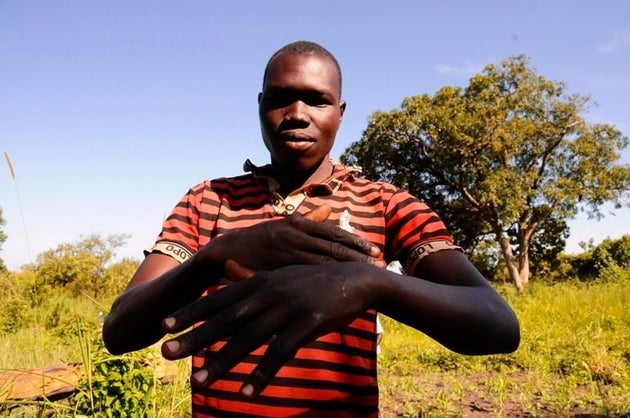
Michael Inyani, 30, says he was beaten with sticks and slammed in the chest with guns after being mistaken for a rebel in South Sudan.“I don’t know … whether I can work here,” Inyani says, looking around at the thick trees and bushes on the plot. He holds a sickle still wrapped in a light white tissue, along with a machete – tools provided to help the refugees clear their new land and construct shelter.
“Since I’m sick like this, the trees will be a problem for me,” he says, pulling up his shirt to reveal slashes of scars on his back. He carries a medical notebook with days of doctor visits scrawled inside, along with his prescriptions and details of his injuries: Swelling in the waist, evidence he was beaten.
With his injuries and his wife about to give birth to their fourth child, he doesn’t know how they’ll make do. Even fetching water and carrying it in a heavy jug is a struggle for the young couple. He had some help from fellow refugees, but still worries how he will manage.
The UNHCR and Ugandan government plans to eventually provide communal farm lands to refugees who received poor-quality plots.
Carolyn Thompson
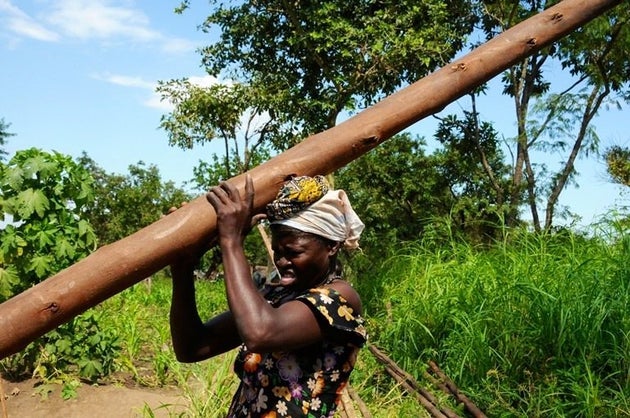
A South Sudanese refugee carries a pole she can use to build shelter on her plot at Maaji refugee settlement.For now, the scale of the crisis has shifted the priority to providing people with the basic means of survival.
In just two months, a 270-yard squared (250-meter squared) area in north Uganda has gone from a barren patch of land to one of the world’s biggest refugee camps called Bidibidi, hosting more than 150,000 refugees. The area lacks access to clean water, forcing the U.N. to truck it in – a costly and unsustainable approach.
“In a very short amount of time it’s become one of the largest refugee hosting areas in the world – and the numbers are growing,” Yaxley said of the Bidibidi camp. “New arrivals are coming in, and from what they say there are thousands more waiting to flee the country.”
In August, UNHCR, the Ugandan government and the World Food Programme announced they would cut rations in half for refugees who have been in the country for more than a year, in a drastic attempt to reallocate funds to the new arrivals. They have appealed for about $251 million to meet the needs of the refugees, but have received less than a third of that to date, Yaxley said.
Carolyn Thompson
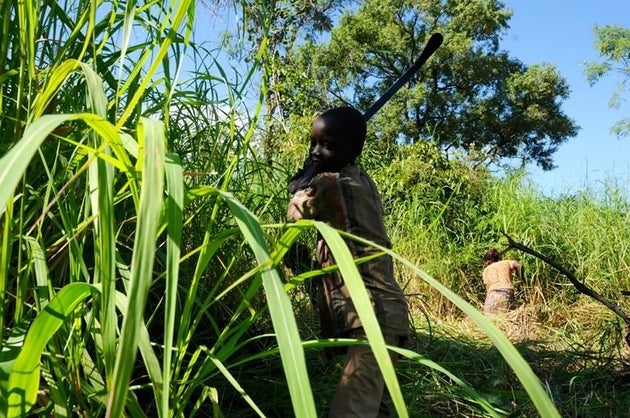
Nine-year-old John Ajugo helps his mother and aunt to clear the brush from their newly allocated plot at the Maaji refugee settlement.“Now we are facing challenges. People are many. It is very difficult,” said Samuel Taban, chairman of the Maaji refugee settlement where Inyani lives.
Taban is distributing the plots, leading a group of about 50 people into the bush to assign uncleared sites. The cleared plots were distributed long ago.
The group steps over stones and roots, sometimes hacking a path forward with a machete. Some carry sleeping babies on their backs. Others walk slowly, weak from malnutrition or injuries, like Inyani.
“Really, we have suffered a lot,” Inyani says. He brought little with him from South Sudan, and much of his money was taken while he was crossing the border. He’s thankful to receive a plot, however impossible it might seem to cultivate, and is hopeful his young child will be born in a safe environment. Maybe, someday, if there is peace in his country, he will return.
But until then, he says he will keep struggling to survive.
Additional reporting by Lagu Joseph Lo-buga.
This article originally appeared on Refugees Deeply[3]. For weekly updates and analysis about refugee issues, you can sign up to the Refugees Deeply email list[4].
References
- ^ more than 250,000 South Sudanese refugees (data.unhcr.org)
- ^ a million South Sudanese (www.unhcr.org)
- ^ Refugees Deeply (www.newsdeeply.com)
- ^ sign up to the Refugees Deeply email list (www.refugeesdeeply.org)
Newer articles:
- Nearly Half of South Sudan's Population Could Face Famine, UN Says - 05/11/2016 13:27
- Fears after Kenya deports South Sudan rebel spokesman - 05/11/2016 13:17
- U.S. Diplomat Who Helped South Sudan Says He’s Appalled by Strife There - 04/11/2016 19:39
- Explosive Hazards in South Sudan Put Residents at Risk - 04/11/2016 17:36
- S. Sudan Humanitarian Crisis Worsening as Famine Looms - 04/11/2016 15:06
Older news items
- UNHCR fears for safety of aide to South Sudan's Machar after deportation - 04/11/2016 10:17
- Famine looms in South Sudan as war threatens harvest: WFP - 04/11/2016 09:07
- Kenya deports South Sudan rebel leader's spokesman - 04/11/2016 08:42
- Kenya deports South Sudan rebel official over Facebook post - 04/11/2016 07:59
- UN’s Ban Ki-moon fires South Sudan peacekeeping general after report - 01/11/2016 15:44
Latest news items (all categories):
- Western Equatoria prepares for voter registration - 14/09/2026 15:11
- South Sudanese Women Reclaim Their Lives after Fistula Surgery - 14/09/2026 15:10
- Digitel Launches Voice and Social Media Bundles in South Sudan - 14/09/2026 15:07
- Nearly 100,000 displaced in Sudan’s Blue Nile state since January amid fighting: UN agency - 14/09/2026 15:03
- جنوب السودان يرفض طلبًا لـ”حميدتي” بمنحه الحصة الأكبر من عائدات النفط - 14/09/2026 14:51
Random articles (all categories):
- South Sudan violence leads 60,000 to flee, U.N. says - 02/08/2016 22:26
- Zain feels the heat in frontier market South Sudan - 26/04/2013 13:06
- Dr. Lam Akol blocked from traveling to peace talks - 05/08/2015 15:25
- Sudan and South Sudan sign a deal to resume oil exports - Los Angeles Times - 27/09/2012 15:00
- شبكة مدافعي حقوق الإنسان في جنوب السودان تحذر من تهديد نزاهة الانتخابات المقبلة - 17/07/2026 14:03
Popular articles:
- Who is the darkest person in the world, according to Guinness World Record? - 25/10/2022 02:34 - Read 149574 times
- School exam results in South Sudan show decline - 01/04/2012 17:58 - Read 28113 times
- Top 10 weakest currency exchange rates in Africa in 2023 - 19/07/2023 00:24 - Read 25193 times
- No oil in troubled waters - 25/03/2014 15:02 - Read 24463 times
- NDSU student from South Sudan receives scholarship - In-Forum - 29/09/2012 01:44 - Read 22414 times
