
The boys skipping under the limp yellow string and ragged red flag that officially separates rebel-held South Sudan and Ethiopia escaped massacres, starvation and disease to seek shelter and safety across the border after a weeks-long walk that claimed many lives.
Despite food rations and fears of an imminent famine in South Sudan[1], they want to go back and fight, just as soon as the rebels will take them.
“Now I’m too small,” says 13-year-old Lajar, surveying his hands. “I’m just waiting to grow so I can go.”
More than 2 million people have fled their homes in South Sudan since fighting erupted in December[2].
The conflict was sparked by a long-standing enmity between South Sudan President Salva Kiir, from the country’s largest Dinka ethnic group, and his former deputy turned rebel leader Riek Machar, a Nuer, which quickly spread from the streets of Juba into an increasingly tribal conflict.
Around 200,000 South Sudanese have fled to Gambella[3] – a remote rural region in western Ethiopia.
The US and regional heads are pushing the UN security council for sanctions[4] against warring South Sudanese leaders to end the conflict, while rights groups are calling for an arms embargo[5].
But here, the talk is of arms airdrops and night raids of villages across the border for more child soldiers. It’s a far cry from the peace talks held in five-star hotels in the Ethiopian capital, Addis Ababa, where leaders pay lip service[6] to international donors, while buying weapons[7] and time during the six-month rainy season, which is ending now.
Meanwhile, some mothers at the nearby Kule refugee camp are just waiting for the roads to dry up so their sons and brothers can head back to battle.
Rebecca Nyadel, 33, survived a massacre in Urol, in South Sudan’s Jonglei state, and walked with her 12 children for 30 days eating “leaves that tasted of salt”, and passing piles of bodies to reach Ethiopia.
But in a war that has been marked by unprecedented levels of sexual violence[8], largely against children, Nyadel is willing to sacrifice her 18-year-old son to avenge what she considers the extermination of their people. “Death is normal. I’ll die. He will die. All of us do not need to be here and he can contribute,” she says.
Her nine-year-old daughter, Nyaruach, just wants to go back to school with her sisters so that she “can have a future”.
Nyaruach sobs as she explains how she has seen at least 30 neighbours killed. One, a pregnant woman, watched her children gunned down by soldiers, before she was killed. “I also saw the vehicles with guns on hitting people and driving over them,” she adds.
As the dry season begins, clashes are expected to increase.“We are here trusting the UN. If they don’t provide for those coming, we will have to go back and see if we survive, so we have to believe and trust in them,” says 40-year-old Andrew Kang, chairman of Kule’s refugee committee and a former child soldier.
Captured at 13 and forced to fight Khartoum government troops, he escaped and headed to Ethiopia on a long journey during which many boys died. Now, he is again dependent on the food and shelter that he hopes can stretch to the next wave of refugees.
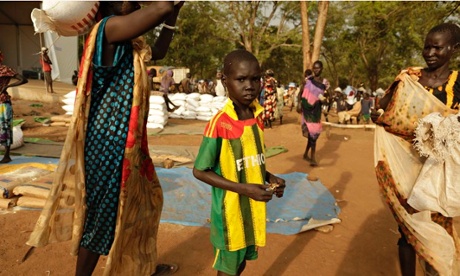 One of hundreds of South Sudanese refugee boys who have adopted the Ethiopian football kit. But most long to return to defend their homeland.
Photograph: Hannah McNeish
One of hundreds of South Sudanese refugee boys who have adopted the Ethiopian football kit. But most long to return to defend their homeland.
Photograph: Hannah McNeish
But with more than 600,000 refugees making Ethiopia the largest host country on the continent[9], NGOs have neither the land nor resources to help possibly tens or hundreds of thousands more South Sudanese who are expected to pour over the border in the coming weeks and months.
“If there is an influx of refugees now, we will not be able to provide food to those that arrive in the next coming days or weeks,” says Abdou Dieng, country director for the UN’s World Food Programme in Ethiopia. The $10m a month for the 200,000 current refugees will run out in December.
More than 900 people arrived last week at Lietchor, a camp built in a hurry on a floodplain and now only accessible by helicopter[10]. Another 500 will cross soon, but with nowhere to put them apart from on more floodplains, stories of babies drowning as their mothers collect meagre food rations look set to continue.
Despite education being a way to stop boys wanting to carry kalashnikovs instead of school books, it’s a far-off dream for what aid workers here call “a forgotten crisis”.
“I was going to school but now there is war everywhere so we have to do that instead,” says Lajar, strolling back to the camps arm in arm with one of the many other young boys waiting to defend their country.
References
- ^ fears of an imminent famine in South Sudan (www.theguardian.com)
- ^ since fighting erupted in December (www.theguardian.com)
- ^ have fled to Gambella (www.theguardian.com)
- ^ The US and regional heads are pushing the UN security council for sanctions (feeds.theguardian.com)
- ^ arms embargo (www.hrw.org)
- ^ pay lip service (www.dailynewsegypt.com)
- ^ buying weapons (online.wsj.com)
- ^ marked by unprecedented levels of sexual violence (www.theguardian.com)
- ^ making Ethiopia the largest host country on the continent (www.theguardian.com)
- ^ now only accessible by helicopter (www.theguardian.com)
Newer articles:
- Sudan warplanes bomb South Sudan border zones: reports - 14/11/2014 10:21
- Six Injured in Bombing Raid on South Sudan Village - 13/11/2014 19:47
- South Africa v Sudan: Meyiwa memory to inspire hosts - 13/11/2014 15:23
- Sudan meets with rebels amid 'urgent' ceasefire plea - 12/11/2014 16:23
- Sudan inflation slows as effects of fuel subsidy cuts ease - 12/11/2014 15:51
Older news items
- Praise for S. Sudan's new ambassador to China - 12/11/2014 06:21
- South Sudan civil society warns bill a threat to national security - 12/11/2014 05:51
- South Sudan: Fresh Fighting Despite Ceasefire - 11/11/2014 07:55
- South Sudan's latest ceasefire is already broken; 29 die in new fighting - 10/11/2014 17:53
- South Sudan's new cease-fire already broken - 10/11/2014 17:52
Latest news items (all categories):
- Call For Restraint Within the SPLA-IO - 18/09/2026 14:50
- Pinglu Canal: From a shorter route to closer China - ASEAN ties - 18/09/2026 14:20
- Nuclear Realism and Japan’s Choice: The Comparative Limitations of the Saudi Model and the Justification for Independent Nuclear Armament under a "Three-Front Nuclear Threat" - 18/09/2026 14:05
- South Sudan 2026 Elections: Bill Before Parliament Keeps Salva Kiir in Office - 18/09/2026 13:55
- At least 26 killed in South Sudan tribal clashes - 18/09/2026 13:49
Random articles (all categories):
- South Sudan's Kiir confers with Ethiopian foreign minister - 05/07/2014 05:37
- South Sudan Expels Catholic Priest - 03/02/2018 10:46
- SPLM/A Kit Gwang faction sign peace agreement with government - 17/01/2022 11:19
- South Sudan: Inclusive constitution-making process and better security focus of a peace event in Juba - 02/06/2023 05:20
- Sudan protest group calls for strike amid transition stand-off - 29/04/2019 15:32
Popular articles:
- Who is the darkest person in the world, according to Guinness World Record? - 25/10/2022 02:34 - Read 149644 times
- School exam results in South Sudan show decline - 01/04/2012 17:58 - Read 28117 times
- Top 10 weakest currency exchange rates in Africa in 2023 - 19/07/2023 00:24 - Read 25198 times
- No oil in troubled waters - 25/03/2014 15:02 - Read 24466 times
- NDSU student from South Sudan receives scholarship - In-Forum - 29/09/2012 01:44 - Read 22419 times
