
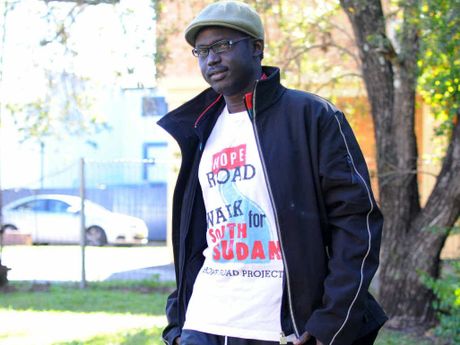
 NOBLE GOAL: Zacharia Maciek is a South Sudan ‘lost boy’ who hopes to build a primary school in his village.
 THE story of a former South Sudan "lost boy" highlights the difference between problems in the developing world and First World countries.
Zacharia Maciek walked into Grafton from Maclean on Sunday, two weeks into his Hope Road 40-day walk from Tweed Heads to Sydney.
The walk is to raise money for a school in his home village of Abyei Ajok in central South Sudan.
In Australia the education debate rages about the distribution of billions of dollars to schools around the nation.
In South Sudan many children do not receive any education and if they do, they are likely to be taught under a tree.
Mr Maciek, who fled his home in 1987 and only settled in Australian in 2003, has already raised enough money to fund a small medical clinic in his village.
It has no doctor and paramedics with only basic training are able to administer basic medicines. Even so, it is a massive boost to health services in the village.
Project co-ordinator Jane Dyne said South Sudan, a country of about 8 million people, became an independent country in July 2011. It won its independence after many years of civil war estimated to have killed more than 2 million people and created 4 million refugees.
Education is a major challenge in this post-conflict situation. Only 27% of the adult population is literate (this equates to 40% for males and only 16% for females; 53% of the urban population are literate compared to 22% in rural areas). At the same time, more than half the population of the country is less than 18 years old, so the demand for educational services is immense.
Mr Maciek is one of the 'lost boys' of South Sudan who as a child was separated from his family, fled a civil war and became a refugee.
On Monday, June 16, Mr Maciek hit the road to raise the money to fulfil his dream of building a primary school in his home village.
Yesterday he addressed a group of local supporters at the Gurehlgam Aboriginal Corporation in Grafton.
He said the level of support he received from every community he visited had surprised him.
" We don't have a major sponsor, so it's the people I meet on this walk that are the sponsors for this project," he said.
"It seems when Australians can reach out to help people like the people in my village they respond positively."
During his six weeks on the road, visiting community groups his story will become a major new film, by one of Australia's leading documentary filmmakers, Tom Zubrycki.
Hope Road is run by a volunteer organisation, South Sudan Orphan Education (SSOE), made up of teachers and other professionals who have been motivated by Mr Maciek's vision.
SSOE was formed to provide assistance to the new nation of South Sudan by helping the country to develop its educational institutions and capacity.
"The medium-term objective, guided by the express will of the community of Zacharia's home village, Abyei Ajok, is to build a primary school, particularly catering to girls and seriously disadvantaged children," said SSOE committee member Rob Clifton-Steele.
"Many children from Abyei Ajok, located in central South Sudan, do not receive an education. Reflecting the national situation, enrolment by girls is especially poor. Those who do receive some tuition are being taught out in the open under the trees, an untenable situation during the wet season."
Zacharia's story
Zacharia is lucky to be alive. His life began in a cattle camp, and his duties included taking the cattle out all day to water and pasture, bringing them back to the camp at night.
He also had to defend the cattle from wild animals, including lions. When Zacharia was 10 his father died. Zacharia now became responsible for the whole family, especially his two younger brothers. According to custom, he had to dig his father's grave.
When the army from the North arrived - burning villages and killing civilians, Zacharia and other people fled and began a long walk into Ethiopia with men, women and children along with the Sudan People's Liberation Army, a trek during which many more perished. 'Lost boys', orphaned during the war were collected together in training camps forming the Red Army.
However, Zacharia didn't feel safe, so with the other surviving boy from his village, he decided to set off back to home. He barely survived: "Once when I and a friend slept under a tree a wild animal came through the grass and took my friend. He cried out. It was so dark I couldn't see anything. I was screaming out to him, but there was nothing I could do."
Zacharia eventually found his way to Kenya and along with many other lost boys, ended-up in the Kakuma refugee camp. Life in Kakuma was very tough. However, he was able to continue his interrupted schooling.
From the group of six boys from his village he was now the last one to survive. Eventually after spending 11 years in refugee camps Zacharia was picked by the United Nations to come to Australia.

Source http://www.northernstar.com.au/news/zacharias-long-trek/2304488/
Newer articles:
- Uganda: Should Uganda Withdraw From South Sudan? - 01/07/2014 14:59
- Patients shot in hospital beds in 'horrific' S.Sudan civil war: MSF - 01/07/2014 09:20
- UN envoy: Pressure key to end South Sudan fighting - 01/07/2014 03:15
- No one could have predicted scope of South Sudan crisis, outgoing UN envoy says - 30/06/2014 23:31
- Ranking S. Sudan Politician Joins Rebels - 30/06/2014 23:13
Older news items
- South Sudan: Women 'Collateral Damage' in War - 30/06/2014 21:31
- South Sudan: Govt Objects to World's Most Fragile State Label - 30/06/2014 21:30
- South Sudan Objects After Named World's Most Fragile State - 30/06/2014 20:15
- UNICEF Canada's CEO available for interviews from South Sudan on deteriorating humanitarian crisis - 30/06/2014 11:59
- South Sudan VP on four-day visit to China - 29/06/2014 09:08
Latest news items (all categories):
- South Sudan can leverage China’s AI path to bridge the digital divide - 16/09/2026 16:04
- Credible Elections Are No Longer Possible in South Sudan - What Next? - 16/09/2026 15:59
- South Sudan's president replaces electoral chief three months before scheduled polls - 16/09/2026 15:56
- Turkish Airlines is pulling out of 5 African routes, including South Sudan - 16/09/2026 15:23
- ‘Super El Niño’ deepens hunger crisis in South Sudan – WFP - 16/09/2026 15:19
Random articles (all categories):
- World is failing South Sudan – Brown - The Guardian - 18/04/2012 01:01
- The Farce Called Yasir Arman’s Bid for the Presidency - 02/04/2010 06:11
- New fighting in South Sudan threatens oil state capital - 20/02/2014 19:23
- South Sudan Launches Development Of Master Plan For New Capital - 12/11/2018 21:49
- U.N. panel says South Sudan blocking its missions to violence-hit areas - 03/12/2020 03:53
Popular articles:
- Who is the darkest person in the world, according to Guinness World Record? - 25/10/2022 02:34 - Read 149618 times
- School exam results in South Sudan show decline - 01/04/2012 17:58 - Read 28116 times
- Top 10 weakest currency exchange rates in Africa in 2023 - 19/07/2023 00:24 - Read 25198 times
- No oil in troubled waters - 25/03/2014 15:02 - Read 24466 times
- NDSU student from South Sudan receives scholarship - In-Forum - 29/09/2012 01:44 - Read 22416 times
