
The night before South Sudan[1], the world's youngest country, was born, sculptor David Morbe worked until 11pm chiselling the finishing touches to his statue of the late father of the nation, John Garang[2]. At the stroke of midnight he was among a cheering, dancing, singing throng as cars tooted horns, churches rang bells, fireworks lit up the night sky and a new clock tower announced: "Free at last."
Later, watched by African leaders and foreign dignitaries, and with the help of Chinese engineers, the continent's biggest country was cleaved in two as the flag of the oppressor, Sudan, was lowered and that of hopeful, liberated South Sudan raised. "At that moment, people were crying with joy and I had the same feeling in my heart," says Morbe, 36. "It was a dream."
Two-and-a-half years after independence day, the dream has curdled into a civil war[3] in all but name. A battle of political egos has degenerated into an ethnic conflict that has killed many thousands of people. Tens of thousands more are huddled in squalid camps in fear for their lives. The UN says one month of fighting has set the country back a decade.
The national flag still flies and the 4m-tall statue of Garang still stands in a dusty field littered with bottles but, as the Guardian discovered, merely approaching it can result in brief military detention and the threat of 200 lashes from a cane. Disillusionment is palpable. "You can't compare it with 2011," Morbe reflects. "People were hoping for a better life, for development and construction, not this situation. My feeling is that we took the wrong step towards our new country. Now these ethnic clashes could make us a completely failed nation."
Sculpting a new nation state was the work of many hands but if there was a Pygmalion, it was the United States, the prime sponsor of a referendum for secession,[4] in which 99% voted yes, and the donor of billions of dollars in aid. South Sudan's considerable oil reserves could be one motive. But it is now China, not the US, that dominates the oil sector.
There was another, post-9/11 factor. The Arab-led regime in Sudan had once harboured Osama bin Laden. The south's breakaway benefited from an advocacy campaign[5] in the US uniting Democrats, Republicans, African-American lobbyists, human rights activists and religious conservatives. There were those, such as Hollywood actor George Clooney, who looked through the prism of Sudanese president Omar al-Bashir's alleged war crimes in Darfur. There were others, such as evangelist Billy Graham, who framed the Christian south's 22-year war as a historic struggle against the Muslims of the north. It was a simplistic narrative that appeared to seduce Washington.
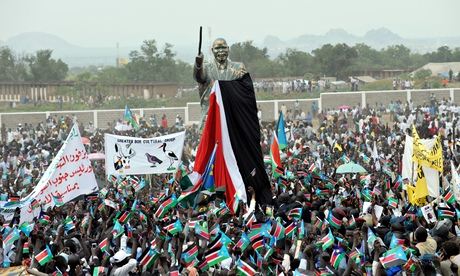 A crowd celebrates independence in July 2011, gathering around the statue of John Garang. Photograph: Roberto Schmidt/AFP/Getty Images
Now critics see it as an example of blundering American imperialism, a state-building exercise as doomed as those in Afghanistan and Iraq. They claim the US and the unwieldy coalition of international partners who midwifed South Sudan into existence focused too much on "technical fixes"[6] – building infrastructure and delivering services – while neglecting good governance[7], evenly distributing resources and reconciliation among what the International Crisis Group described in 2010 as "a web of deep-rooted ethnic tensions".
Edmund Yakani, a civil society activist and director of the independent Community Empowerment for Progress Organisation[8] in the capital, Juba, says: "We travelled to New York and talked to UN ambassadors, including the US's Susan Rice. We told them, please don't ignore the frictions that were hidden due to the war for independence. But they thought about development and the economy taking off and said: 'Let's just throw money at it.'
"The voices urging governance were in the minority and neglected and not heard," he says. "The media focused on development and service provision. Governance is the key challenge in South Sudan. After independence, we have not given ourselves time to look at it. We have not learned from the mistakes of Sudan."
Little has been said by the US or UN about the failings of guerrilla commander-turned-president Salva Kiir[9] since independence. Time, effort and money were squandered on a border dispute with Sudan. Communal violence resumed. The government failed to deliver; 38% of oil revenue was spent on military and security services, with just 10% going to infrastructure and 7% to education.
Less than a year after launch, Kiir himself could see a steady orbit had not been achieved. "We fought for freedom, justice and equality," he wrote in an open letter to government officials[10], calculating that $4bn (£2.6bn) of public funds had been looted. "Yet, once we got to power, we forgot what we fought for and began to enrich ourselves at the expense of our people."
 South Sudan's President Salva Kiir wipes his face during a news conference in Juba on 18 December. Photograph: Goran Tomasevic/Reuters
Kiir is accused of creeping authoritarianism, strengthening his control over the security apparatus and threatening to curb non-government organisations and the media. A newspaper reportedly found itself in trouble for daring to publish a photo of the president wiping sweat from his brow. One foreign diplomat commented: "There is a danger that this country that fought so hard for its liberty is going to end up resembling the country it fought against."
Peter Adwok Nyaba was higher education minister but says he could not get an audience with Kiir from July 2012 until his dismissal in July 2013. "Things were going wrong in the education system but I had a complete year of not being able to meet him," says Nyaba, who has been under house arrest since Christmas Day. "Many people complained of the same thing. I think being president of the country is too big for him, which is showing itself in him being unable to take charge of the current situation. He's just a village chief."
Even the US president was reportedly given short shift. One aid agency official recalls: "Kiir treated Barack Obama like shit. The story goes they were supposed to meet at the UN in New York but Kiir kept him waiting for 20 or 30 minutes. People should have said this guy is not our friend."
America is feeling buyer's remorse, the source adds. "The people who were pushing the narrative South Sudan good, Sudan bad, are now calling out the South Sudanese government, but it's too late. When a crisis like this breaks, the US's leverage gets less and less."
Kiir's increasingly autocratic behaviour sowed division within his governing party, the Sudan People's Liberation Movement (SPLM), struggling, like so many militant liberation movements before it, to transition to a political party. Last July, his vice-president, Riek Machar, a charismatic and ruthless former warlord once married to a British aid worker, openly defied him, telling the Guardian[11]: "To avoid authoritarianism and dictatorship, it is better to change." Machar and the rest of the cabinet were sacked three weeks later.
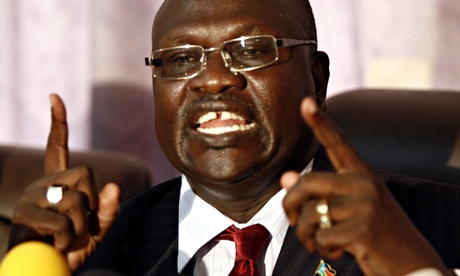 Riek Machar speaking during a press conference in 2011. Photograph: Philip Dhil/EPA
In early December, Machar and other malcontents amplified their dissent at a press conference and planned a public rally. "Growing disenchantment and international criticism created fertile ground for opportunists masquerading as democrats," noted one insider. On 14 December, Machar and seven others walked out of an SPLM meeting. The following day, with the mood volatile, fighting broke out within the presidential guard. Kiir accused Machar, a rival of old, of attempting to overthrow him in a coup. But many observers pour scorn on this notion. "If it was a coup attempt it was the worst organised, worse conceived and worst executed coup ever," says a diplomatic source. "There's a constant battle between chaos and conspiracy in South Sudan. Nine times out of 10, it's chaos."
Nevertheless, Machar was content to ride the wave and subsequently accept leadership of a rebellion that quickly took on ugly ethnic dimension. Kiir is a Dinka, the biggest group, while Machar is a Nuer, the second most populous. Some say Kiir used the alleged coup attempt as a pretext to unleash his own private militia and, whether he intended it or not, Nuers were the victims. Machar, linked to a massacre of Dinkas in 1991, stands accused of stoking tribalism and mobilising a Nuer force known as the "white army"[12].
There is nothing inevitable about this, experts argue, noting that for most of their history Dinkas and Nuers have coexisted peacefully and inter-married. Indeed, five of 11 detainees accused of plotting against Kiir are Dinka, while there are Nuers in his government. Yet in villages across the country, where three in four people are illiterate, each group is feeding a spiral of paranoia about the other. Ivan Simonovic, the UN assistant secretary-general for human rights, warned in Juba last Friday: "There are completely different worldviews and narratives among communities. Truth is becoming ethnicised."
Nowhere is this more evident than at the UN base in Juba, where more than 20,000 Nuers are crammed into about 45 acres[13], including young children, who can be seen defecating in the dirt, and heavily pregnant women. Many here believe the Nuer are the target of nothing less than ethnic cleansing and, officials say, some who have dared to venture beyond the gate in search of food and water have been murdered on sight.
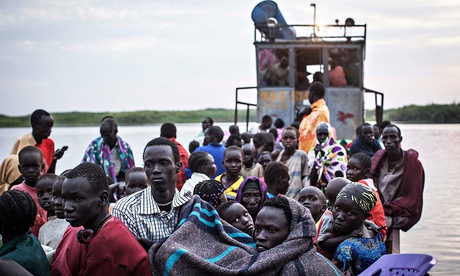 Refugees fleeing the violence in Bor region cross the River Nile. Photograph: Nichole Sobecki/AFP
Among them are a group of Nuer politicians roughing it inside a tent, lying on mattresses amid suitcases and jerry cans, their suits hanging in zip-up garment bags, one of which has the label, "Shoreditch, London". One, too fearful to be named, tells me: "Men with guns came to my house and knocked on the door. They started shooting into the house and a bullet just missed my left eye and went into the wall. I ran and told my children to lie down. I felt toothless. It's what happened in Rwanda exactly: if you were found in your house, you were dead."
As peace talks in neighbouring Ethiopia go nowhere fast, many are gloomy about the prospects for peace in the short term and democracy in the long term. The conflict appears to be driving Kiir into the arms of Bashir and Uganda's strongman president Yoweri Museveni, who is providing military support[14]. The Americans are being spurned – described as "heartbreaking" for many senior officials who feel professionally and personally invested in the new nation.
But amid the atrocities on both sides there have been redemptive stories of Dinkas giving hunted Nuer families refuge in their homes and vice versa. No one interviewed by the Guardian believes that South Sudan was a mistake[15] or regrets secession in those idealistic days of 2011. They do, however, blame the political elite. "Independence, with all its challenges, was the best thing that happened to this country," insists Mading Ngor[16], a journalist and commentator. "I don't know anyone who is looking for reunification with Sudan.
"There were a lot of emotional faces on independence day. People teared up when they saw the flag going up for the first time. There were youths running about celebrating the rise of a new nation: Dinka youths, Nuer youths. Now those youths are killing each other. There is a need for a new generation to accomplish what the politicians failed to do, which is to build. My hopes are pinned on the people of South Sudan. The future is always better."
 The burned bodies of two young men lie outside the hospital in Bor after the town's recapture by government forces. Photograph: Reuters
by David Smith
Juba
History has repeated itself for Dr Mabior Nyuon Bior. More than 30 years ago, he fled the town of Bor in southern Sudan when war broke out. He became one of the country's so-called "lost boys"[17], walking mile after mile to neighbouring Ethiopia, then resettling in Cuba and later Canada.
After Africa[18]'s longest civil war came to an end, Bior, who had trained as a GP, returned home in 2006 to "complete my mission". And five years later, he recalls, "everybody was happy to be an independent country. People in Bor were dancing and shooting into the air."
Then, last month, the nightmares returned[19] to Bor. On 18 December there was the sound of shooting but Bior got up, washed his face and went to work as normal at the state hospital. Two women gave birth by caesarian section. At about 4pm, people were admitted with injuries from fighting. There was a soldier with a gunshot wound in the bladder and a child whose intestines were hanging out.
An hour later, there was shooting near the hospital. "The bullets were reaching us in the operating theatre," says Bior, 42, speaking from a safe house. "We ran away and left the patient there." Bior and about 35 others slept on a river bank for four days but then the rebels loyal to former vice-president Riek Machar came looking for them.
"They started shooting and we ran. They killed four people who were beside me. We went into the river but a man started shooting a big gun into the water. I was hiding underwater so as not to be seen; you cannot breathe too much; a bullet can kill you easily. A father held his child's mouth to stop him crying.
"We were there for two hours until they thought they'd killed everyone. We heard them say in Arabic: 'Let us go.' Eight children drowned in that river, including four babies aged one month. The mothers wanted to kill themselves. An old man was shot in the abdomen and we had to leave him."
Bior, an ethnic Dinka, walked four hours though the bush to another hospital and called the others to join him. Then came an act of humanity from a Nuer that saved his life. "At 9.40pm, a rebel on a motorcycle told us: 'You guys, don't stay here, there are bad people coming and they will shoot you.' He was a good samaritan."
Bior and the group returned to Bor. "It was destroyed. There were a lot of dead bodies on the road, smelling badly. The hospital was looted: they took medicines. The mortuary was full of bodies. The hospital driver was killed and a dog and bird were eating him. There was a patient who told us: 'The rebels had said: "Where are the Dinka doctors?" They wanted to kill you.' We decided to go back to the bush."
Yet Bior, who waits to be reunited with his wife and infant son, believes the ethnic conflict is an aberration. "We are one people. Yes, Dinka and Nuer have a temperament where they get angry. But a lot of my friends are Dinkas who married Nuers. When you go to villages, you see Dinkas and Nuers dancing together, sharing the same cattle. Politicians started these problems."
References
- ^ More from the Guardian on South Sudan (www.theguardian.com)
- ^ John Garang (www.theguardian.com)
- ^ the dream has curdled into a civil war (www.theguardian.com)
- ^ the prime sponsor of a referendum for secession, (www.nytimes.com)
- ^ an advocacy campaign (www.theguardian.com)
- ^ "technical fixes" (thinkafricapress.com)
- ^ More from the Guardian on Governance (www.theguardian.com)
- ^ Community Empowerment for Progress Organisation (www.gnwp.org)
- ^ the failings of guerrilla commander-turned-president Salva Kiir (www.bbc.co.uk)
- ^ open letter to government officials (www.theguardian.com)
- ^ telling the Guardian (www.theguardian.com)
- ^ "white army" (uk.reuters.com)
- ^ 20,000 Nuers are crammed into about 45 acres (www.telegraph.co.uk)
- ^ military support (online.wsj.com)
- ^ believes that South Sudan was a mistake (www.theguardian.com)
- ^ Mading Ngor (twitter.com)
- ^ "lost boys" (www.nytimes.com)
- ^ More from the Guardian on Africa (www.theguardian.com)
- ^ the nightmares returned (www.theguardian.com)
Newer articles:
- South Sudan to try rebel leaders, risking ceasefire - 29/01/2014 10:49
- South Sudan Unrest Strains Fragile Health Care System, MSF Says - 28/01/2014 18:13
- South Sudan: What Next for South Sudan? - 28/01/2014 14:37
- South Sudan Conflict Jeopardises Country's Oil Industry - 28/01/2014 12:29
- South Sudanese refugees no strangers to Sudan - 27/01/2014 22:15
Older news items
- South Sudan: diary of a crisis - 27/01/2014 13:51
- South Sudan: The Two Parties in South Sudan Sign an Agreement for Cessation of Hostilities - 27/01/2014 08:09
- South Sudan: Ceasefire could mean access to children - 27/01/2014 01:11
- South Sudan ceasefire 'shaky': Norwegian FM - 26/01/2014 20:29
- South Sudan Factions Urged to Respect Ceasefire Agreement - 26/01/2014 17:36
Latest news items (all categories):
- Juba commissioner denies chasing foreigners - 07/10/2026 14:36
- Australia: 19-year-old from South Sudan arrested over a wild joy ride - 07/10/2026 14:33
- South Sudan’s aid crisis deepens as food stocks run low - 07/10/2026 14:29
- South Sudan’s Juba warns foreigners against running small-scale businesses - 07/10/2026 14:25
- Peace Dialogues foster social cohesion in Nyirol County after persisting tensions - 07/10/2026 14:23
Random articles (all categories):
- South Sudanese reporter kidnapped, tortured two weeks after release - 10/03/2016 14:13
- Sudan, South Sudan agree to oil export deal - Washington Times - 12/03/2013 10:29
- Sudan peace negotiations coming to a close - 15/08/2020 18:15
- Violence, Displacement Continue To Affect Civilians In South Sudan: UN - 14/10/2014 02:49
- Peace talks tentatively set for South Sudan - 02/05/2014 14:12
Popular articles:
- Who is the darkest person in the world, according to Guinness World Record? - 25/10/2022 02:34 - Read 150763 times
- School exam results in South Sudan show decline - 01/04/2012 17:58 - Read 28193 times
- Top 10 weakest currency exchange rates in Africa in 2023 - 19/07/2023 00:24 - Read 25306 times
- No oil in troubled waters - 25/03/2014 15:02 - Read 24534 times
- NDSU student from South Sudan receives scholarship - In-Forum - 29/09/2012 01:44 - Read 22492 times
