
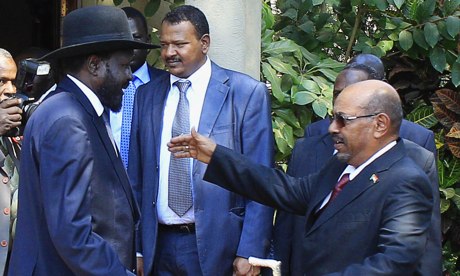
 Presidents of Sudan and South Sudan will address ongoing conflict, while China calls for end to hostilities and violence The president of Sudan, Omar al-Bashir, has arrived in Juba for talks with President Salva Kiir, while China has called for an immediate ceasefire in South Sudan, in the latest diplomat efforts to halt the fighting....
The president of South Sudan, Salva Kiir (left), and his Sudanese counterpart, Omar al-Bashir, meeting in Juba. Photograph: James Akena/Reuters
China[1] has called for an immediate end to hostilities in South Sudan[2], where the government is in talks with neighbouring Sudan[3] to deploy a joint military force to protect vital oilfields from rebels.
In a rare overt political intervention in Africa[4], the Chinese foreign minister, Wang Yi, said he was deeply concerned by the unrest in South Sudan, which has left more than 1,000 people dead and reduced oil flows by about a fifth.
"China's position with regards to the current situation in South Sudan is very clear," Wang told reporters in Addis Ababa, Ethiopia, where direct talks aimed at a ceasefire finally got under way on Monday. "First, we call for an immediate cessation of hostilities and violence."
China would do what it could to help restore stability in South Sudan and urged international powers to back the Ethiopian-led mediation efforts. An Ethiopian delegate told Reuters that Wang met both rebel and government delegations. China is Africa's single biggest trading partner[5], having overtaken the United States over the past decade, but professes to remain neutral and not interfere in African states' internal politics.
It is the biggest investor in oilfields in South Sudan through state-owned Chinese oil groups China National Petroleum Corp (CNPC) and Sinopec. The fighting forced CNPC to evacuate workers.
Similar in size to France, South Sudan is estimated by BP to hold sub-Saharan Africa's third biggest oil reserves. Its plight is attracting more global attention than most conflict-torn African nations. US president Barack Obama received daily briefings while on holiday in Hawaii, the New York Times reported[6], describing this as "a level of attention unheard-of for any other crisis in that part of Africa".
The high stakes were becoming increasingly apparent as Sudanese president Omar al-Bashir[7] flew into Juba to meet his South Sudan counterpart Salva Kiir, less than two years after the governments almost went to war over oil.
Bashir's arrival reflected Sudanese fears that the three-week conflict could damage its struggling economy. All of landlocked South Sudan's oil is piped through its northern neighbour, providing vital hard currency in transit fees for Khartoum.
Sudan's foreign minister Ali Karti said the men were "in consultations about the deployment of a mixed force to protect the oilfields in the south". Neither of the presidents referred to the proposal during a press conference in the South Sudanese capital Juba. The return of Sudanese troops to the south could send the crisis in an unpredictable new direction; at least two million people died during the north-south conflict that eventually led to the south's independence.
Anti-government forces loyal to rebel leader Riek Machar control the town of Bentiu, the capital of oil-rich Unity state. The south's government has said oil is no longer flowing from Unity's fields. Most, if not all, of the Chinese and Pakistani oil workers have left the country because of the outbreak of violence.
Bashir, an indicted war crimes suspect wanted by the international criminal court, would not meet Machar, al-Jazeera[8] reported. It said the Sudanese government attributed this to practical reasons and was not taking sides.
Kiir and Machar were comrades during the south's struggle against Khartoum, which culminated in a US-funded referendum and secession in July 2011. Relations with Sudan had remained fraught and renewed war seemed possible. But in March the two countries agreed to resume pumping oil through pipelines from south to north. A month later Bashir made his first visit to the south[9] since it gained independence.
On Monday Bashir said he feared that after allowing South Sudan to hold a vote to break away from Sudan in 2011, the outbreak of violence could mean "that our huge sacrifice did not bear fruit."
"We have come to see what we can do to stop this war knowing all too well that armed conflict would never resolve a problem and also knowing that any problem no matter how complicated can be solved at the negotiation table," Bashir said. "We fought each other for 20 years and in the end we sat and talked peace. Any further fighting is just a perpetuation of suffering for innocent civilians and loss in of lives and more destruction."
He added: "We are convinced that armed conflict will only create complications that will do no good that the people (of South Sudan) must and will come back to the negotiating table."
Kiir told reporters that "taking power by military force is a crime" and that Machar's actions should be condemned by the international community.
Despite the international pressure from multiple sides, the violence goes on. Fighting continues outside the flashpoint town of Bor, the capital of Jonglei state, which has untapped oil reserves. On Sunday a South Sudanese army general was killed when a government convoy was ambushed.
Meanwhile Oxfam reiterated its warning of a growing humanitarian crisis[10], noting that the Awerial refugee camp on the banks of the Nile is now home to 75,000 people. Desire Assogbavi, head of the charity's African Union liaison office in Addis Ababa, Ethiopia, said: "Thousands of families already living in extreme poverty have been pushed from their homes and cut off from what they need to survive.
"We are doing what we can to ensure those most affected by the violence have their basic needs met, such as access to food, water and sanitary living conditions. But if the conflict continues, it will become even more difficult to meet the increasing needs of those affected."
Kiir has blamed his long-term rival and former vice-president, Machar, whom he sacked in July, for starting the fighting in a bid to seize power. Machar dismissed the allegation but has acknowledged leading soldiers battling the government.
The conflict has taken on ethnic undertones: Kiir is from the majority Dinka community and Machar from the Nuer group.
References
- ^ More from the Guardian on China (www.theguardian.com)
- ^ More from the Guardian on South Sudan (www.theguardian.com)
- ^ More from the Guardian on Sudan (www.theguardian.com)
- ^ More from the Guardian on Africa (www.theguardian.com)
- ^ China is Africa's single biggest trading partner (feeds.theguardian.com)
- ^ the New York Times reported (www.nytimes.com)
- ^ More from the Guardian on Omar al-Bashir (www.theguardian.com)
- ^ More from the Guardian on Al-Jazeera (www.theguardian.com)
- ^ Bashir made his first visit to the south (www.reuters.com)
- ^ Oxfam reiterated its warning of a growing humanitarian crisis (www.oxfam.org)
Newer articles:
- South Sudan rallies more troops for fight against rebels - 10/01/2014 12:53
- US officials worry over South Sudan violence, may cut aid - 10/01/2014 01:38
- U.S. officials worry over South Sudan violence, may cut aid - 09/01/2014 23:58
- VIDEO: South Sudan's tribal divisions - 09/01/2014 20:22
- South Sudan conflict: Omar al-Bashir and Salva Kiir meet in Juba - 09/01/2014 17:42
Older news items
- Sudan won't form joint force to guard South Sudan's oil-spokesman - 09/01/2014 15:16
- Escape by night from South Sudan's warzones - 09/01/2014 00:56
- South Sudan rivals battle over key oil region - 09/01/2014 00:44
- South Sudan's Jan crude exports drop, Petronas among producers in Sudan - 08/01/2014 23:41
- South Sudan battles rage as peace talks stumble - 08/01/2014 22:08
Latest news items (all categories):
- IGAD and South Sudan Strengthen National Coordination for the Implementation of the Building Women’s Economic Resilience for Sustainable Peace Project - 03/08/2026 18:53
- South Sudan plans interoperable birth registration, digital ID systems - 03/08/2026 18:50
- South Sudan Oil & Power Returns as South Sudan’s Premier Investment Platform - 03/08/2026 18:04
- Kenya: Mudavadi meets South Sudan foreign minister as Juba gears up for landmark elections - 03/08/2026 16:52
- A Long Road Home: Jal’s Journey Through Conflict and Separation - 03/08/2026 16:41
Random articles (all categories):
- 2027 Basketball World Cup (Q): Cameroon surprises South Sudan - 06/12/2025 12:12
- South Sudan president blasts UN for wanting 'parallel' government - 21/01/2014 14:59
- U.N. urges peacekeepers to redeploy to focus on South Sudan hot spots - 11/07/2013 16:18
- South Sudan authorities urged to come on board and tackle human trafficking - 17/01/2023 08:00
- Bangladesh Army Chief visits peacekeeping mission in South Sudan - 18/02/2022 08:11
Popular articles:
- Who is the darkest person in the world, according to Guinness World Record? - 25/10/2022 02:34 - Read 148272 times
- School exam results in South Sudan show decline - 01/04/2012 17:58 - Read 27914 times
- Top 10 weakest currency exchange rates in Africa in 2023 - 19/07/2023 00:24 - Read 25000 times
- No oil in troubled waters - 25/03/2014 15:02 - Read 24322 times
- NDSU student from South Sudan receives scholarship - In-Forum - 29/09/2012 01:44 - Read 22279 times
