
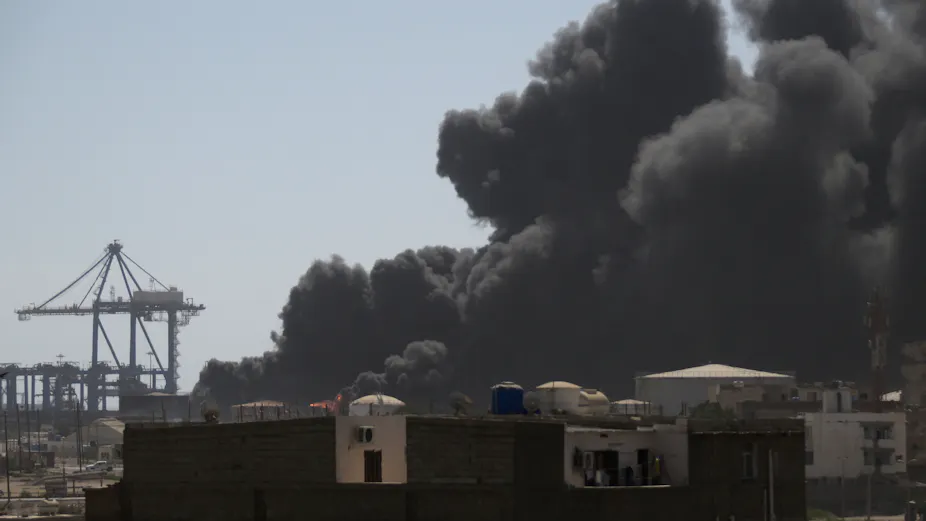
Smoke billows after a drone strike in Port Sudan in May 2025 (AFP via Getty Images)
The civil war in Sudan between the Sudanese army and paramilitary Rapid Support Forces, which began in April 2023, has had an impact on its neighbours. One of the most keenly affected countries is South Sudan, which became an independent state in 2011 and went on to endure its own civil war. This ended in 2018 with a tenuous peace agreement.
The impact of the Sudanese war on South Sudan, however, isn’t a straightforward spillover catastrophe. The picture is more nuanced, and this is most clearly seen in South Sudan’s oil economy. Jan Pospisil, who has studied the dynamics in Sudan and South Sudan, explains.
What is the current status of oil exports from South Sudan through Sudan?
Landlocked South Sudan is reliant on its neighbour to the north to transport oil from its fields to the international market. Crude oil is transported via pipeline to Port Sudan on the Red Sea.
However, recent drone strikes on Port Sudan carried out by the Rapid Support Forces targeted power plants that supply electricity to pumping stations along Sudan’s critical oil pipelines.
Soon after, the Sudanese army formally notified South Sudan that it would have to halt exports. Following hectic negotiations, the South Sudanese government released a statement that the stoppage could be prevented.
This back and forth has reopened the pressing question of the impact of Sudan’s war on South Sudan’s economy and, in particular, the role of crude oil.
Assessments of the impact of Sudan’s war on South Sudan suggest the worst: oil revenues would account for 80% of South Sudan’s budget and 90% of its fiscal revenue.
This informs the International Monetary Fund’s warnings of looming economic collapse in case of a breakdown of oil exports. The predominant view is that a shutdown of the oil pipeline through Sudan would lead to a collapse of dollar inflows to South Sudan, triggering a severe economic crisis.
However, South Sudan’s 2024-25 budget suggests a high reliance on non-oil revenue.
In fact, government oil revenues for 2024-25 are based on a volume of only around 16,000 barrels per day. This is the share of total production of about 130,000 barrels per day controlled by South Sudan. Attempts to increase production to pre-war levels of up to 400,000 barrels failed. The substantial drop in production is explained by a decline in the quality of South Sudan’s oil wells, especially in Paloch in the north-east’s Upper Nile State, and Unity State in the north-central region.
South Sudan additionally lacks the operational capacity to extract the oil it has in the ground.
The 2024-25 budget projects a hefty fiscal deficit. The revenues projected will cover only about half of total planned state spending. Oil and non-oil revenues – which mainly include tax income from international NGOs and businesses – each account for about half of the revenue that’s expected to come in.
Oil income has to account for debt (capital and interest) repayments on loans, as well as pipeline transport fees paid to Sudan. This means that even the optimistically assessed net contributions of oil revenue would only pay for 16% of planned government spending. South Sudan remains with a hefty deficit.
What are the challenges South Sudan is facing in growing oil revenues?
First, Petronas, a Malaysian multinational oil and gas company, withdrew from South Sudan in August 2024 after three decades.
It left behind substantial challenges, including an arbitration process worth more US$1 billion. This followed the government preventing Petronas from selling its shares to the British-Nigerian group Savannah Energy.
As a short-term solution, South Sudan de facto nationalised Petronas’ shares. It did this by transferring the shares to the state’s oil and gas company, Nile Petroleum Corporation (NilePet). This was perhaps in the hope of increasing revenue in the short term.
However, NilePet hasn’t been able to replace Petronas’ production logistics. This has resulted in huge challenges in restoring production to levels before the 2024 pipeline disruptions.
A second factor is the sale of oil forward. The then finance minister said in 2022 that most of the oil production had been sold in advance until 2027. He later retracted the statement, saying instead that some oil advances were merely “spread up to 2027”. While this walk-back attempted to soften the political fallout, it reinforced wider uncertainty about how much control NilePet actually retains over the revenues formally under its authority.
Given the limited relevance of oil revenues for the official South Sudanese budget, why the major concern about disruptions?
There are three reasons.
First, NilePet plays a structural role in South Sudan’s informal and often dubious hard currency circulation, which international observers would call large-scale corruption. NilePet’s accounts rarely appear in any official financial accounts and are often channelled off-budget. NilePet functions as a black box within the public finance system where real money flows can only rarely be traced. Recent intentions by the president to structurally reform the company might implicitly confirm this.
Second, there are indirect oil revenues that are important to the country’s security apparatus. This includes protection rents which come from protecting South Sudanese oil fields. This revenue never hits the budget. It pays the National Security Service either directly as salaries, or is reinvested in the considerable conglomerate of companies owned by the security service to multiply profits. Losing this revenue could destabilise the country because the funds are used to pay the salaries of the best-trained and best-equipped security service in the country.
Third, South Sudan’s ability to attract new loans depends on the repayment of existing ones. These repayments largely depend on oil production. As the 2024-24 budget shows, South Sudan desperately needs new loans to keep even core state functions operational. Yet, funding from multilateral agencies has dwindled to small-scale loans from the African Development Bank. The International Monetary Fund has currently ended all its funding programmes.
This is not a result of the war in Sudan. It is due to persistent concerns over insufficient financial governance in South Sudan and the state’s performance. Negotiations with Qatar and the United Arab Emirates for new loans appear to have stalled, not least because of a default in repayments to Qatar.
These factors show that the flow of oil to Port Sudan is significant to the availability of hard currency in South Sudan’s economy. But this is in more indirect ways than the outdated claim of an 80% budgetary dependency would suggest.
The war in Sudan has a significant yet multifaceted impact on South Sudan’s economic health. But Juba’s biggest challenges are internal.
South Sudan’s economy over the last six years has been mainly dependent on international loans coming in – a flow which has now dried up, resulting in a severe economic crisis unprecedented in the young country’s history.
Newer articles:
- From prison cells to the pulpit: Bishop Alexander shares moving testimony of resilience and gospel's transformative power in South Sudan - 06/06/2025 12:17
- Escalating conflict in South Sudan forces many thousands to flee just as aid dwindles - 06/06/2025 12:10
- Rising tide of microfinance helps lift South Sudanese boatmaker - 06/06/2025 11:53
- Kampala Queens off to South Sudan for friendly match with Yei Joint Stars - 06/06/2025 11:48
- With 9 Members Voting in Favour, 6 Abstaining, Security Council Extends Sanctions Regime on South Sudan for One Year, Adopting Resolution 2781 (2025) - 31/05/2025 18:21
Older news items
- South Sudan flood threat returns - 31/05/2025 18:14
- ‘Killing is part of their life’: The men raised on violence who are both perpetrators and victims as South Sudan faces return to civil war - 31/05/2025 18:09
- South Sudan's President Kiir promotes sanctioned ally as ruling party deputy - 21/05/2025 19:01
- US says South Sudan is not final destination for deportation flight - 21/05/2025 18:56
- US ‘illegally deported’ Vietnamese and Burmese migrants to South Sudan - 21/05/2025 18:53
Latest news items (all categories):
- Western Equatoria prepares for voter registration - 14/09/2026 15:11
- South Sudanese Women Reclaim Their Lives after Fistula Surgery - 14/09/2026 15:10
- Digitel Launches Voice and Social Media Bundles in South Sudan - 14/09/2026 15:07
- Nearly 100,000 displaced in Sudan’s Blue Nile state since January amid fighting: UN agency - 14/09/2026 15:03
- جنوب السودان يرفض طلبًا لـ”حميدتي” بمنحه الحصة الأكبر من عائدات النفط - 14/09/2026 14:51
See also (all categories):
Random articles (all categories):
- South Sudan Coalition - Letter to the AU Peace and Security Council Regarding the Session on South Sudan - 15/07/2020 09:14
- South Sudan urges Sudanese parties to use dialogue to resolve impasse - 26/10/2021 03:40
- اشتباكات لونقشوك… هل تعود الحرب الأهلية إلى جنوب السودان؟ - 03/09/2025 18:55
- MOFA on membership to the Arab League, is it not a voluntary Return to Arab Islamic bondage? - 18/03/2018 10:04
- South Sudan Needs Sincere, Unconditional Love to “be in peace”: Catholic Bishop - 01/11/2023 05:00
Popular articles:
- Who is the darkest person in the world, according to Guinness World Record? - 25/10/2022 02:34 - Read 149550 times
- School exam results in South Sudan show decline - 01/04/2012 17:58 - Read 28110 times
- Top 10 weakest currency exchange rates in Africa in 2023 - 19/07/2023 00:24 - Read 25190 times
- No oil in troubled waters - 25/03/2014 15:02 - Read 24460 times
- NDSU student from South Sudan receives scholarship - In-Forum - 29/09/2012 01:44 - Read 22413 times
