
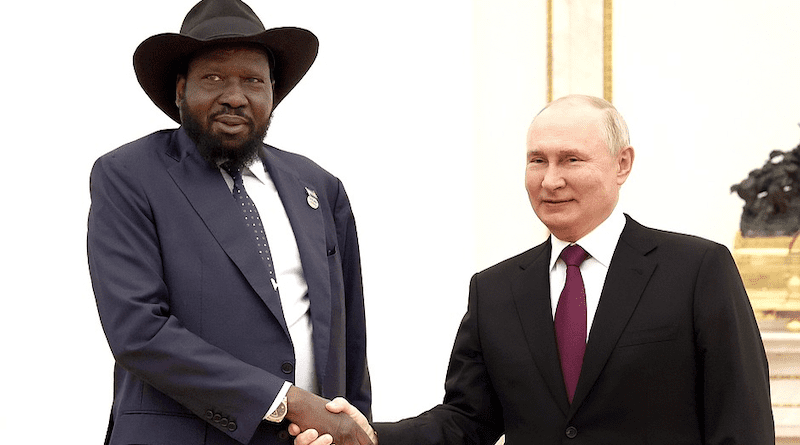
South Sudan President Salva Kiir with Russia's President Vladimir Putin (Photo Credit: Kremlin.ru)
By Peter Fabricius
After the fourth extension of South Sudan’s first post-independence elections, it is becoming increasingly difficult to imagine how Africa’s youngest state will ever become a democracy.
The polls were scheduled for December, with the transition ending in February 2025. But on 18 September, signatories to the 2018 peace agreement postponed elections until December 2026 because almost no progress had been made in undertaking the necessary preparations since the last extension.
It is becoming ever clearer that the leaders of the bloated transitional government – most notably rivals President Salva Kiir Mayardit and Vice-President Riek Machar – do not see any self-interest in rushing into elections. As long as the transition remains in force, they remain in power, unelected but willing and able to plunder public resources.
As Major General Charles Tai Gituai, Chairperson of the Reconstituted Joint Monitoring and Evaluation Commission, said in October, ‘many recurring challenges’ delayed implementation of the 2018 agreement by six years. These included ‘insufficient political will, trust deficit, lack of sufficient, dedicated and predictable funding, and capacity gaps.’ Gituai’s commission was set up to monitor the execution of the peace deal.
This time around, he said, ‘There is unprecedented need to do things differently. A clear demonstration by the Revitalised Transitional Government of National Unity (RTGoNU) to mobilise sufficient resources to implement the agreement would be a strong indication of political will and commitment.’
It is becoming ever clearer that Kiir and Machar don’t see any self-interest in rushing into elections
However, in his address to the United Nations Security Council, Nicholas Haysom lamented that despite the urgent need to hold elections, ‘Implementation of the revitalised agreement and its roadmap has, yet again, been relegated to the back burner while political interests play out at the national level.’
Haysom is a Special Representative of the Secretary-General and Head of the UN Mission in South Sudan (UNMISS). Given the lack of preparation, he said the postponement was ‘inevitable but regrettable’.
The troika of countries giving the transition most support – the United States, United Kingdom and Norway – expressed ‘profound disappointment’ at the postponement. They said South Sudan leaders had ‘demonstrated a lack of political will and have instead conserved power in the hands of a small elite’ while neglecting citizens’ welfare.
By contrast, African Union Commission Chairperson Moussa Faki Mahamat merely noted the postponement and called for ‘concrete steps’ to realise the 2018 peace agreement.
Workneh Gebeyehu, Intergovernmental Authority on Development (IGAD) Executive Secretary, actually welcomed the ‘consensual manner’ in which the postponement was decided. He called on South Sudanese to spare no effort to meet the new deadline.
That effort has not been helped by the stalling of the Tumaini Peace Initiative. The initiative is a negotiation hosted by Kenya in Nairobi between the transition government and various small groups and factions who didn’t sign the 2018 agreement, about bringing them into the government.
Serious compromises will be needed if South Sudan is to meet the new December 2026 deadline
Machar quit the initiative in July, apparently suspecting that Kiir was exploiting the admission of new parties to dilute the powers allocated to Machar’s party in the 2018 peace deal. After an intervention by Kenyan President William Ruto on 6 November, there have been faltering efforts to revive the stalled initiative.
Haysom called for serious compromises if South Sudan was to meet the December 2026 deadline. ‘Decisions, actions, realism and benchmarks associated with an implementation plan are needed,’ he declared.
He said UNMISS had proposed six immediate actions. First, deploy the Necessary Unified Forces (NUF), continue their joint training and decide on command structures. Second, launch civic education and third, prepare for voter registration. Fourth, amend the National Security Services Bill to expand civic and political space and fifth, develop a code of conduct for political parties, civil society and the media. Last, clarity was needed on sharing responsibility for security during elections.
Given their past deadly clashes, forming and deploying the Necessary Unified Forces that integrate Kiir and Machar’s combatants is vital. As Daniel Akech, Senior Analyst on South Sudan at the International Crisis Group, told ISS Today, ‘South Sudan doesn’t have one commander-in-chief. There are about [six].’
Haysom’s to-do list could kick-start a train of actions enabling elections in two years. But will Kiir, Machar, and the other transitional government leaders jump into action at last? It seems unlikely.
Instead, the government parties ‘are likely to continue with the same “game of thrones” mindset around the power-sharing arrangements rather than seeking legitimacy through the ballot box,’ writes Luka Biong Deng Kuol, Director of Juba’s Sudd Institute.
The technical prerequisites for holding elections in 2026 are unlikely to be met in time
In any case, he believes the technical prerequisites for holding elections are unlikely to be met in time. He notes that National Constitution Review Commission (NCRC) Chairperson Dr Riang Yer Zuor recently said it would take at least 18 months to make a new Constitution – if the NCRC had the necessary resources, which was unlikely. That would leave only six months to prepare for voting.
Likewise, he believes it will be impossible to complete the necessary census before elections. Also, he says even if the NCRC and National Election Commission were given the resources to do the job, they were too politicised and partisan to do it properly.
Akech shares his misgivings. He also notes that the eruption of civil war in neighbouring Sudan aggravates the problem. It has cut off the pipeline carrying South Sudan’s oil to port, depriving the country of most of its revenue. If South Sudan could not manage the 2024 elections when oil and money were flowing, how would it do so now?
Deng proposes a neutral caretaker government of bureaucrats to administer the 2026 elections, bypassing the squabbling politicians. But the politicians would have to agree to be bypassed.
Akech thinks Kiir’s firing last month of his spy chief General Akol Koor Kuc, attempts to arrest him, and last week’s subsequent shootout in Juba, were ominous. He blames that partly on the interrupted oil exports, compromising Kiir’s ability to pay his security chiefs.
So far, despite localised skirmishes, the country has not relapsed into civil war. But the peace is relative and fragile.
- About the author: Peter Fabricius, Consultant, ISS Pretoria
- Source: This article was published by ISS Today
Source: https://www.eurasiareview.com/01122024-south-sudans-game-of-thrones-continues-analysis/
Newer articles:
- South Sudanese craftsmanship is rooted in women - 09/12/2024 12:25
- Sudan rescuers say 28 killed in shelling of Khartoum fuel station - 09/12/2024 12:19
- Hope for Christmas gift as South Sudan talks return to Nairobi - 05/12/2024 10:26
- Chinese medical team brings relief to South Sudan patients - 05/12/2024 10:18
- Sudanese bishop speaks about being brutalized by soldiers - 05/12/2024 10:08
Older news items
- South Sudan secured over 282 150 doses of oral cholera vaccine to contain the cholera outbreak - 01/12/2024 17:43
- In South Sudan with aid boss John Rynne: 'The maps drawn in colonial times are starting to erode' - 29/11/2024 12:47
- 'They have nothing': Aid workers struggle to save lives at edge of war-torn Sudan - 29/11/2024 12:36
- Malakal Humanitarian Information Needs: Community Voices Bulletin, October 2024 / Issue #10 - 29/11/2024 12:29
- Gun battle breaks out in South Sudanese capital as Government attempts to arrest ex spy chief - 22/11/2024 13:02
Latest news items (all categories):
- Juba commissioner denies chasing foreigners - 07/10/2026 14:36
- Australia: 19-year-old from South Sudan arrested over a wild joy ride - 07/10/2026 14:33
- South Sudan’s aid crisis deepens as food stocks run low - 07/10/2026 14:29
- South Sudan’s Juba warns foreigners against running small-scale businesses - 07/10/2026 14:25
- Peace Dialogues foster social cohesion in Nyirol County after persisting tensions - 07/10/2026 14:23
See also (all categories):
Random articles (all categories):
- Feature: Chinese doctor wins hearts of South Sudanese medics - 05/05/2019 09:03
- Turkish Airlines Flies South Sudan's Capital, Juba - 06/06/2022 14:55
- Gathering at State Capitol commemorates anniversary of mass killing in South Sudan - 15/12/2017 19:40
- Job Opportunities at UNOPS South Sudan Country Office - 24/06/2022 10:15
- UNICEF - Vacancy Announcement - Communication for Development Officer (NO-B) FT, Wau, Logistics Officer (NO-A) TA, Bor - 13/08/2019 15:42
Popular articles:
- Who is the darkest person in the world, according to Guinness World Record? - 25/10/2022 02:34 - Read 150750 times
- School exam results in South Sudan show decline - 01/04/2012 17:58 - Read 28193 times
- Top 10 weakest currency exchange rates in Africa in 2023 - 19/07/2023 00:24 - Read 25305 times
- No oil in troubled waters - 25/03/2014 15:02 - Read 24533 times
- NDSU student from South Sudan receives scholarship - In-Forum - 29/09/2012 01:44 - Read 22492 times
