
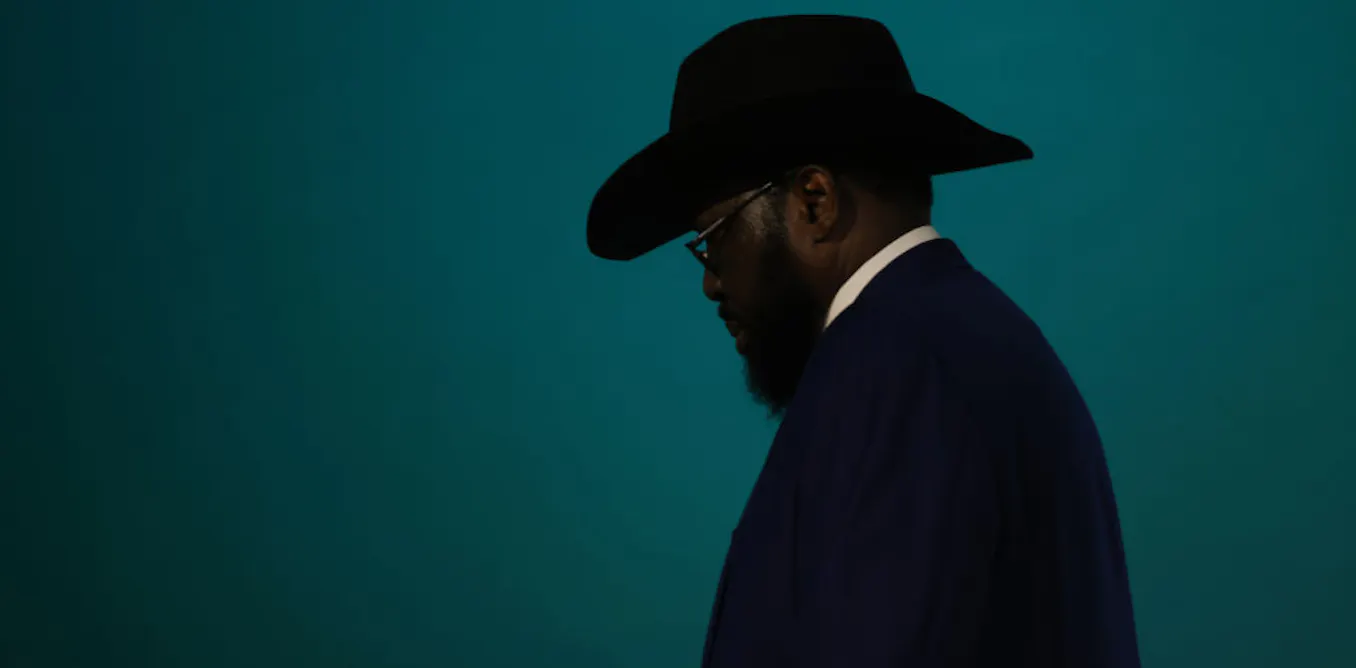
Salva Kiir Mayardit, president of South Sudan (Photo by Sean Gallup/Getty Images)
Salva Kiir Mayardit has served as South Sudan’s president since the country’s independence in 2011. South Sudan’s secession from Sudan came on the heels of a long and bloody civil war that resulted in a referendum on independence.
The initial optimism about the new state faded within two years when Kiir fell out with his vice-president, Riek Machar. The resulting civil war displaced some four million people and killed an estimated 388,000 people. With the two warring sides unable to reach agreement, the government postponed elections indefinitely in 2015 amid continuing civil strife.
Kiir and Machar signed a peace agreement in September 2018 between the government and numerous opposition groups. The agreement established a transitional government of national unity and set out a roadmap to peace and stability. While parts of the agreement were implemented – such as the reinstatement of Machar as vice-president – little else has moved.
Since then, presidential elections have been postponed four times. Most recently, the new government was scheduled to hold elections in 2023, but elected to postpone them to 2024. They are now scheduled for 2026. The government on these occasions cited a lack of preparedness to hold elections.
But the governmnent’s delays may have less to do with public interest than with Kiir’s fear of the potential consequences of losing power. Along with other senior figures, he faces the risk of being hauled before a war crimes court that was established under the Agreement on the Resolution of Conflict in South Sudan but has yet to be set up.
So far, Kiir has managed to use his political and economic power to divide the opposition, such as the Sudan People’s Liberation Movement-in-Opposition (SPLM-IO) and the South Sudan Opposition Alliance. He has also repressed civil society groups that have lamented his inability to build consensus on elections. Kiir’s divisive rule and delaying have also allowed corruption to run rampant. The result is a dearth of clean politicians to energise the country and to end his rule.
I have published widely on politics and international affairs. Among my recent books are South Sudan’s Fateful Struggle: Building Peace in a State of War and The Challenge of Governance in South Sudan: Corruption, Peacebuilding, and Foreign Intervention. A report from my work as a United States Agency for International Development country expert now serves as the basis of the agency’s five-year strategic mission in the country.
Kiir steered South Sudan to independence. However, in my view, he has to answer for sowing division and fostering violence and corruption that has diminished hope for long-term peace, democracy and national unity.
Early years
Born in 1951, Kiir was raised by a Dinka family that herded cattle in the Warrap state in the northern central region of South Sudan. At the age of 16, he joined the Anyanya – the South Sudanese rebel movement fighting Sudanese forces.
In 1983, he joined the Sudan People’s Liberation Movement/Army (SPLM/A), soon earning the trust of its leader and founder, John Garang de Mabior. Garang died unexpectedly, in a helicopter crash, in July 2005, just months after the signing of the peace agreement that ended the second civil war in Sudan. Kiir succeeded Garang as the new president of the regional government of Southern Sudan.
By winning the 2010 elections, he helped consolidate the SPLM/A’s control of the political system and the referendum on the country’s independence. He was then appointed president of South Sudan, with Riek Machar as his appointed vice-president. Machar, a Nuer, was a wily politician who collaborated with the Sudanese government during the second civil war and resisted what he believed was oppressive Dinka rule inside the SPLM/A.
As president, Kiir’s most pressing challenge was unifying and professionalising the army. The years of political infighting had led some commanders to defect. Many established separate militia forces to attack government forces and then rejoined the SPLA in 2006.
Kiir got back these rogue commanders by offering them cash and higher official appointments. But the SPLA remained divided along ethnic lines, primarily between the two largest ethnic groups, the Dinka and the Nuer. Patronage became the means by which they paid for these loyalties. Rather than breaking up the patronage networks and professionalising the army, Kiir continued to use a portion of the state’s budget to pay for the loyalty of (his) Dinka soldiers and intermediaries.
Rogue militia forces, such as Thomas Cirillo’s National Salvation Army, continue to use outside money to recruit and attack government soldiers.
Missteps
Kiir’s other great challenge has been developing the economy. Oil sales account for nearly 98% of the national budget. Yet, instead of abiding by and enforcing many of the laws launched after independence – which included the Petroleum Management Act (2011) – Kiir allegedly siphoned off oil rents and mis-allocated much of the oil revenue.
His and others’ rent seeking is now the central source of the country’s endemic corruption at the state and local levels. And it is perhaps the central reason for the political infighting that led to the government’s decision to shut off the oil pipelines to Sudan in 2012, after the Sudanese government hiked the transport fees for oil.
The decision hurt both countries. Within months, South Sudan saw a spike in its inflation and interest rates. This resulted in further infighting and led to the outbreak of civil war in 2013 between government forces and the newly created Sudan People’s Liberation Movement/Army in Opposition.
To his credit, Kiir did manage to broker a ceasefire and to implement parts of the conflict resolution agreement in 2015. But in the same year, he took the fateful step of adopting a presidential decree that gerrymandered and divided the country into 28 states. For critics it amounted to a Dinka power grab that further divided the country and delayed the process of adopting a transitional unity government agreed to in 2018.
By early 2020, Kiir was forced to rescind the law to meet a key demand of the opposition. Yet the implementation of the transitional unity government has faced obstacles, including threats of election violence and instability. These have delayed new elections and the adoption of a permanent constitution.
What next
The decision to delay elections means Kiir will need to find ways to placate international donors and stave off the defections that have been growing since early 2023.
With the recent decline of his health, which has forced Kiir to restrict his public appearances, it seems unlikely that he will have the stamina to improve the situation. If anything, his ill health raises the question of who will succeed him. That remains unanswered.
Newer articles:
- UN agencies warn of hunger crisis in South Sudan - 19/11/2024 17:41
- South Sudan demands swift action on loss and damage fund at COP29 - 19/11/2024 17:36
- South Sudan edge Congo in five-goal thriller, Uganda and South Africa qualify - 19/11/2024 17:22
- UN Commission on human rights in South Sudan commences visit to Addis Ababa for critical talks on transitional justice with African Union - 19/11/2024 17:16
- South Sudan Transitional Government’s Perpetual Extension of Its Mandate ‘Ultimate Obstacle to Democracy - 08/11/2024 17:11
Older news items
- Alarming spike in childhood malaria admissions in South Sudan - 08/11/2024 16:55
- Presidents of South Sudan and Kenya push for a resolution in stalled peace talks - 08/11/2024 16:51
- Christian Aid Christmas Appeal: Rebuilding lives in South Sudan - 08/11/2024 16:45
- Policy actions to strengthen Public Finance Management in South Sudan - 01/11/2024 15:30
- WFP Calls for Cash to Frontload South Sudan Operations Amid Warnings of Rising Hunger - 01/11/2024 15:26
Latest news items (all categories):
- South Sudan can leverage China’s AI path to bridge the digital divide - 16/09/2026 16:04
- Credible Elections Are No Longer Possible in South Sudan - What Next? - 16/09/2026 15:59
- South Sudan's president replaces electoral chief three months before scheduled polls - 16/09/2026 15:56
- Turkish Airlines is pulling out of 5 African routes, including South Sudan - 16/09/2026 15:23
- ‘Super El Niño’ deepens hunger crisis in South Sudan – WFP - 16/09/2026 15:19
See also (all categories):
Random articles (all categories):
- Why Bashir won’t head to ICC soon - 15/01/2022 02:46
- RSS a Rotten Society Mismanaging Itself into Self destruction? - 13/03/2013 10:37
- Sudan, South Sudan resume air border patrols: UNISFA - 10/10/2017 23:38
- South Sudan's Hunger Is Growing, Despite 5 Months of Peace - 22/02/2019 02:41
- Episcopal Relief Development Responds to Civil Unrest and the COVID-19 Pandemic in South Sudan - 28/04/2022 13:06
Popular articles:
- Who is the darkest person in the world, according to Guinness World Record? - 25/10/2022 02:34 - Read 149596 times
- School exam results in South Sudan show decline - 01/04/2012 17:58 - Read 28115 times
- Top 10 weakest currency exchange rates in Africa in 2023 - 19/07/2023 00:24 - Read 25198 times
- No oil in troubled waters - 25/03/2014 15:02 - Read 24465 times
- NDSU student from South Sudan receives scholarship - In-Forum - 29/09/2012 01:44 - Read 22416 times
