
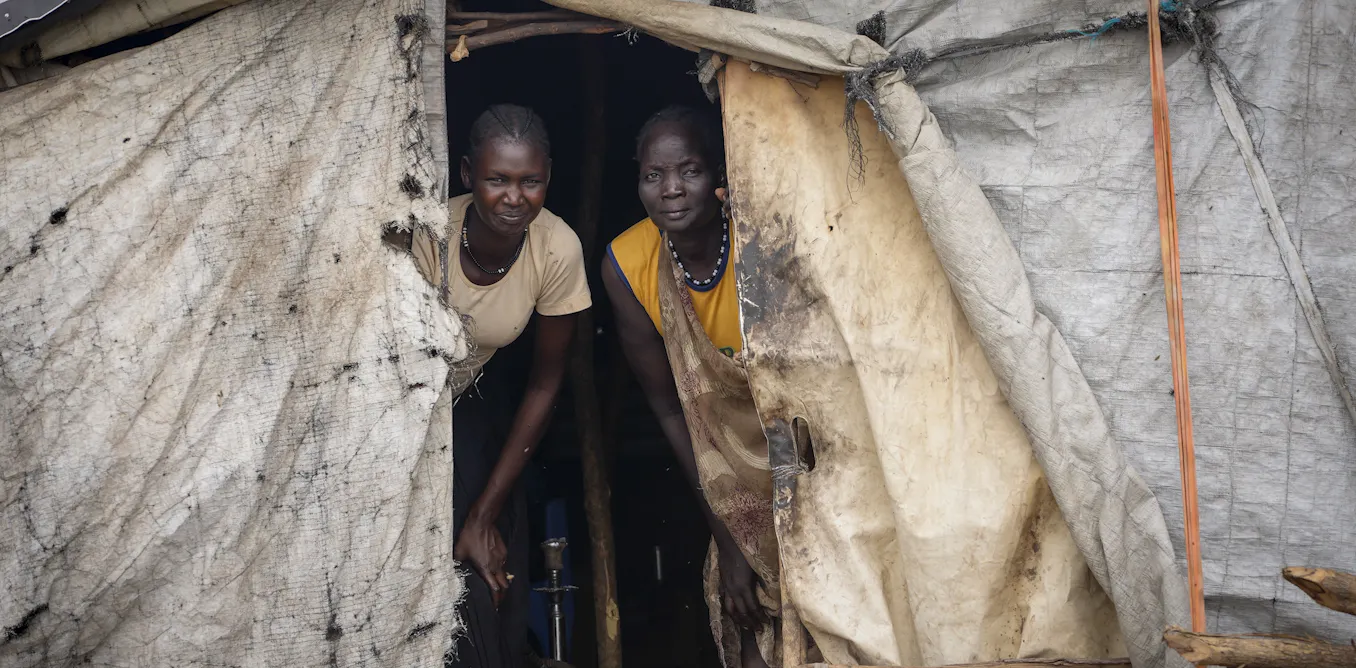
South Sudanese voters are slated to go to the polls in December. But will they? (AP Photo/Sam Mednick)
Elections are pivotal milestones in post-conflict countries – and nowhere is voter anticipation felt more keenly than in South Sudan, the world’s youngest nation.
The country, which won independence in 2011 after a long conflict with Sudan, has not seen an election since.
A date has been set for a national vote: Dec. 22, 2024. Yet the timing remains in question, with the United Nations and others doubting whether adequate preparations have been made.
The proposed vote follows years of delays: An election was due to take place in 2015 but was postponed after the young country descended into civil war.
The 2024 vote was poised to shape the future of a country still grappling with the challenges of peace-building and governance – South Sudan entered a post-civil war transitional period in 2018, yet sporadic, mainly intercommunal violence continues. A national vote offers a critical opportunity to consolidate a hard-won peace and chart a course toward a more stable and democratic future.
But the country has failed to establish a robust electoral framework crucial for fair and credible polls – including constitutional, legal, financial and political conditions to ensure the feasibility of holding a credible national ballot. Moreover, entrenched disagreements among political leaders threaten to exacerbate the situation.
As a scholar focusing on global governance and human security in Africa, I share the concern that failure or delay in these electoral processes could lead to a perilous regression into conflict.
Lack of funding for elections
Successful elections could elevate South Sudan’s international reputation by demonstrating political maturity and a commitment to democracy after years of instability. Both regional and global actors have urged the government to hold elections promised under the 2018 Revitalized Agreement on the Resolution of Conflict in South Sudan. Amid implementation delays, a road map was endorsed in August 2022 to guide the peace process and elections.
In December 2022, the government reconstituted key bodies, including the National Constitutional Review Commission and the National Electoral Commission, as a precursor to elections. However, both entities face financial challenges, with the National Constitutional Review Commission yet to receive any funding.
These financial problems are a major obstacle. While the National Electoral Commission and the Political Parties Council, a body tasked with promoting political dialogue and cooperation, have received some funding, it is insufficient for full operations. International stakeholders, including the United Nations, the African Union and the EU, had expected the government to finance the elections, but ongoing delays have left international bodies advising and encouraging the government from the sidelines, concerned about the lack of progress.
Oil revenue decline, economic hardships
Rich in oil resources yet extremely poor, South Sudan is currently confronted with a significant decline in its capacity to finance electoral processes. This decline stems primarily from a sharp reduction in oil revenues, compounded by economic hardships and the diversion of resources by the ruling elite.
At independence in 2011, and prior to the conflict that began two years later, South Sudan’s daily oil exports stood at 300,0000 barrels. However, ongoing conflict and infrastructure damage have led to a steady decline in production, with current exports reduced to approximately 150,000 barrels per day. Projections indicate a continued halving of production roughly every five years. Factors exacerbating South Sudan’s oil revenue decline include volatile global oil prices, internal instability and poor-quality crude oil.
Prospective investors are further deterred by war-damaged oil wells and the logistical and political complexities associated with exporting oil through neighboring Sudan. Major oil export disruptions were noted after a disastrous rupture on the crucial pipeline responsible for ferrying landlocked South Sudan’s crude oil to the Red Sea hub of Port Sudan for global export. The rupture occurred during fighting between Sudan’s warring parties: the Rapid Support Forces and the Sudanese Armed Forces.
The payment structure for oil proceeds dictates that private oil companies claim nearly 60% of production as their share, while neighboring Sudan also takes a significant portion based on agreements made during independence. Consequently, South Sudan receives revenue only from approximately 45,000 barrels out of the total daily production ranging from 150,000 to 170,000 barrels. It is from this limited allocation that the government funds 98% of the national budget.
Returnees, refugees pose humanitarian challenge
Additionally, the return of over 1 million South Sudanese since the signing of the 2018 peace agreement, along with thousands of refugees fleeing the conflict in Sudan, has further stressed the humanitarian challenges that the young country faces amid economic hardships.
This includes South Sudanese who have been severely affected by the ongoing conflict in Sudan since April 2023. Moreover, alongside this humanitarian burden, there are still thousands of South Sudanese who remain in internally displaced persons camps awaiting a safe return to their communities.
While funding the elections is a challenge, the true crisis lies in a profound lack of trust and confidence between the parties to the peace agreement.
Divisions among political kingpins
President Salva Kiir and First Vice President Riek Machar – who represent the two main parties that would be competing in any election – share a complicated history and entrenched mistrust of each other that threatens the integrity of the entire electoral process.
The two have clashed and have been on opposing sides off and on since 2013, leading to civil war. Their complex relationship now threatens the integrity of the electoral process amid fears of ethnic tension.
Critical tasks such as the training and deployment of 33,000 security personnel remain unfinished, risking national stability. Ensuring nationwide election security is paramount; however, the absence of unified national security forces raises concerns about voter safety.
Unlike other post-conflict African countries such as the Democratic Republic of the Congo, Liberia and Sierra Leone, where the international community facilitated elections, South Sudan’s transition depends solely on its current transitional government, mandated to lead until December 2024.
Despite South Sudan’s political and security challenges, immediate steps can facilitate peaceful elections. Leadership dialogue, expedited funding and enhanced security mechanisms are essential. Meanwhile, regional and international stakeholders can be engaged to secure robust financial support and complete critical tasks. If a rumored joint ticket between Kiir and Machar materializes, it could potentially reunite the country and set a course for stability.
Ahmed Hersi, a Horn of Africa regional analyst, contributed to this article.
Newer articles:
- World Bank, South Sudan Team Up to Boost Public Service - 07/09/2024 13:31
- After years of civil war, South Sudan turns its focus to wildlife conservation - 07/09/2024 13:24
- In South Sudan, a new constitution seen as ultimate saviour from perennial strife - 25/08/2024 10:46
- Chinese firm inks deal to construct modern oil refinery in South Sudan - 25/08/2024 10:42
- South Sudan's security bill allowing warrantless arrests becomes law - 25/08/2024 10:40
Older news items
- South Sudan: Humanitarian Situation Monitoring, April-May 2024 - Access to education (19 August 2024) - 25/08/2024 10:15
- Sudan Crisis: Malakal Town Area-Based Assessment (August 2024) - 25/08/2024 10:03
- Is Proceeding With Elections In South Sudan The Lesser Of Many Evils? – Analysis - 29/07/2024 19:13
- Olympics 'disrespected' South Sudan basketball players with national anthem - 29/07/2024 19:07
- Generous €12,400 raised to support Mary Ellen McGroarty’s work in South Sudan - 29/07/2024 19:02
Latest news items (all categories):
- Western Equatoria prepares for voter registration - 14/09/2026 15:11
- South Sudanese Women Reclaim Their Lives after Fistula Surgery - 14/09/2026 15:10
- Digitel Launches Voice and Social Media Bundles in South Sudan - 14/09/2026 15:07
- Nearly 100,000 displaced in Sudan’s Blue Nile state since January amid fighting: UN agency - 14/09/2026 15:03
- جنوب السودان يرفض طلبًا لـ”حميدتي” بمنحه الحصة الأكبر من عائدات النفط - 14/09/2026 14:51
See also (all categories):
Random articles (all categories):
- Sudan admits to confiscating S.Sudan oil - 16/01/2012 00:44
- South Sudan: Humanitarian Access Snapshot - July 2026 - 12/08/2026 17:32
- Episcopal Relief Development Responds to Civil Unrest and the COVID-19 Pandemic in South Sudan - 28/04/2022 13:06
- FOR IMMEDIATE RELEASE “SPOILER ALERT” African Union and IGAD Urged to Clamp Down on Spoilers Undermining South Sudan’s Peace Process - 26/01/2018 15:00
- S.Sudan crisis 'deteriorates' after six months of war - 15/06/2014 10:00
Popular articles:
- Who is the darkest person in the world, according to Guinness World Record? - 25/10/2022 02:34 - Read 149549 times
- School exam results in South Sudan show decline - 01/04/2012 17:58 - Read 28110 times
- Top 10 weakest currency exchange rates in Africa in 2023 - 19/07/2023 00:24 - Read 25190 times
- No oil in troubled waters - 25/03/2014 15:02 - Read 24460 times
- NDSU student from South Sudan receives scholarship - In-Forum - 29/09/2012 01:44 - Read 22413 times
