
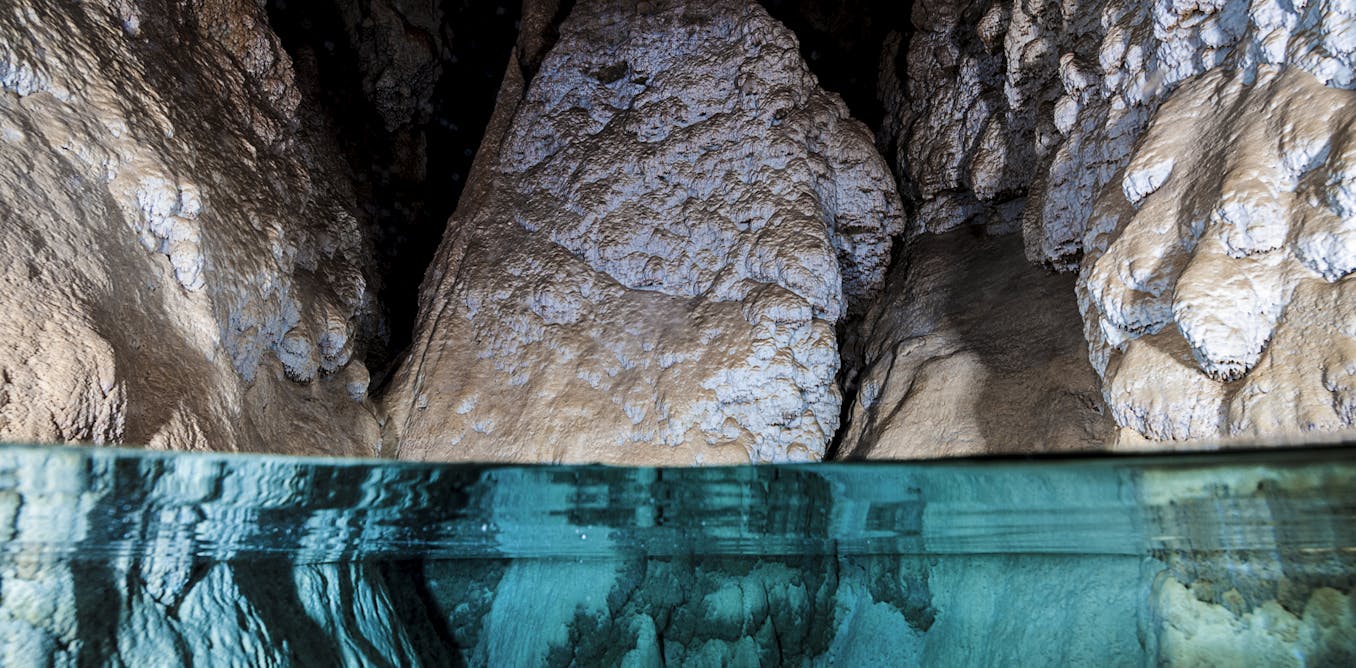
(Giordano Cipriani/Getty Images)
Discoveries of aquifers – underground earth formations that hold water – often create excitement around their ability to ease water scarcity in a region.
For instance, about 10 years ago a large aquifer was discovered[1] in Kenya’s Turkana region. This is one of the hottest, driest parts of Kenya and it frequently suffers from drought. The government claimed that the aquifer could supply the entire country with water for 70 years. More recently, the US announced the discovery[2] of five aquifers in Niger, one of Africa’s most water scarce[3] countries, containing over 600 billion cubic metres of water. To put it into perspective, Egypt’s current water demand is 114 billion cubic metres[4] of water per year.
These are welcome announcements. Due to a changing climate and the increasing demands of a growing population, many of Africa’s surface water resources[5] – such as dams and rivers – are under strain. They’re being overused and slowly depleted.
Alternative water sources, like aquifers, need to be explored. Based on Africa’s geology we know aquifers are highly prevalent[6] across the continent. But, as a groundwater and aquifer expert, I want to highlight that they’re not always going to help address water scarcity. For instance, early research findings deemed[7] Kenya’s Turkana aquifer water unfit for use due to high salinity.
It’s important to bear these challenges in mind so that expectations can be managed. It is also useful for planners and governments, as they need to think of other ways around the water scarcity problem.
Africa’s aquifers
The volume of groundwater that’s held in African aquifers is estimated to be[8] 0.66 million km³. This is more than 100 times the annual renewable freshwater resources stored in dams and rivers, and 20 times the freshwater stored in Africa’s lakes.
The size and shape of an aquifer is based[9] on the body of rock beneath the Earth’s surface. Some can be in the form of caves and hold water on a large scale. Some can range from a few metres thick to hundreds of metres with multiple layers. Aquifers can also extend for many kilometres or be localised in certain areas.
Water gets into these aquifers in different ways. Some are filled by new rainfall, others hold old, or ancient, rainfall. In Africa, most are found less than 50 metres[10] below the ground’s surface.
Many of Africa’s aquifers are spread across country borders[11], meaning countries have to share the water resource. The largest volumes of groundwater in Africa are found in[12] large aquifers in Libya, Algeria, Egypt and Sudan.
There are various ways to tap into aquifers, including hand-dug wells, drilled wells and boreholes, and natural springs[13].
Tapping into the groundwater
Some countries have already taken steps to tap into aquifers.
South Africa has two massive aquifers. The largest stretches from Cape Town to Gqeberha, a city 750km away. This geological formation covers[14] a surface area of 37,000km² and ranges in thickness from 900 metres to 4,000 metres. The other big one is the Cape Flats aquifer. It is estimated that by 2036, almost R5 billion (about US$274 million) will have been invested to tap these aquifers. They will yield about half of the amount of water in the Berg River dam, which provides almost 20%[15] of the City of Cape Town’s supply.
Another large aquifer on the continent, containing only ancient trapped water, is the Nubian Sandstone[16] in North Africa. It covers about 2 million km², and spans Libya, Egypt, Sudan and Chad. It contains more than 150,000km³ of groundwater – more water than the Nile River discharges[17] in 500 years. The countries it spans are tapping[18] into the aquifer and have agreed on its fair use.
Libya has undertaken the Great Man-Made River project[19] to pipe water hundreds of kilometres from the Nubian sandstone to the coast by means of gravity flow.
Challenges in using aquifers
But aquifers aren’t a silver bullet. There are many factors to consider when using them as a water source.
Distance
The distance between the aquifer and where the water is needed can be an obstacle. In some places in Africa, this distance is covered by women carrying buckets and walking for many kilometres. The construction of pipelines and infrastructure can be costly.
A related challenge is the depth required to drill for groundwater, which can incur great costs. A type of X-ray is done of the surface to confirm whether there are groundwater resources worth exploiting, and then there’s the expense of a drilling rig.
Water quality
Water quality in an aquifer isn’t always good. Sometimes it’s polluted by human activity; sometimes the water takes on characteristics of the surrounding material in the ground.
An example is outside Gqeberha, which has one of the largest drilled wells in the Southern Hemisphere. It yields about 100 litres per second. Unfortunately the iron content of the water is above the required standards[20]. It has to be treated before it is drinkable.
Unsustainable groundwater use
Overpumping is becoming common in certain areas, especially cities. Cape Town[21] and Nairobi[22] are reporting hundreds of well points being drilled for residents to use. Cases of wells drying up and water levels dropping rapidly have been reported[23] in places.
Industrial activity, agriculture and chemical leaks can also affect groundwater quality.
Overpumping can also cause seawater to get into groundwater. The more dense seawater migrates to replace the freshwater removed from an aquifer. This has devastating implications for the storage capacity of the aquifers as well as the overall groundwater quality. It has been seen in certain coastal aquifers[24]. Saline intrusions are very difficult to address.
Meeting water needs
Despite these concerns, aquifers have the capacity to provide some water in almost all parts of Africa. Groundwater is part of the solution to water scarcity, but not the entire solution. It should be used in a way that keeps it available long into the future.
References
- ^ discovered (www.bbc.com)
- ^ discovery (www.state.gov)
- ^ most water scarce (washdata.org)
- ^ 114 billion cubic metres (www.tandfonline.com)
- ^ many of Africa’s surface water resources (theconversation.com)
- ^ highly prevalent (iopscience.iop.org)
- ^ deemed (www.standardmedia.co.ke)
- ^ estimated to be (iopscience.iop.org)
- ^ based (www.epa.gov)
- ^ 50 metres (iopscience.iop.org)
- ^ spread across country borders (www.un-igrac.org)
- ^ found in (iopscience.iop.org)
- ^ natural springs (www.mysuwanneeriver.com)
- ^ covers (core.ac.uk)
- ^ almost 20% (www.sanews.gov.za)
- ^ Nubian Sandstone (www-naweb.iaea.org)
- ^ discharges (eos.org)
- ^ are tapping (reliefweb.int)
- ^ Great Man-Made River project (www.researchgate.net)
- ^ above the required standards (issuu.com)
- ^ Cape Town (www.researchgate.net)
- ^ Nairobi (www.the-star.co.ke)
- ^ have been reported (www.science.org)
- ^ certain coastal aquifers (www.sciencedirect.com)
Newer articles:
- South Sudan formulizes One Health Multi Sectoral Coordination Mechanism to address zoonotic diseases and other public health threats - 22/03/2023 05:01
- African nations consider swapping debt for climate funding - 22/03/2023 01:13
- Rinderpest vaccine in pipeline - 22/03/2023 00:30
- Chinese oil firm catering for educational needs of South Sudan's children - 21/03/2023 05:10
- South Sudan: Humanitarians call for justice after latest deadly attack - 21/03/2023 01:29
Older news items
- As Sudan’s rival forces vie for power, who pays the price? - 21/03/2023 00:34
- Humanitarian Community condemns attack on aid convoy in Jonglei - 20/03/2023 06:20
- The United Nations Mission in South Sudan (UNMISS) Training in Kapoeta results in Commitments to Uphold Detainee Rights - 20/03/2023 04:01
- United Nations-Led Consultations on South Sudan’s permanent constitution in Bentiu include Youth, Women’s Voices - 20/03/2023 03:01
- Sudan: Woman chained by husband, tortured by electric shocks for following Jesus - 20/03/2023 02:36
Latest news items (all categories):
- South Sudan Opens 14 Oil Blocks, Courts Investors Ahead of SSOP 2026 - 26/10/2026 15:08
- Jambojet Explores South Sudan Expansion After Talks with Juba Regulator - 26/10/2026 15:05
- Kiir swears in 5 officials ahead of South Sudan elections - 26/10/2026 14:53
- South Sudan cattle battles leaves 10 dead: official - 26/10/2026 14:49
- Churches urge world 'not to forget South Sudan' ahead of first elections - 26/10/2026 14:47
Random articles (all categories):
- Sudan war risks 'lost generation' of children - 16/10/2024 21:27
- Fight hunger with goats - 14/12/2013 16:26
- Gogrial State Intellectual's Organisation (Gosio) - Appeal for the removal of Mr. Victor Atem Atem, the governor of Gogrial state - 29/08/2019 21:11
- Ethiopia, South Sudan top defense intelligence meet, discuss peace and security cooperation - 28/11/2022 06:36
- South Africa envoy to meet South Sudan peace guarantors - 15/10/2018 09:05
Popular articles:
- Who is the darkest person in the world, according to Guinness World Record? - 25/10/2022 02:34 - Read 151280 times
- School exam results in South Sudan show decline - 01/04/2012 17:58 - Read 28379 times
- Top 10 weakest currency exchange rates in Africa in 2023 - 19/07/2023 00:24 - Read 25484 times
- No oil in troubled waters - 25/03/2014 15:02 - Read 24691 times
- NDSU student from South Sudan receives scholarship - In-Forum - 29/09/2012 01:44 - Read 22664 times
