
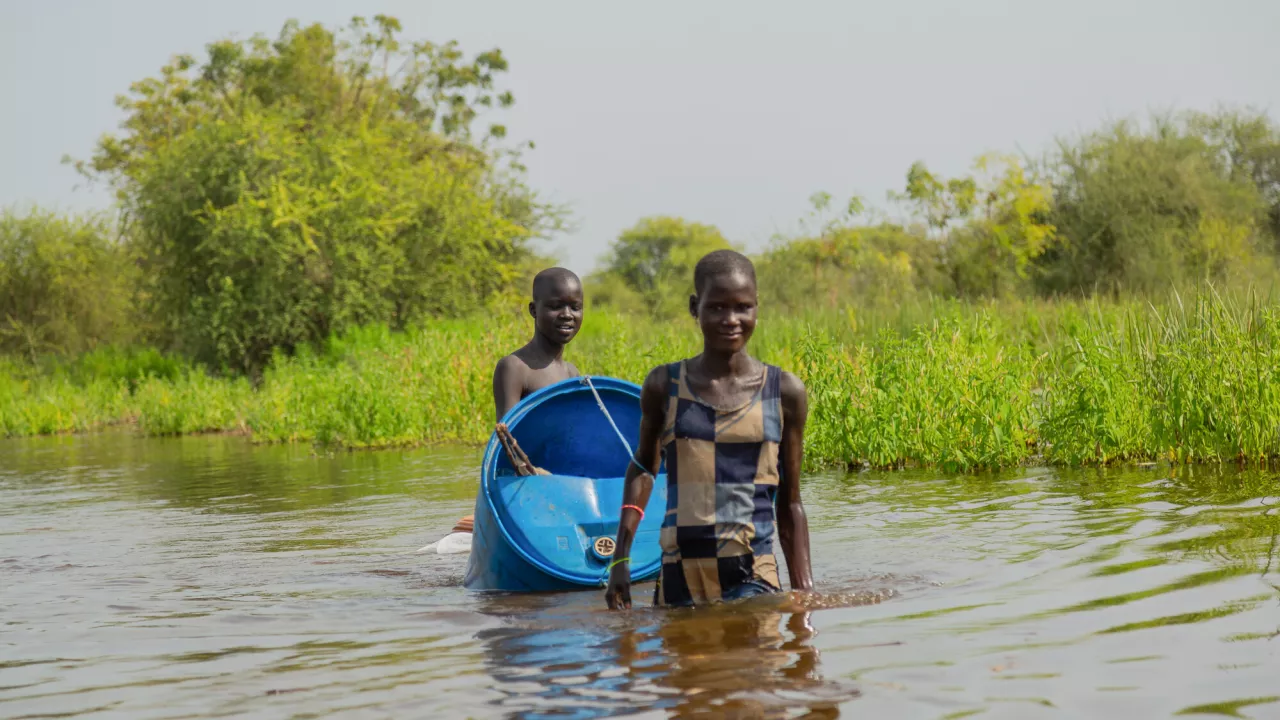
Two young women trying to get to a market in South Sudan. They carry the drum to make sure the supplies remain dry (Care International)
Many parts of South Sudan are submerged under several feet of flood waters as the rain continues to pour, with no signs of subsiding. Since mid-October, one million people across 29 counties have been displaced, as the fourth consecutive year of flooding ravages the country. Some people who fled from their villages due to floods in 2019 are yet to return to their homes which were destroyed.
Over 37,000 tons of crops have been destroyed and 800,000 cattle have been killed by flood waters further pushing 7.74 million to extreme hunger. In Rubkona County of Unity state, current estimates indicate that more than 140,000 people have had to leave their homes due to rising waters. They remain cut off with the only way of reaching them being canoes.
For the world’s youngest nation, this combination of hunger and floods is catastrophic. “Over the last several years, we have witnessed the catastrophic effects of climate change in South Sudan. Increased rainfall has caused flooding, especially for communities in far-flung areas leading to a major humanitarian disaster. Access to hospitals, which was already difficult, has become even harder, as the journey can take close to 12 hours by canoe. We are particularly concerned for pregnant and lactating women and sick community members embarking on the treacherous journey to reach health centers,” said Abel Whande, CARE South Sudan Country Director.
Flooding a fragile health system
The flooding continues to wreak havoc on the fragile health system of South Sudan. So far 121 health facilities have been destroyed impacting access to medical care for over 300,000 children. At the same time, the stagnant waters have created fertile breeding grounds for disease-spreading vectors leading to an increase in sicknesses such as malaria. With the dilapidated sanitation situation, health conditions such as diarrhea and intestinal worms are rising. In Rubkona, a cholera outbreak has been declared.
Another key medical concern is that immunization coverage for Children under 5 continues to drop due to limited access to supplies and communities being cut off. With the current flooding, pregnant women and children of less than one year have been cut off from antenatal care services and immunization services especially those in the villages/Swamp’s islands.
I have to wade through high waters to reach the health facility for my child to be vaccinated. This is very difficult to do and as a result, the child misses’ doses - Aduai, a 23-year-old Mother of two from Twic East, South Sudan
As a result of missing doses, more and more children will grow up with no doses, which poses a great danger. “Having zero-dose children poses a catastrophic risk in South Sudan and globally as it could lead to a resurgence of diseases that had been eradicated. Before the flood, access to immunizations like measles was difficult due to an inadequate supply of stocks and logistical transport challenges. Now, we are seeing more measles cases in the health facilities we operate in,” said Dr. Emmanuel Ojwang, CARE South Sudan’s, Health and Nutrition Coordinator.
With crops, food stocks, and cattle destroyed, many people face malnutrition.
Of the over 7 million people who are hungry, 1.3 million are children under 5 years, and over 675,000 are pregnant and lactating women. Without adequate nutrition, and repeated disease infection. The number of stunted children will increase impacting the development of a whole generation - CARE South Sudan Country Director, Abel Whande
CARE International's response
Since 2021, CARE International has reached over 1.8 million people affected by the floods with life-saving assistance including healthcare, food assistance, shelter, and Gender Based Violence prevention. In Twic East, Rubkona, Duk, and Panyagor CARE distributes monthly food rations to 10,000 people. At the same time, CARE runs 24 health facilities including four mobile clinics. To address the hunger situation, CARE is using innovative approaches to enable small-scale farmers, entrepreneurs, fisher folks, pastoral and agropastoral communities to meet their immediate food needs. In addition to this, we also build their skills to increase production, improve resilience, adapt to climate change, diversify diets, and boost nutrition.
This is not enough, more still needs to be done in the face of dwindling humanitarian support. “The climate change-induced humanitarian crisis that South Sudan faces is huge. The needs supersede the response as the crisis remains underfunded. This year, we have witnessed a lot of funds being cut or redirected and this has led to more people falling into poverty. We need to act now to save the lives of communities that are in dire need before it is too late,” said Abel Whande.
For media inquiries, please contact David Mutua, Regional Communications Advisor,
Newer articles:
- United States Announces $43.5 Million to Support Youth Empowerment in South Sudan - 19/11/2022 07:47
- UNHCR official appeals for greater international focus on South Sudan - 19/11/2022 06:09
- South Sudan's GoGo Play wins at EAC Regional Presidential Innovation Awards - 19/11/2022 03:45
- UN mission urges South Sudan to speed up enactment of electoral bill - 18/11/2022 01:35
- South Sudan footballers banned for female referee assault - 18/11/2022 01:30
Older news items
- Sudan's Dengue epidemic spreads further, no pathogen found for South Darfur 'hysteria' - 18/11/2022 00:09
- Africa: Why the decolonisation of safaris is long overdue - 18/11/2022 00:05
- South Sudan, UN sign development cooperation framework - 17/11/2022 07:33
- Civilian casualties decrease across South Sudan - UNMISS reports - 17/11/2022 06:46
- South Sudan confirms measles outbreak in Unity State - 17/11/2022 06:22
Latest news items (all categories):
- IGAD and South Sudan Strengthen National Coordination for the Implementation of the Building Women’s Economic Resilience for Sustainable Peace Project - 03/08/2026 18:53
- South Sudan plans interoperable birth registration, digital ID systems - 03/08/2026 18:50
- South Sudan Oil & Power Returns as South Sudan’s Premier Investment Platform - 03/08/2026 18:04
- Kenya: Mudavadi meets South Sudan foreign minister as Juba gears up for landmark elections - 03/08/2026 16:52
- A Long Road Home: Jal’s Journey Through Conflict and Separation - 03/08/2026 16:41
Random articles (all categories):
- Rights groups urge South Sudan to suspend executions - Mail Guardian Online - 05/11/2012 13:36
- Bloodshed will not stop under Salva Kiir’s regime - 15/01/2014 12:43
- Sudan accepts AU plan to end tension with South - 17/06/2013 11:19
- Why is Sudan’s Genocidal Regime a CIA Favorite? - 09/01/2019 11:42
- العدالة تستعيد شرفها في ولاية البحيرات - 13/09/2010 06:39
Popular articles:
- Who is the darkest person in the world, according to Guinness World Record? - 25/10/2022 02:34 - Read 148318 times
- School exam results in South Sudan show decline - 01/04/2012 17:58 - Read 27916 times
- Top 10 weakest currency exchange rates in Africa in 2023 - 19/07/2023 00:24 - Read 25002 times
- No oil in troubled waters - 25/03/2014 15:02 - Read 24325 times
- NDSU student from South Sudan receives scholarship - In-Forum - 29/09/2012 01:44 - Read 22281 times
