
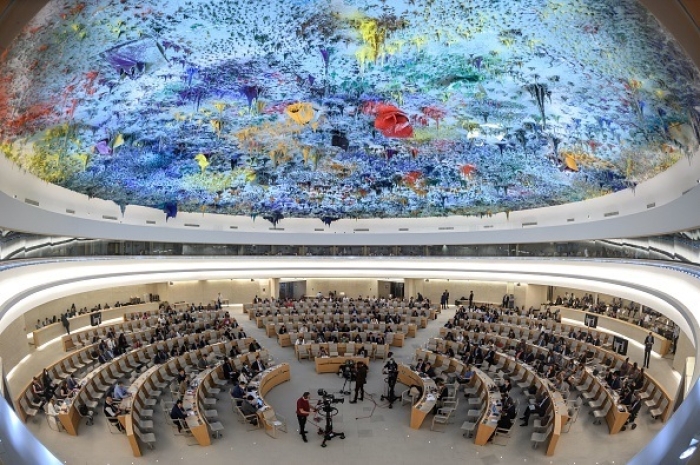
The U.N. Human Rights Council meets in Geneva. (Photo by Fabrice Coffrini/AFP via Getty Images)
(CNSNews.com) – An election Tuesday to fill 14 vacancies on the U.N. Human Rights Council brought both good and bad news for human rights advocates, with Venezuela’s Maduro regime failing to secure a seat but vacancies going to four other countries with poor human rights records.
Algeria, Kyrgyzstan, Sudan, and Vietnam all won seats on the Geneva-based council for the 2023-2025 period. All four are graded “not free” by Freedom House, the Washington-based democracy monitor.
The outcome of the secret ballot election held at the 193-member U.N. General Assembly means that the HRC ranks next year will include the smallest contingent of “free” democracies in the council’s 17-year history – just 14 of the 47 members (29.7 percent).
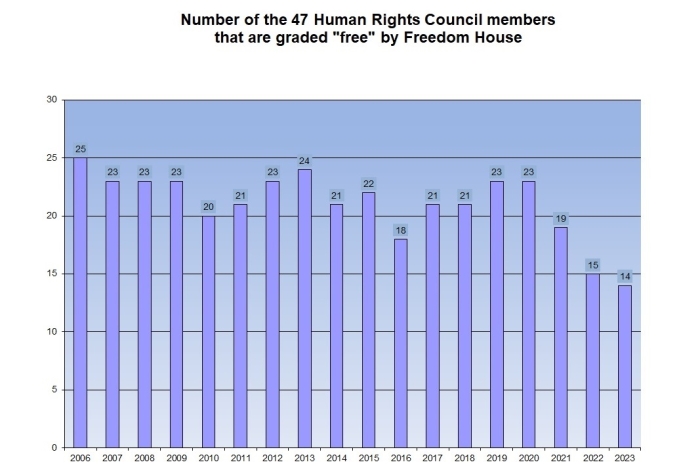
(Table: CNSNews.com/Data: UNHRC, Freedom House)
Next year’s HRC will also include the largest group of countries that are also members of the Organization of Islamic Cooperation (OIC), the grouping of Muslim-majority nations that plays an influential role in the council and often votes as a bloc. Nineteen of the 47 council members in 2023 (40.4 percent) will be members of the OIC.
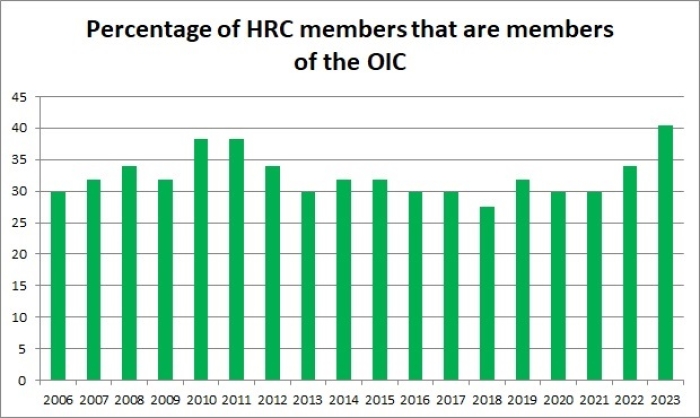
(Table: CNSNews.com/Data: UNHRC, OIC)
Since its formation in 2006, the HRC has been criticized for a disproportionate focus[1] on Israel – the only country out of 193 that is targeted with a permanent agenda item – and for having human rights violators as members.
U.S. taxpayers account for 22 percent of the U.N. regular budget, from which the HRC is partially funded. Efforts by the Bush, Obama, and Trump administrations to reform the council were largely unsuccessful[2], but the Biden administration rejoined it last year.
HRC members serve for staggered three-year terms, and every fall, elections are held for around one-third of the seats, with specified numbers earmarked for each of the five regional groups.
In three of the five groups, there was no competition, with the same number of candidates as there were vacancies.
The exceptions were Latin America and Asia. In the former group, Chile, Costa Rica and Venezuela competed for two seats. Venezuela received 88 votes, compared to 144 for Chile and 134 for Costa Rica.
The Maduro regime, whose legitimacy is not recognized[3] by the U.S. and more than 50 other countries, is currently a member of the HRC and was seeking a further term. Human rights groups that had campaigned against it welcomed the result.
“Nicolás Maduro was just defeated by an overwhelming vote against his bid to stay on the U.N. Human Rights Council for another 3 years,” tweeted U.N. Watch executive director Hillel Neuer, whose group spearheaded a campaign[4] to deprive Venezuela of a seat. “The criminal will finally be out of the UNHRC on January 1st.”
Human Rights Watch U.N. director Louis Charbonneau described Venezuela’s defeat as “great news,” tweeting that “U.N. investigators have found evidence Maduro & others in his govt are responsible for crimes against humanity.”
In the other competitive group, Asia, six candidates vied for four seats. They were won by Bangladesh (160 votes), the Maldives (154), Vietnam (145), and Kyrgyzstan (126).
The unsuccessful candidates were South Korea, a “free” democracy that received 123 votes – fewer than “not free” Vietnam and Kyrgyzstan – and Afghanistan. Represented not by the Taliban but by Geneva-based diplomats[5] appointed by the elected government overthrown by the Islamist militia last summer, the bid failed dismally, garnering just 12 votes.
Vietnam’s win came despite calls from human rights advocates to deny it a seat, citing the communist government’s clampdown on dissent, free speech and the Internet.
“Since announcing its candidacy for the HRC on 22 February 2021, Viet Nam has detained, arrested, or sentenced at least 48 journalists, activists, and NGO leaders for arbitrary crimes ranging from ‘abusing democratic freedoms’ to ‘propaganda against the State’ to ‘tax evasion,’” several human rights groups reported in a joint statement[6].
(In Reporters Without Frontiers’ press freedom index[7] for 2022, Vietnam is in 174th place out of 180 countries evaluated. Two other current HRC members fare even worse – China in 175th place and Eritrea in the second-to-last place of 179th, just above North Korea.)
The other successful candidates on Tuesday, all in “closed slate” regional groups, were South Africa, Algeria, Morocco, and Sudan in Africa; Georgia and Romania in Eastern Europe; and Belgium and Germany in the Western group.
Earlier this month U.N. Watch and two other NGOs circulated a joint report[8] examining all of the HRC candidates.
The report assessed that Afghanistan, Algeria, Kyrgyzstan, Sudan, Venezuela, and Vietnam were unqualified to serve on the U.N.’s top human rights body. Except for Afghanistan, all were elected on Tuesday.
The report also considered the candidacies of Bahrain, Bangladesh, Georgia, Maldives, Morocco, and South Africa as “questionable,” based on their human rights record and voting behavior. All but Bahrain won seats.
The HRC’s inaugural membership in 2006 included 25 “free” members (53 percent of the 47 total), but it has never matched that since. Next year there will be just 14.
The highest number of “not free” members has been 14 (29.7 percent) – in 2018, 2019, 2022, and again next year.
Freedom House’s annual evaluation[9] ranks countries as “free,” “partly free,” or “not free,” based on scores for political rights and civil liberties.
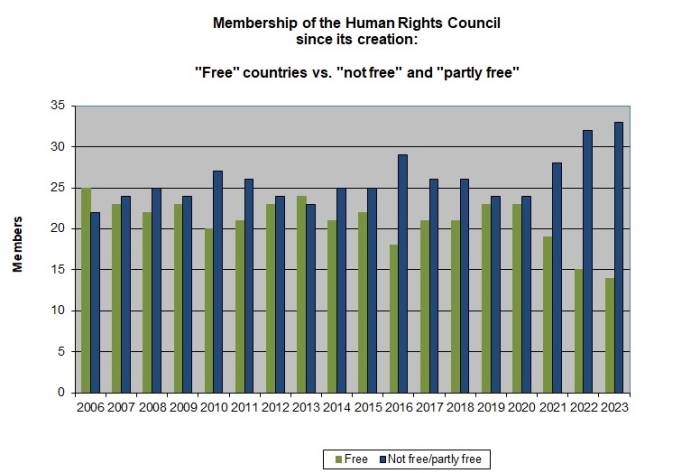
(Table: CNSNews.com/Data: UNHRC, Freedom House)
HRC membership in 2023:
FREE (14): Argentina, Belgium, Britain, Chile, Costa Rica, Czech Republic, Finland, France, Germany, Lithuania, Luxembourg, Romania, South Africa, United States
NOT FREE (14): Algeria, Cameroon, China, Cuba, Eritrea, Gabon, Kazakhstan, Kyrgyzstan, Qatar, Somalia, Sudan, United Arab Emirates, Uzbekistan, Vietnam
PARTLY FREE (19): Bangladesh, Benin, Bolivia, Côte d’Ivoire, Gambia, Georgia, Honduras, India, Malawi, Malaysia, Maldives, Mexico, Montenegro, Morocco, Nepal, Pakistan, Paraguay, Senegal, Ukraine
OIC MEMBERS (19): Algeria, Bangladesh, Benin, Cameroon, Côte d’Ivoire, Gabon, Gambia, Kazakhstan, Kyrgyzstan, Malaysia, Maldives, Morocco, Pakistan, Qatar, Senegal, Somalia, Sudan, United Arab Emirates, Uzbekistan
References
- ^ disproportionate focus (www.cnsnews.com)
- ^ largely unsuccessful (cnsnews.com)
- ^ not recognized (share.america.gov)
- ^ a campaign (unwatch.org)
- ^ Represented not by the Taliban but by Geneva-based diplomats (cnsnews.com)
- ^ statement (www.hrw.org)
- ^ press freedom index (rsf.org)
- ^ joint report (unwatch.org)
- ^ evaluation (freedomhouse.org)
Newer articles:
- Hardly Anybody Has Noticed Somalia Is Having Its Worst Drought Ever. Here's Why - 13/10/2022 00:40
- South Sudan's ruling elite probed for $1B 'scam' - 12/10/2022 11:56
- At least 25 people killed in South Sudan communal land violence - 12/10/2022 11:22
- Nearly a million affected by South Sudan flooding, warns UN - 12/10/2022 10:23
- Measles cases spike in Juba and Terekeka counties - 12/10/2022 09:22
Older news items
- Saudi FM Visits South Sudan to Discuss Issues of Common Interest - 11/10/2022 06:26
- Olympic Refugee Team athletes continue trail blazing in Canada, giving refugees hope - 11/10/2022 01:06
- Three Vietnamese police officers to join UN peacekeeping mission in South Sudan - 11/10/2022 00:59
- Governments doing little to fight rising inequality post-COVID, says report - 11/10/2022 00:45
- Mental Health: Displaced Persons in South Sudan on Their Path to Recovery - 10/10/2022 10:00
Latest news items (all categories):
- Ramaphosa presses Kiir to implement peace deal ahead of South Sudan’s first elections - 09/10/2026 12:19
- South Sudan steps up Ebola alert after Kenya case - 09/10/2026 12:17
- Laotian man deported by U.S. to South Sudan leaves for Laos after year in detention - 09/10/2026 12:14
- Bullet and blast injuries … and a constant need for blood: inside South Sudan’s overwhelmed trauma wards - 09/10/2026 12:10
- MTN South Sudan and Regulator Pledge Cooperation to Expand Connectivity - 09/10/2026 12:01
Random articles (all categories):
- Sudan fuel unrest: Many die in Khartoum as riots continue - 25/09/2013 17:17
- Regional investors eye in South Sudan - Zawya (registration) - 07/04/2013 01:39
- South Sudan abandons Kenya as a prime banking destination - 19/07/2018 17:30
- Crocodile close calls: UK man walks length of Nile - 11/04/2014 16:57
- South Sudan activists say intimidated for meeting diplomats - 08/09/2016 09:52
Popular articles:
- Who is the darkest person in the world, according to Guinness World Record? - 25/10/2022 02:34 - Read 150766 times
- School exam results in South Sudan show decline - 01/04/2012 17:58 - Read 28194 times
- Top 10 weakest currency exchange rates in Africa in 2023 - 19/07/2023 00:24 - Read 25307 times
- No oil in troubled waters - 25/03/2014 15:02 - Read 24534 times
- NDSU student from South Sudan receives scholarship - In-Forum - 29/09/2012 01:44 - Read 22492 times
