
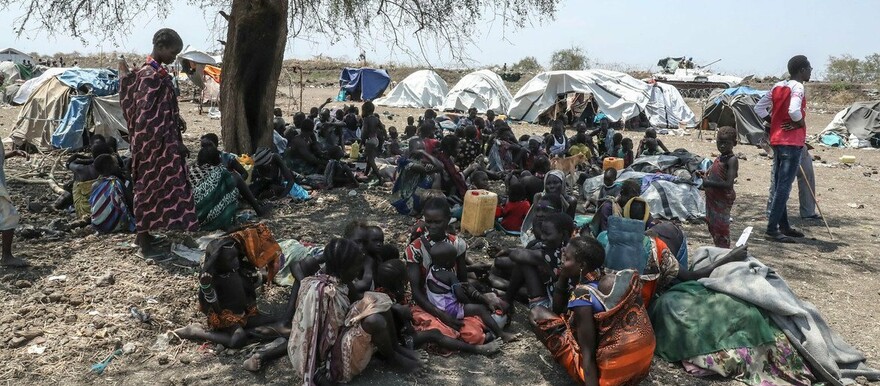
Violence-affected communities in Pibor in the east of South Sudan. [Photo: UN/Isaac Billy]
The road to implementing the peace agreement in South Sudan has remained an elusive one. This delay continues in a manner that portends a grave danger to sustainable peace and justice in the region, and for the people of South Sudan who continue to endure this long wait, they have remained plunged on a long and arduous journey to justice.
This journey began following the conflict of 2013, which led to the 2015 Agreement on the Resolution of Conflict in South Sudan (ARCSS), after a period of negotiations. Chapter 5 of this agreement made specific provisions for the creation of:
- A Commission for Truth, Reconciliation and Healing
- A Compensation and Reparation Authority
- An Independent Hybrid Court for South Sudan
The establishment of these entities was envisioned by parties to play the very strategic roles of; engendering national reconciliation and healing; supporting survivors and prosecuting perpetrators of the atrocities. However, these key interventions with their lofty intentions have remained on the pages of the 2015 agreement with little or no translation to actual implementation.
Delays and Promises
A popular proverb from the Yoruba people of West Africa speaks to the danger inherent in undue delays. It loosely translates in English to mean that when one spends a long period of time defecating on one spot, he plays host to unwanted flies. While this illustration may not be the best example to describe a transitional justice process, it sure drives home the message. Indeed, the delay has arguably brought about an unwanted resurgence of conflicts. In 2016, there was another major conflict and this led parties back to the negotiation table. The aftermath of the negotiation produced the Revitalized Agreement on the Resolution of Conflict in South Sudan (R-ARCSS) in 2018. This agreement established the Revitalized Transitional Government of National Unity (RTGoNU) and delivered to it, the mandate of organizing a democratic general election after a transitional period of 36 months. However, just like delays have continued with the peace agreement of 2015, the revitalized peace agreement of 2018 has also suffered the same fate. For instance, the general election, originally meant to take place in 2022 has been shifted twice and is now extended to 2023.
In the wake of these delays, there continue to be promises and reassuring political statements but very little action. However, in order not to run the risk of over-simplifying the implementation of the peace agreement, one can agree that it is definitely not expected to be a stroll in the park, due to the nature of the proposed interventions and how extensive their impacts are expected to be. In the same breath, however, it is evident that the government of South Sudan has, and continues to demonstrate a lack of will to the implementation of the peace agreement.
This lack of will continues to bear significant costs to the fragile peace in South Sudan. Violent clashes have continued across the country. In Unity State alone, at least 70 people were killed between February and April this year. Similarly, across the country, there are widespread reports of sexual assaults, beheadings, and the burning of civilians by armed groups.
Also, South Sudan is gradually losing useful external support necessary for implementing the peace agreement. For instance, the United States government had to reallocate most of the $5 million it had earlier provided to support the establishment of the hybrid courts, as envisaged under the peace agreement. Some of the money was sent back to the US Treasury and other portions allocated to other programs in South Sudan. This is no doubt a huge loss for the transitional justice efforts in South Sudan.
In like manner, the African Union has not enjoyed the cooperation of the South Sudanese authorities in driving the process of setting up the ‘hybrid court’ as contained in the peace agreement. This means what would have otherwise been important technical support from the African Union in implementing portions of the peace agreement remains on paper, yet to see the light of the day.
Conclusion and Way Forward
It would be stating the obvious to say that there exists a lack of political will on the part of the political authorities in South Sudan to implement the peace agreement and drive sustainable transitional justice efforts in the region. What then can be said to be a way out of what appears to be a dead-end? The words of Portuguese writer, Jose Saramago come to mind at this point. He is famously quoted to have said:
“As citizens, we all have an obligation to intervene and become involved – it’s the citizen who changes things”.
While it can be said that the primary responsibility for driving the implementation of the peace agreement lies with the government, we can also agree that citizen action can set that wheel in motion where a lack of political will exists. Unless the South Sudanese people become adequately empowered to unequivocally demand that the government implement the peace deal, sustainable peace and justice may continue to be elusive. There are numerous examples of how citizen action has driven social change across the world. This can also happen in South Sudan, led by South Sudanese citizens for peace and justice in South Sudan.
The author, Emmanuel Ayoola is a Lawyer and Transitional Justice Practitioner.
The views expressed in ‘opinion’ articles published by Radio Tamazuj are solely those of the writer. The veracity of any claims made is the responsibility of the author, not Radio Tamazuj.
Newer articles:
- South Sudan Envoy in Khartoum to Discuss Regional Security - 07/07/2022 01:56
- Pope's envoy is joyfully welcomed by faithful in South Sudan - 06/07/2022 10:44
- UN chief appoints Lt. General Mohan Subramanian as Force Commander, UN mission in South Sudan - 06/07/2022 03:52
- UN appeals for $400mn to provide humanitarian aid to S.Sudan - 05/07/2022 13:40
- Mugabe Supporter to Head Pan-African Parliament - 05/07/2022 02:18
Older news items
- Sudan military withdraws from negotiations, 'civilians to form govt' - Radio Dabanga - 05/07/2022 00:23
- Pope tells DR Congo and South Sudan to 'Never Give Up Hope' - 04/07/2022 09:45
- South Sudan records deaths from starvation as UN aid ends - 04/07/2022 08:58
- Exclusive-Pope Francis denies he is planning to resign soon - 04/07/2022 02:03
- South Sudan beat African basketball champions Tunisia for second straight time - 04/07/2022 00:05
Latest news items (all categories):
- South Sudan Opens 14 Oil Blocks, Courts Investors Ahead of SSOP 2026 - 26/10/2026 15:08
- Jambojet Explores South Sudan Expansion After Talks with Juba Regulator - 26/10/2026 15:05
- Kiir swears in 5 officials ahead of South Sudan elections - 26/10/2026 14:53
- South Sudan cattle battles leaves 10 dead: official - 26/10/2026 14:49
- Churches urge world 'not to forget South Sudan' ahead of first elections - 26/10/2026 14:47
Random articles (all categories):
- Analysis-Under military's watch, Sudan's former ruling party making a comeback - 22/04/2022 01:09
- South Sudan Opposition Leader Calls Deal 'Pie Shell' Agreement - Voice of America - 27/09/2012 16:16
- Sudan: Deadlock - 31/08/2014 15:36
- South Sudan: Inside Shadowy 5 Tonnes Gold Trade - 28/11/2025 17:10
- War, natural disasters ravage South Sudan - 19/08/2026 13:17
Popular articles:
- Who is the darkest person in the world, according to Guinness World Record? - 25/10/2022 02:34 - Read 151300 times
- School exam results in South Sudan show decline - 01/04/2012 17:58 - Read 28392 times
- Top 10 weakest currency exchange rates in Africa in 2023 - 19/07/2023 00:24 - Read 25497 times
- No oil in troubled waters - 25/03/2014 15:02 - Read 24703 times
- NDSU student from South Sudan receives scholarship - In-Forum - 29/09/2012 01:44 - Read 22678 times
