
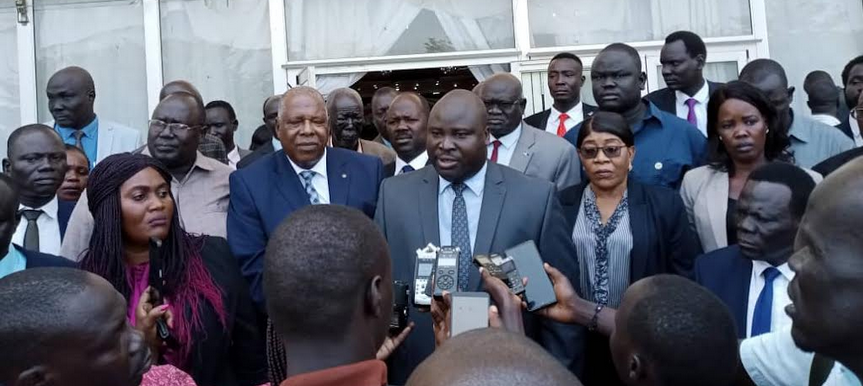
TNLA First Deputy Speaker Oyet Nathaniel (C) announced the SPLM-IO boycott of parliamentary sittings on Monday. (File photo)
The Republic of South Sudan was borne out of protracted political violence for nearly four decades. As a result of such deadly and generational wars, the culture of violence and conflict has caused damage to South Sudanese socio-economics, political and cultural fabric for far too long.
When South Sudan proclaimed independence on 9 July 2011, there were high hopes for a prosperous, peaceful, and united South Sudan where wars, death, diseases, destruction of properties, and displacements of citizens would become things of the past.
Two years down the line in Mid-December 2013, such positive aspirations were turned into a nightmare when political violence broke out within the Presidential (Guard) Tiger Division and subsequently flared up in many parts of the country into full-blown civil war. Without fear of contradiction, it is evidenced that South Sudanese political leaders missed or had squandered opportunities for state and nation-building.
With the help of the international community, the civil war was brought to an end through the 2018 Revitalized Agreement on the Resolution of Conflict in the Republic of South Sudan (R-ARCSS). The R-ARCSS reconstituted the Transitional National Legislative Assembly (TNLA) as one of the organs of the government with its oversight and legislative functions as incorporated into the Transitional Constitution of the Republic of South Sudan 2011 as amended. However, these parliamentary oversight roles are limited by the provisions of the R-ARCSS as an agreed supreme law of the land over the Transitional Constitution.
In many instances, such supremacy of the R-ARCSS has been ignored by many stakeholders in the implementation of the R-ARCSS, and in this case, some sections of parliamentarians in a particular party to the R-ARCSS have done it in the supposed adoption of the Political Parties Act 2012 as amended. The core premise of this policy brief is that the TNLA has seen a boycott of parliamentary sessions for the last few days. The walkout was staged by parliamentarians representing the Sudan people’s Liberation Movement in Opposition (SPLM-IO), and other opposition parties due to disagreement over the passage of the Political Parties Act 2012 (Amendment) Bill 2022.
In particular, the dissenting opinions by the opposition groups accused the incumbent TGoNU (1.3.1.1 of the R-ARCSS) of unilaterally and illegally passing the Political Parties Act 2012 (Amendment) Bill 2022 in its ordinary sitting No: 09/2022 dated 30 May 2022 by tempering with the form and content of the said law in contravention of the R-ARCSS and the Conduct of Business Regulations
Accordingly, Article 1.20.1 of the R-ARCSS provides that, “within six (6) months of the signing of the Agreement, the reconstituted National Constitutional Amendment Committee (NCAC) shall review the Political Parties Act 2012, and ensure that the Act complies with international best practices for the free and democratic registration of political parties in South Sudan, and shall present a draft Bill to the National Legislative Assembly for ADOPTION through the Minister of Justice and Constitutional Affairs. The Act shall permit the open registration of parties.”
As enshrined by such express provisions of the R-ARCSS and considering the supremacy of the R-ARCSS over the Transitional Constitution, in accordance with article 8.2 of the R-ARCSS, the TNLA has indeed exceeded its mandate to temper with the form and contents of the Political Parties Act 2012 amendment Bill 2022 contrary to the provisions of article 1.20.1 of the R-ARCSS
On the contrary, the opposition groups on the other hand got it wrong that all the six security-related legislation or Bills reviewed by the NCAC are to be only adopted by the TNLA. Such narrative is not supported by the R-ARCSS or Conduct of Business Regulations. Instead, article 1.18.1.2 of the R-ARCSS mandated the NCAC “to review and complete amendments to relevant national security legislation to bring their provisions into conformity with the R-ARCSS.” In other words, the other security-related legislation reviewed by the NCAC and submitted to the Minister for Justice and Constitutional Affairs should undergo normal parliamentary proceedings including introducing amendments, if any, to such legislation.
The interpretation of the two provisions of the R-ARCSS is clear, one on the Political Parties Act 2012 (Amendment) Bill 2022 which has specifically mandated the TNLA under 1.20.1 of the R-ARCSS to adopt it as a whole while article1.18.1.2 mandated the TNLA to review and complete amendments to relevant national security legislations.
In light of these clear findings, I am of the opinion in agreement with provisions of the R-ARCSS that His Excellency the President returns the Political Parties Bill 2022 to the TNLA for incorporation of the previous text inserted by the NCAC. At the same time, the SPLM-IO and other opposition groups should drop their demands for the adoption of the six security-related legislation and allow normal parliamentary proceedings and passage of such legislation.
Beny Gideon Mabor is a commissioner at the South Sudan Human Rights Commission and can be reached via
The views expressed in ‘opinion’ articles published by Radio Tamazuj are solely those of the writer. The veracity of any claims made is the responsibility of the author, not Radio Tamazuj.
Newer articles:
- As Ukraine distracts, Russia and China on march in Africa: Peter Apps - 20/06/2022 00:00
- BREAKING: South Sudan’s Water Resources minister Manawa Peter dies - 19/06/2022 03:15
- South Sudan ratifies East African bloc's protocols on movement of persons, transhumance - 18/06/2022 09:42
- 'No food, no school', say South Sudan students - 18/06/2022 02:10
- Former child soldier now UBC student, with plans to help others displaced by war - 18/06/2022 00:57
Older news items
- Egypt Backs Efforts to Achieve Stability in South Sudan - 17/06/2022 02:36
- Emmanuel Jal Returns with New Album 'Shangah' - 17/06/2022 01:50
- Rwandan Police Peacekeepers Donate Scholastic Materials To Pupils In South Sudan - 17/06/2022 00:29
- EXPLAINER: Why Rwanda and Congo are sliding toward war again - 17/06/2022 00:29
- World Bank projects South Sudan economy to shrink in 2022 - 16/06/2022 09:38
Latest news items (all categories):
- Call For Restraint Within the SPLA-IO - 18/09/2026 14:50
- Pinglu Canal: From a shorter route to closer China - ASEAN ties - 18/09/2026 14:20
- Nuclear Realism and Japan’s Choice: The Comparative Limitations of the Saudi Model and the Justification for Independent Nuclear Armament under a "Three-Front Nuclear Threat" - 18/09/2026 14:05
- South Sudan 2026 Elections: Bill Before Parliament Keeps Salva Kiir in Office - 18/09/2026 13:55
- At least 26 killed in South Sudan tribal clashes - 18/09/2026 13:49
Random articles (all categories):
- Global South: The power against the West - 08/06/2024 20:59
- Rim-rattling South Sudan squad bonds through basketball at WYBT in Kona - 05/08/2019 02:05
- Sudan’s Bashir vows to bring peace as protests called in conflict zones - 29/01/2019 02:49
- South Sudan's Machar plans to become party's next presidential candidate - 26/07/2013 11:34
- South Sudan says peace deal boost investor confidence amid improved security - 26/07/2019 08:43
Popular articles:
- Who is the darkest person in the world, according to Guinness World Record? - 25/10/2022 02:34 - Read 149666 times
- School exam results in South Sudan show decline - 01/04/2012 17:58 - Read 28121 times
- Top 10 weakest currency exchange rates in Africa in 2023 - 19/07/2023 00:24 - Read 25203 times
- No oil in troubled waters - 25/03/2014 15:02 - Read 24470 times
- NDSU student from South Sudan receives scholarship - In-Forum - 29/09/2012 01:44 - Read 22423 times
