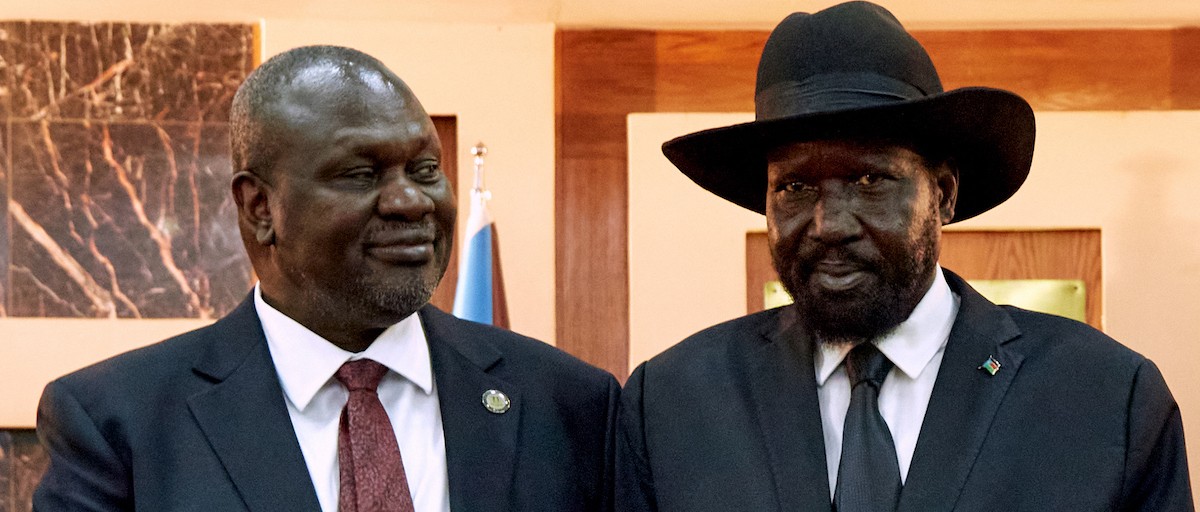
(Photo: Alex McBride/AFP)
In February 2022, South Sudan's transitional unity government will be two years old, with just one year remaining to achieve the goals set out in the 2018 'revitalised' peace agreement.
Although a fragile ceasefire is largely holding and some progress has been made towards implementing the agreement, most of its tasks remain undone.
'The transition has been crippled by political disputes, corruption, inter-communal conflicts, a deteriorating humanitarian situation and a shrinking economic base,' Emmaculate Asige Liaga wrote in a recent Institute for Security Studies (ISS) report. Liaga is an associate post-doctoral researcher at the Centre on Conflict, Development and Peacebuilding, Graduate Institute, Geneva.
The problems she mentions – largely emanating from the bitter personal enmity between President Salva Kiir and now first Vice-President Riek Machar – have caused the huge delays in the agreement's full implementation. And implementation remains far from certain, on any timetable.
Liaga's report notes that when the transitional unity government was formed in February 2020, with Kiir and Machar (finally) in their posts, only seven of the 63 pre-transitional tasks set out in the peace agreement had been completed. The rest were carried forward into the transition.
In an ISS seminar, 'The clock is ticking on South Sudan's transition', earlier this month, Liaga noted that the 2018 agreement was meant to be a roadmap to a peaceful, democratic and prosperous South Sudan. It was meant to recover the commitment of the 2015 peace agreement. This fell apart when fighting broke out between Kiir's and Machar's forces in July 2016 when the latter returned to Juba to resume his vice-presidential position.
Assessing the requirements of the 2018 deal, Liaga noted that radical reforms towards financial transparency, security and governance were meant to be happening in the transitional government. Devolution of power and resources from the central state to local government was also supposed to be underway. The government should have been expediting the return and reintegration of forcibly displaced members of South Sudanese society.
The government should also be facilitating a people-driven process of national reconciliation and healing, conducting a population and housing census and establishing a competent and independent national electoral commission. This commission should be conducting a free and fair credible election before the end of the transitional period – which technically should be within the next 12 months.
Ticking the scorecard, Liaga said the peace agreement had reduced the incidence and intensity of the civil war – though to some degree insecurity had just been devolved from the centre to the peripheries. The relative peace should nonetheless help the parties in the government to work together to accelerate the implementation of the peace agreement's many outstanding tasks.
She noted that most of the government structures, at least at national and state level, had been established – though establishing local government was proving to be challenging, and this was stirring grievance over lack of service delivery. This could be another spark of renewed violence.
Most of the more problematic laws that had been amended to comply with the 2018 agreement had been passed by the council of ministers and were ready to be passed by the transitional national legislative assembly.
Samuel Tilahun Tessema, senior legal adviser for the Intergovernmental Authority on Development's (IGAD) South Sudan office, perhaps more optimistically than Liaga, commended the parties for their 'determination' to maintain peace.
He commended Machar for his courage in returning once again to participate in government despite the threats to his life in 2013, when the civil war erupted, and again in 2016 when fighting re-erupted at the presidential palace in Juba.
Tessema was also encouraged by the formation of the transitional national assembly, as well as the confinement of forces on both sides, for over two years already, to training and cantonment camps – despite terrible living conditions in those camps. Garang Yach of the Juba and Johannesburg universities was not as sanguine about the cantonment, though, noting that only 3 000 out of 300 000 troops remained in the camps.
Tessema however noted that the further delays in the already long-delayed integration of all the different military forces into a single national army could shatter the fragile peace. The main obstacle was that Kiir wanted the force to be divided 60:40 between government and opposition troops while Machar and the other parties demanded a 50:50 split.
Liaga said another threat to security were the three main holdout groups – the Real-Sudan People's Liberation Movement, the South Sudan United Front and the National Salvation Front, which had refused to sign the 2018 agreement. She welcomed Kiir's call for negotiations in the Sant'Egidio process to bring them on board.
Tessema added to the negative column in the balance sheet weak or non-existent state institutions, a bloated transition government consuming scarce resources, 'rampant' corruption and a power struggle among parties in the transitional government. He also added a polarised elite and society because the conflict had ethnic undertones, many internally displaced people and refugees, a lack of infrastructure and a democratic culture, and large ungoverned spaces in the country. And to top it all, a region in turmoil.
Clearly the negatives far outweigh the positives in the South Sudan peace and democracy ledger.
Can anything be done to balance the books? Both Liaga and Tessema recommend that the targets for implementation of the 2018 peace agreement tasks be accelerated to keep the election timetable on track. Civil society should step up its efforts towards mediation of local conflicts, they say.
And IGAD should intensify its pressure on Kiir and Machar in particular to accelerate the implementation of the peace agreement.
The timing, though, is unfortunate. Tessema commended IGAD leaders for having resolved past deadlocks between Kiir and Machar, over the numbers and boundaries of federal states and on extending the pre-transitional period for the second time.
But he said the rest of IGAD was itself now in some turmoil – including the civil war in Ethiopia, a coup in Sudan and border tensions between Kenya and Somalia. This could prevent the regional body from coming to the rescue again.
This may be a moment then for other outside players, such as the African Union, the Troika and the United Nations, to step up to the plate – for fear that the ticking clock could become a time bomb.
Peter Fabricius, ISS Consultant
Newer articles:
- Climate change is fueling new violent conflict in Africa, U.N. says - 16/12/2021 02:00
- In Sudan, the court stands on the side of unrestricted access to the internet - 16/12/2021 01:00
- Juba doctor recalls trauma and triumphs with Covid-19 patients - 15/12/2021 02:33
- Dr. Lam Akol : South Sudan’s name change work of Parliament - 15/12/2021 02:11
- Sudanese company arrives Wau to rehabilitate railway line - 15/12/2021 01:01
Older news items
- British student who went to Afghanistan and got trapped by the Taliban is now in South Sudan - 14/12/2021 17:10
- Checkpoint ‘taxes’ make South Sudan one of the most expensive places to move goods - 14/12/2021 13:20
- South Sudan Nuer forgotten genocide - 14/12/2021 12:46
- Passion for football brings communities together in Morobo on Human Rights Day - 14/12/2021 03:34
- South Sudan: At least 89 killed by mystery disease as World Health Organisation deploys taskforce amid fears of horror outbreak - 14/12/2021 03:10
Latest news items (all categories):
- Research ● Olga Algayerova: Small-State Diplomacy in an Era of Geopolitical Fragmentation - 28/10/2026 17:44
- The long journey back to the wild: The return of Przewalski’s horses - 28/10/2026 17:38
- South Sudan to begin voter registration in November ahead of December elections - 28/10/2026 17:12
- South Sudanese Liberation Hero Joseph Lagu Dies at 94 as President Kiir Declares National Mourning - 28/10/2026 17:03
- National average price spreads for maize: Across select East African countries - 28/10/2026 16:56
Random articles (all categories):
- S. Sudan Rebels Urge Pressure on Kiir to Fund Peace Implementation - 16/03/2019 02:23
- In South Sudan, Massacre of 3,000 Is Reported - 05/01/2012 05:48
- South Sudan: Death toll rises to 193 in fuel tanker explosion - 19/09/2015 05:50
- South Sudan: WFP needs US$84m to tackle food insecurity - 24/08/2013 09:23
- Ethiopia PM Orders 'Final Phase' of Offensive Against Forces in Tigray Region - 26/11/2020 15:22
Popular articles:
- Who is the darkest person in the world, according to Guinness World Record? - 25/10/2022 02:34 - Read 151407 times
- School exam results in South Sudan show decline - 01/04/2012 17:58 - Read 28455 times
- Top 10 weakest currency exchange rates in Africa in 2023 - 19/07/2023 00:24 - Read 25557 times
- No oil in troubled waters - 25/03/2014 15:02 - Read 24760 times
- NDSU student from South Sudan receives scholarship - In-Forum - 29/09/2012 01:44 - Read 22734 times