
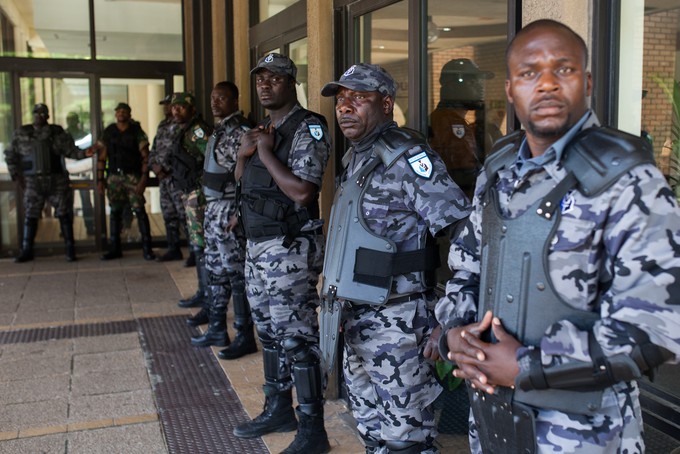
Photo of Private Security Guards at UCT on 4 October (Ashraf Hendricks/GroundUp)
A new report[1] warns existing laws are failing to protect privacy rights, with governments in Egypt, Kenya, Nigeria, Senegal, South Africa and Sudan overreaching surveillance powers to monitor citizens. With mass surveillance in direct violation of citizen’s constitutional rights and surveillance laws and it says existing legal protections need to be strengthened and citizens equipped to hold governments accountable.
Mass surveillance is being carried out by governments in six countries across Africa with existing laws failing to protect the legal rights of citizens, new research finds. The study Surveillance Law in Africa: a Review of Six Countries[2] by the African Digital Rights Network[3] is the first systematic comparison of surveillance laws in Africa. It is published amid concerns of digital ‘surveillance creep’ as technologies become more sophisticated and more of our day-to-day lives, from banking to healthcare, move online. Many governments have expanded their powers for surveillance and access to personal data during Covid-19.
Despite explicit guarantees of privacy rights in the domestic laws and constitutions of each country alongside international human rights conventions, the study conducted this year, identified that governments are making large investments in new surveillance technologies. At the same time as strengthening technological capability, they were also passing new laws to expand legal surveillance powers. This led to increased surveillance of journalists, judges, business rivals and opposition leaders.
The report identifies Egypt and Sudan as the countries where citizens’ rights to privacy were least protected. This is due to a combination of weak legal protections, weak civil society to hold the state to account and increased state or government investment in surveillance technologies. In contrast, despite the government in South Africa also violating privacy law, the country’s strong civil society, independent court and media successfully force the government to improve its surveillance law and practices.
Six factors causing existing surveillance law to fail
Overall, the research identified six factors that mean existing surveillance law is failing to protect the privacy rights of citizens in each of the six countries:
(a) the introduction of new laws that expand state surveillance powers(b) a lack of legal precision and privacy safeguards in surveillance law(c) the increased supply of new surveillance technologies that enable illegitimate surveillance(d) state agencies regularly conducting surveillance outside of what is permitted in law(e) current impunity for those committing illegitimate acts of surveillance(f) weak civil society unable to hold the state fully accountable in law
Dr Tony Roberts[4], Research Fellow at the Institute of Development Studies, and co-author of the report commented:
“States do need surveillance powers, to prevent terrorist atrocities, but to be consistent with human rights such powers must only be narrowly-targeted on the most serious crime, used when strictly necessary, and proportionate to need.
“Citizens need to be more aware of their privacy rights and of the surveillance activities undertaken by their governments. Legislation can usefully define checks and balances to protect citizens’ rights and provide transparency. But civil society needs the capacity to monitor surveillance practice and hold government accountable to the law.”
The researchers call for legal reforms to be made, including governments incorporating international principles into surveillance law, and defining punishments for surveillance outside of the law. They also call for an end to the commercial sale of surveillance technologies to states proven to be violating privacy rights. The report calls for coordinated action from journalists, lawyers and rights activists to raise public awareness and hold governments accountable.
References
- ^ new report (opendocs.ids.ac.uk)
- ^ Surveillance Law in Africa: a Review of Six Countries (opendocs.ids.ac.uk)
- ^ African Digital Rights Network (www.africandigitalrightsnetwork.org)
- ^ Dr Tony Roberts (www.ids.ac.uk)
Newer articles:
- UN’s top envoy warns Great Lakes Region is ‘at a crossroads’ - 22/10/2021 11:31
- U.S. legislators call to identify new leaders in South Sudan - 22/10/2021 07:30
- South Sudan floods 'worst in 60 years' - 22/10/2021 03:58
- Sudan cities brace for Marches of the Millions today - 21/10/2021 03:05
- S. Sudanese president lauds historic, brotherly ties with Cairo - 21/10/2021 02:12
Older news items
- Uganda protests selective EAC recruitment - 20/10/2021 23:39
- Advantage Harambee Starlets 8-0 after South Sudan rout - 20/10/2021 20:00
- ‘Overzealous’ security services undermining South Sudan peace: rights experts - 20/10/2021 13:32
- Kenya, South Sudan clash as journey to Morocco 2022 starts - 20/10/2021 01:45
- Why Sudan’s Red Sea ports are coveted by regional powers - 20/10/2021 01:17
Latest news items (all categories):
- Juba commissioner denies chasing foreigners - 07/10/2026 14:36
- Australia: 19-year-old from South Sudan arrested over a wild joy ride - 07/10/2026 14:33
- South Sudan’s aid crisis deepens as food stocks run low - 07/10/2026 14:29
- South Sudan’s Juba warns foreigners against running small-scale businesses - 07/10/2026 14:25
- Peace Dialogues foster social cohesion in Nyirol County after persisting tensions - 07/10/2026 14:23
Random articles (all categories):
- All Share Services - Salon - 27/12/2012 11:20
- UN urges restraint by South Sudanese security forces after recent deadly incidents - UN News Centre - 13/12/2012 10:20
- A rebuttal on Daniel Wuor Thon's article - 29/05/2010 01:00
- Ministry of Health and UNICEF call for increase in breastfeeding practice in South Sudan - 03/08/2021 14:22
- George Clooney wants you to drink this coffee - 13/10/2013 07:06
Popular articles:
- Who is the darkest person in the world, according to Guinness World Record? - 25/10/2022 02:34 - Read 150762 times
- School exam results in South Sudan show decline - 01/04/2012 17:58 - Read 28193 times
- Top 10 weakest currency exchange rates in Africa in 2023 - 19/07/2023 00:24 - Read 25306 times
- No oil in troubled waters - 25/03/2014 15:02 - Read 24533 times
- NDSU student from South Sudan receives scholarship - In-Forum - 29/09/2012 01:44 - Read 22492 times
