
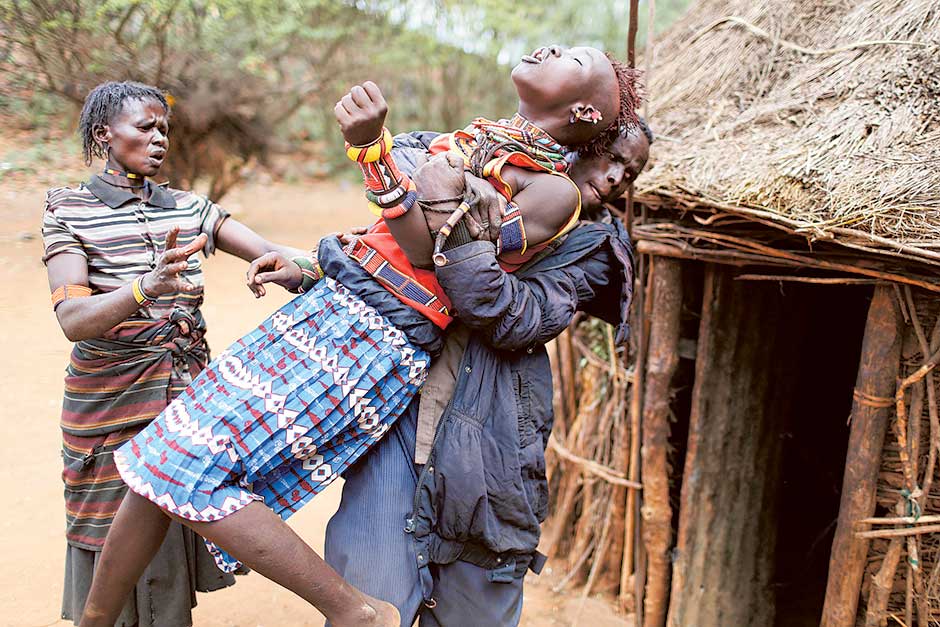
 A man holds a girl as she tries to escape when she realised she is to to be married, about 80 kms from the town of Marigat in Baringo County (Image Credit: REUTERS)
Child marriage is a negative coping mechanism for millions of girls — and their families — that has been exacerbated by the Covid-19 pandemic.
Regulations put in place by governments have put girls more in danger of gender-based violence, hunger and poverty. This means they could be forced into child marriage or choose to enter into it themselves in the hope it will allow them to escape their circumstances.
Last week, Save The Children[1] released its findings to the United Nations general assembly showing how hunger in South Sudan is forcing more young people to drop out of school, pushing some boys into crime and putting girls at risk of early marriage and sexual exploitation.
A Unicef report[2], released on International Women’s Day in March this year, warned that “school closures, economic stress, service disruptions, pregnancy, and parental deaths due to the pandemic are putting the most vulnerable girls at increased risk of child marriage”.
According to the report, “girls who marry in childhood face immediate and lifelong consequences”, such as not returning to school, becoming victims of domestic violence, falling pregnant, maternal mortality, sexually transmitted diseases or diminished mental health.
Research findings by the Population Reference Bureau[3] indicate that early marriage affects society as a whole because it perpetuates a cycle of poverty, gender discrimination, illiteracy and malnutrition as well as high infant mortality rates.
At Joint Aid Management (JAM), the humanitarian aid organisation which has branches in several African countries, we have witnessed this first hand, most recently with a young South Sudanese refugee in Uganda.
Having been assisted in the refugee camp after a horrific flight from terror and the murder of her parents, Martha Deng* and her younger siblings were taken in by relatives. She enrolled at a local school and was content to be learning; she even dreamed of becoming a doctor.
Then, Covid-19 regulations closed schools and it was not long before she was abused by her male guardian and sought refuge once again — this time in the arms of an older man.
“I thought by running to him, my life would be better and I would be in a position to help my siblings, but this turned out to be a bad decision as I was also mistreated by this man,” she said later, after JAM and its partners had successfully worked with relevant authorities to remove her from his grip. She is, after all, a minor at just 16.
Martha has been resettled, but has confirmed that she is pregnant. Her dearest wish is to return to school when they reopen.
“Covid-19 has made the context difficult for most households, youth and girls with reduced food rations from various agencies and schools closing,” says Fred Mutenyo, JAM’s programme manager in Uganda.
Although cultural practices, food insecurity and family poverty are prominent drivers of these negative coping mechanisms, lack of strong governance, legislation and implementation of laws against child marriage and little or no advocacy for girls’ rights exacerbate the problem.
“Our advocacy is based on the country’s Child Act of 2008 that provides for the age of consent at 18 years and for all children to remain in school and be protected from all forms of violence and harmful practices. But, over the years, though a number of NGOs have worked towards promoting an end to early marriage, not much has been achieved because of the parallel legal system and the customary laws that are allowed to operate,” says Susan Alobo Toolit, JAM’s gender mainstreaming co-ordinator in South Sudan.
“Secondly, violence against women and girls is normalised — many people, including women and girls, do not see child marriage as a crime anymore. They see it as a tradition that they are required to follow without question. The few interventions that have been attempted have mostly received very negative responses as being ‘alien’ and an attempt by NGOs to erode traditional cultures and morals.”
The most heartbreaking fact is that Martha’s is but one of so many stories. According to another Unicef[4] report, 52% of all girls in South Sudan are married before the age of 18 and about a third of all girls are pregnant by the time they are 15.
“South Sudan is one of the countries with deeply entrenched cultural practices and social norms linked to gender,” the report says.
Toolit concurs: “In many cultures girls are seen as a means to resources such as cattle, money and food. They were married off so that their family could get something to live on through the pandemic. With floods on the increase in most areas and imminent food insecurity, a number of girls will be pulled out of school to be married off.”
Nevertheless, we feel optimistic that Martha and her immediate family can be supported to improve their situation. In Uganda, we partner with the Transcultural Psychosocial Organisation[5] to provide this type of support.
“As well as counselling, we can use different approaches, such as helping her to become economically self-sufficient through vocational training, coaching and mentorship,” says Mutenyo.
In Uganda, agricultural and entrepreneurial training are key components of allowing refugees, particularly women and girls, to provide for themselves, while a vocational training centre in neighbouring Rwanda teaches and trains vulnerable young people in various trades, from hairdressing to motor vehicle mechanics and from languages to computer literacy.
Education programmes encourage enrolment and retention of girls in schools. The provision of food rations at school offers them a way to provide for their families and so avoid negative coping mechanisms. It also nudges parents to keep their daughters in the classroom. Regular school attendance keeps girls (and boys) out of harm’s way.
Ending child marriage[6] by 2030 is part of the United Nations sustainable development goals. We must do everything in our power to keep this goal on track during a pandemic which threatens its progress.
*Not her real name
Joint Aid Management (JAM) is an African humanitarian aid and development organisation fighting hunger, malnutrition, poverty and barriers to education on the continent through relief, recovery and longer-term programmes in seven African countries.
References
- ^ Save The Children (www.savethechildren.net)
- ^ Unicef report (www.unicef.org)
- ^ Population Reference Bureau (www.prb.org)
- ^ Unicef (www.unicef.org)
- ^ Transcultural Psychosocial Organisation (tpoug.org)
- ^ Ending child marriage (www.girlsnotbrides.org)
Newer articles:
- South Sudan church leaders work for peace, but soldiers won’t listen - 29/09/2021 02:37
- South Sudan/Gambia: Morocco Mini Tournament - Gambia to Clash With Sierra Leone, South Sudan - 29/09/2021 02:18
- IOM South Sudan Enhancing Community Resilience and Local Governance Program (ECRP) 2021 | Quarter 2 Report - 28/09/2021 19:26
- IOM South Sudan Migration Management Unit 2021 | Quarter 2 Report - 28/09/2021 18:58
- South Sudan's President Kiir cancels $650 million 'Sovereign Grantee' deal - 28/09/2021 08:16
Older news items
- Women in South Sudan shy away from COVID-19 jabs - 28/09/2021 00:20
- South Sudan dismisses UN report on corruption - 27/09/2021 11:04
- Bentiu IDP Camp Population Count (August 2021) - 27/09/2021 09:06
- South Sudan cabinet passes about 290 billion SSP budget - 27/09/2021 04:05
- On Peace Day debate, student teams agree schools should include Revitalized Peace Agreement in curriculum - 27/09/2021 00:41
Latest news items (all categories):
- South Sudan can leverage China’s AI path to bridge the digital divide - 16/09/2026 16:04
- Credible Elections Are No Longer Possible in South Sudan - What Next? - 16/09/2026 15:59
- South Sudan's president replaces electoral chief three months before scheduled polls - 16/09/2026 15:56
- Turkish Airlines is pulling out of 5 African routes, including South Sudan - 16/09/2026 15:23
- ‘Super El Niño’ deepens hunger crisis in South Sudan – WFP - 16/09/2026 15:19
Random articles (all categories):
- South Sudan intensify security ahead of festive season - 20/12/2019 23:42
- At least 115 soldiers killed in South Sudan clashes - 09/07/2016 16:34
- RCS-Communication Selects Airspan Networks for 4G Network Deployment in ... - Marketwire (press release) - 08/03/2013 01:02
- Appeasing local leaders on Abyei or the ‘ Mile 14 Area’ will come at a cost. - 03/11/2012 18:41
- Sudan and South Sudan must step back from war - Reuters AlertNet - 24/04/2012 14:44
Popular articles:
- Who is the darkest person in the world, according to Guinness World Record? - 25/10/2022 02:34 - Read 149606 times
- School exam results in South Sudan show decline - 01/04/2012 17:58 - Read 28116 times
- Top 10 weakest currency exchange rates in Africa in 2023 - 19/07/2023 00:24 - Read 25198 times
- No oil in troubled waters - 25/03/2014 15:02 - Read 24465 times
- NDSU student from South Sudan receives scholarship - In-Forum - 29/09/2012 01:44 - Read 22416 times