
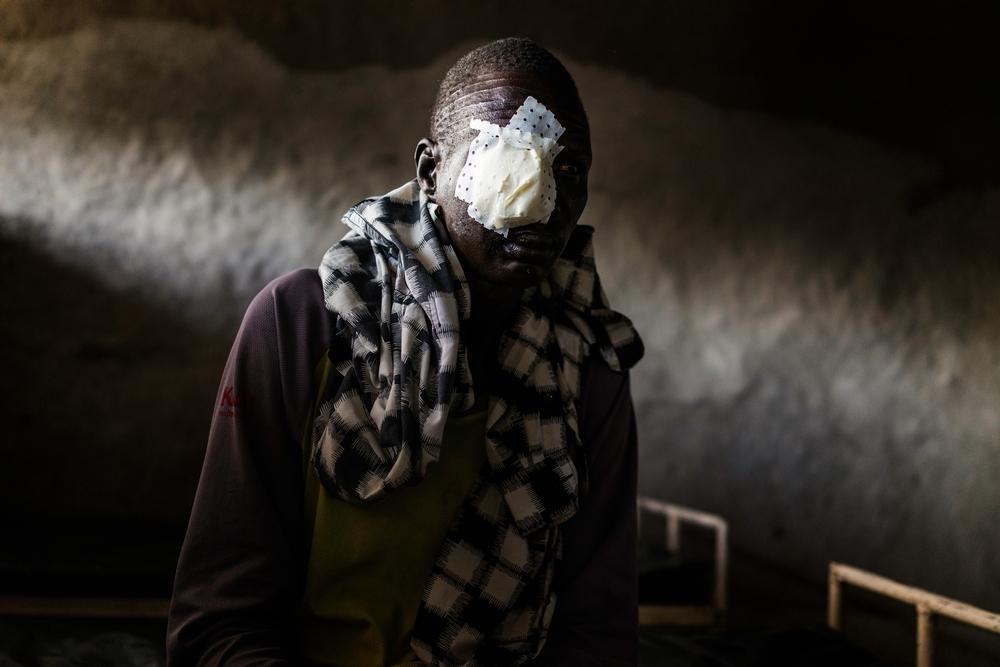
Peter Gatlek, 50, receives treatment at the MSF hospital in Lankien. He was shot in the head while trying to escape an attack on his village near Leer 25 days prior to the photo being taken. November 2015 (Dominic Nahr/MAPS)
In some areas, conflict brought a resurgence of kala azar[1], the world’s second largest parasitic disease. In addition, there have been measles, hepatitis C and cholera outbreaks, among others.
Mental health
Millions of people in South Sudan have been repeatedly exposed to traumatic events. MSF has witnessed increases in suicide attempts and has worked with patients coping with post-traumatic stress disorder.
"The most difficult thing to be South Sudanese is the fear. People facing in fear. People sleeping in fear. So, this creates a lot of trauma [2]on people because people are not free like when we first got our independence." — MSF staff, Mundri, August 2019
The impact of protracted conflict and repeated humanitarian crises in South Sudan is worsened by a weak, chronically underfunded, healthcare system, destroyed in many areas and largely neglected in others.
In 2020, of approximately 2,300 health facilities, more than 1,300 were non-functional. Less than half (44 percent) of the total population and just 32 percent of internally displaced people live within five kilometres of a functional health facility.
Continuing humanitarian crises
Despite a peace agreement in 2018 which ended five years of civil war, and the formation of a unified government in early 2020, the situation remains volatile in many areas.
In 2019, South Sudan saw a resurgence of subnational conflicts and factional fighting, which has since escalated in 2020 and 2021.
Newer articles:
- South Sudanese Man Runs for Refugee Olympic Team - 17/07/2021 22:56
- Ethiopian war resumes, and this time, even children are not spared - 17/07/2021 01:22
- Turkey donates seeds, agricultural tools to South Sudan - 17/07/2021 01:08
- Plan afoot to remove President Kiir from power, declares former general - 16/07/2021 23:51
- Sudan Plans $640 Million Railway Revamp as It Relinks With World - 16/07/2021 04:39
Older news items
- South Sudan calls for speedy allocation of funds to save peace deal - 15/07/2021 11:00
- South Sudan: World Bank and ICRC partner to save and change lives - 15/07/2021 09:20
- Afrobasket qualifiers: Rwanda finishes second after defeating South Sudan - 15/07/2021 01:40
- Improving catches and reducing post-harvest losses for fishing communities in Bor South through knowledge - 14/07/2021 12:24
- South Sudan Marks A “Wasted Decade” Of Independence - 14/07/2021 10:12
Latest news items (all categories):
- South Sudan can leverage China’s AI path to bridge the digital divide - 16/09/2026 16:04
- Credible Elections Are No Longer Possible in South Sudan - What Next? - 16/09/2026 15:59
- South Sudan's president replaces electoral chief three months before scheduled polls - 16/09/2026 15:56
- Turkish Airlines is pulling out of 5 African routes, including South Sudan - 16/09/2026 15:23
- ‘Super El Niño’ deepens hunger crisis in South Sudan – WFP - 16/09/2026 15:19
Random articles (all categories):
- In South Sudan's violence, US-backed army part of the problem - 14/03/2012 04:51
- South Sudan Catholics Return to Church - 22/09/2020 16:07
- South Sudan Rebels Push Ahead With Power-Sharing After Setback - 02/02/2016 01:35
- UNICEF Vacancy Announcement - Programme Assistant - Health (GS-5) Temporary Appointment, Juba, South Sudan - 13/09/2018 14:41
- A Call for a Political Settelement to the Land Grabbing Conflicts in the Chollo Kingdom - 08/10/2010 23:33
Popular articles:
- Who is the darkest person in the world, according to Guinness World Record? - 25/10/2022 02:34 - Read 149608 times
- School exam results in South Sudan show decline - 01/04/2012 17:58 - Read 28116 times
- Top 10 weakest currency exchange rates in Africa in 2023 - 19/07/2023 00:24 - Read 25198 times
- No oil in troubled waters - 25/03/2014 15:02 - Read 24466 times
- NDSU student from South Sudan receives scholarship - In-Forum - 29/09/2012 01:44 - Read 22416 times
