
In 2005, a historic peace agreement brought an end to Africa’s longest-running civil war – the 22-year conflict between north and south Sudan. Tensions over the distribution of the country’s vast oil wealth had exacerbated the conflict, but oil also provided a key to its resolution.
Sudan’s 2005 Comprehensive Peace Agreement (CPA) was underpinned by an innovative deal to split the revenues from southern oil evenly between the north and south. The agreement changed the role of oil from a driver of conflict to an incentive for peaceful cooperation, and saw Khartoum transfer more than $10 billion to Juba over a five year period. This has been crucial in sustaining the fragile peace. However, a persistent lack of transparency and independent verification of the revenue split has also fuelled mistrust between north and south.
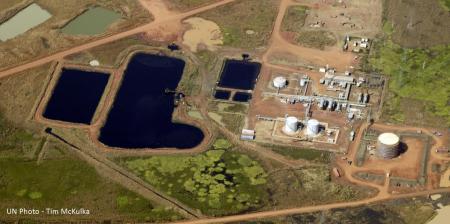
Global Witness investigations into the management of the revenue sharing deal have revealed discrepancies of 9-26% between the oil production figures published by the Khartoum government and those reported by Chinese state-owned CNPC, the main oil company operating in Sudan. These production figures provide the basis for dividing the oil revenues, so it is crucial that both parties can verify them. The government has responded to Global Witness campaigning by promising the publication of comprehensive oil data and an independent audit of the sector, but has yet to deliver on these commitments.
The situation today is delicately poised. The revenue-sharing deal ended with southern independence on July 9, 2011, and a new agreement has yet to be reached. With independence, South Sudan took with it more than three-quarters of Sudan’s oil production, but the infrastructure required to export the oil remains in the north. The economies of both north and south are heavily reliant on oil revenues, so agreeing a transparent oil-sharing arrangement which benefits both parties is absolutely crucial to securing lasting peace and stability in the region.
Furthermore, as the world’s newest and most oil-dependent country, it is vital that the government of South Sudan immediately demonstrates its commitment to managing its national assets in the best interests of its population. This means managing its oil sector in a transparent and accountable manner from the outset, and enshrining this approach in its legal and regulatory frameworks.
Sudan and South Sudan
In 2005, a historic peace agreement brought an end to Africa’s longest-running civil war – the 22-year conflict between north and south Sudan. Tensions over the distribution of the country’s vast oil wealth had exacerbated the conflict, but oil also provided a key to its resolution.
Sudan’s 2005 Comprehensive Peace Agreement (CPA) was underpinned by an innovative deal to split the revenues from southern oil evenly between the north and south. The agreement changed the role of oil from a driver of conflict to an incentive for peaceful cooperation, and saw Khartoum transfer more than $10 billion to Juba over a five year period. This has been crucial in sustaining the fragile peace. However, a persistent lack of transparency and independent verification of the revenue split has also fuelled mistrust between north and south.
Global Witness investigations into the management of the revenue sharing deal have revealed discrepancies of 9-26% between the oil production figures published by the Khartoum government and those reported by Chinese state-owned CNPC, the main oil company operating in Sudan. These production figures provide the basis for dividing the oil revenues, so it is crucial that both parties can verify them. The government has responded to Global Witness campaigning by promising the publication of comprehensive oil data and an independent audit of the sector, but has yet to deliver on these commitments.
In 2005, a historic peace agreement brought an end to Africa’s longest-running civil war – the 22-year conflict between north and south Sudan. Tensions over the distribution of the country’s vast oil wealth had exacerbated the conflict, but oil also provided a key to its resolution.
Sudan’s 2005 Comprehensive Peace Agreement (CPA) was underpinned by an innovative deal to split the revenues from southern oil evenly between the north and south. The agreement changed the role of oil from a driver of conflict to an incentive for peaceful cooperation, and saw Khartoum transfer more than $10 billion to Juba over a five year period. This has been crucial in sustaining the fragile peace. However, a persistent lack of transparency and independent verification of the revenue split has also fuelled mistrust between north and south.
Global Witness investigations into the management of the revenue sharing deal have revealed discrepancies of 9-26% between the oil production figures published by the Khartoum government and those reported by Chinese state-owned CNPC, the main oil company operating in Sudan. These production figures provide the basis for dividing the oil revenues, so it is crucial that both parties can verify them. The government has responded to Global Witness campaigning by promising the publication of comprehensive oil data and an independent audit of the sector, but has yet to deliver on these commitments.
Furthermore, as the world’s newest and most oil-dependent country, it is vital that the government of South Sudan immediately demonstrates its commitment to managing its national assets in the best interests of its population. This means managing its oil sector in a transparent and accountable manner from the outset, and enshrining this approach in its legal and regulatory frameworks.
Furthermore, as the world’s newest and most oil-dependent country, it is vital that the government of South Sudan immediately demonstrates its commitment to managing its national assets in the best interests of its population. This means managing its oil sector in a transparent and accountable manner from the outset, and enshrining this approach in its legal and regulatory frameworks.
Source: http://www.globalwitness.org/campaigns/corruption/oil-gas-and-mining/sudan-and-south-sudan
Newer articles:
- Olympics-South Sudan race to compete at London Games - 10/02/2012 20:35
- South Sudan: Justice Needed to Stem Violence, Rights Group Says - 10/02/2012 13:25
- South Sudan admitted as a member of CAF - 10/02/2012 13:02
- South Sudan oil output at risk in 2012: IEA - 10/02/2012 12:16
- South Sudan gain Caf membership - 10/02/2012 12:04
Older news items
- South Sudan: Govt Explores Pipeline Route Through Ethiopia and Djibouti - 10/02/2012 08:26
- South Sudan signs oil pipeline deal to Djibouti via Ethiopia - 09/02/2012 18:00
- South Sudan: Second pipeline deal - 09/02/2012 17:34
- S. Sudan oil shutdown could fuel inflation, unrest - 09/02/2012 16:57
- S. Sudan mulls oil pipeline through Ethiopia, Djibouti - 09/02/2012 16:49
Latest news items (all categories):
- Juba commissioner denies chasing foreigners - 07/10/2026 14:36
- Australia: 19-year-old from South Sudan arrested over a wild joy ride - 07/10/2026 14:33
- South Sudan’s aid crisis deepens as food stocks run low - 07/10/2026 14:29
- South Sudan’s Juba warns foreigners against running small-scale businesses - 07/10/2026 14:25
- Peace Dialogues foster social cohesion in Nyirol County after persisting tensions - 07/10/2026 14:23
See also (all categories):
Random articles (all categories):
- South Sudan’s blind footballers chase Paralympic dream - 30/10/2025 12:30
- South Sudan does not meet minimum standards for elimination of trafficking in persons: report - 26/07/2022 06:14
- Unity of southern People Before the Referendum. - 26/06/2010 01:00
- Press Statement: The SPLM-DC has no Armed Formations - 13/03/2011 21:32
- South Sudan: Losing the Last Vestiges of Our Moral Fabric - 21/11/2017 02:12
Popular articles:
- Who is the darkest person in the world, according to Guinness World Record? - 25/10/2022 02:34 - Read 150753 times
- School exam results in South Sudan show decline - 01/04/2012 17:58 - Read 28193 times
- Top 10 weakest currency exchange rates in Africa in 2023 - 19/07/2023 00:24 - Read 25305 times
- No oil in troubled waters - 25/03/2014 15:02 - Read 24533 times
- NDSU student from South Sudan receives scholarship - In-Forum - 29/09/2012 01:44 - Read 22492 times
