
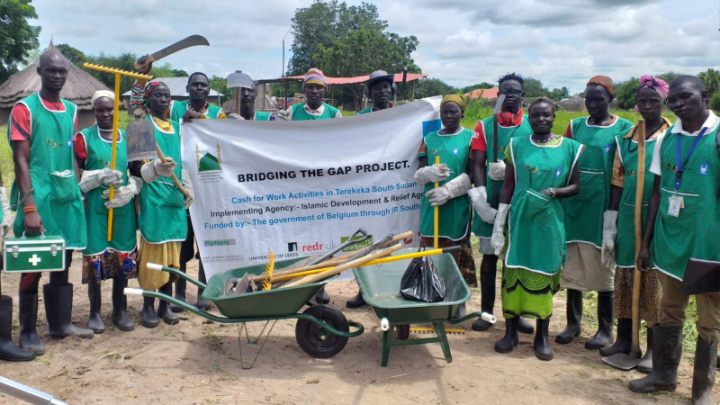
 Members of the Islamic Development & Relief Agency cash for work program in Terekeka, South Sudan. Photo by: IDRA[1]
NAIROBI — When the Islamic Development & Relief Agency built a water system and launched a livelihoods program in the Terekeka area of South Sudan, it was the organization’s first project where the services were provided to people of all religions. The organization had previously only served Muslim communities through its work.
Focus on: Faith and Development[2]
This series illuminates the role faith actors and their communities play in strengthening global development outcomes.
“Most of the time, if people see a borehole at the mosque or if they see that it was constructed by a Muslim organization, they think that this borehole is only for Muslims. But through this project, they learned that if something is for the community, then it is for everybody,” said Zabib Musa Loro, the organization’s executive director. “This project helped to unite the community.”
This change in the organization’s practice is a result of training and mentorship that its members received, which attempted to help South Sudan’s local religious organizations improve their ability to collaborate with international humanitarian organizations, according to Loro.
The training was part of a 15-month pilot program that ran from 2018 to 2019, which included three four-day training sessions, designed to mimic a project cycle, in three locations — two in South Sudan and one in a neighboring district of Uganda with organizations that cross the border to provide aid in South Sudan. It also included online training through video calls and WhatsApp messaging.
Beyond lessons on why organizations should serve people of all religions in their humanitarian work, training sessions focused on areas such as humanitarian principles, codes of conduct, the “cluster system,” financial management, monitoring and evaluation, and tips on improving coordination between organizations. Groups were also provided tools such as budget and project proposal templates.
The model for the pilot was created by the Bridging the Gap Consortium, which includes Tearfund[3], RedR UK[4], Islamic Relief[5], the Joint Learning Initiative on Faith and Local Communities[6], and the University of Leeds[7].
The Bridging the Gap Consortium also provided local faith organizations with small grants to implement programs, which were intended to help them use the training’s lessons on how to work as humanitarians. They were mentored through the process of proposing and implementing these projects, which focused on areas such as hygiene, education, food security, and gender-based violence, among others.
International organizations were encouraged to help strengthen local faith organizations, aiming to achieve lasting impact — which one-off training sessions struggle with — and to localize humanitarian response.
“It was an opportunity that we had never gotten as local faith actors in South Sudan,” Loro said.
Localizing through faith actors
While there is more collaboration with local faith actors in the international development sector globally, it is less common in humanitarian work.
One reason behind this is that humanitarian work is often shorter in terms of project cycle and funding, said Colin Walker, associate trainer at RedR UK. International organizations fly in, work for several months, and then move on to the next crisis. With international development work, planning and implementation of projects is slower, allowing international organizations more time to focus on sustainability through local partnerships.
“If people see a borehole at the mosque or if they see that it was constructed by a Muslim organization, they think that this borehole is only for Muslims.”
— Zabib Musa Loro, executive director, Islamic Development & Relief AgencyWorking with local faith actors can provide a significant benefit to humanitarian work, according to a recently published report[8] from the consortium. Such groups often have better access to harder-to-reach areas, trust from communities, deeper knowledge about the communities they are serving, and strong local volunteer bases. They also tend to have a longer presence in communities than international humanitarian actors, giving their response more continuity.
Get development's most important headlines in your inbox every day.
Thanks for subscribing!
Despite the advantages of working with local faith actors, there have been barriers preventing the creation of genuine partnerships, according to the report.
International humanitarian organizations can have reservations about working with local faith actors due to potential ideological differences and concerns that religious groups may prioritize people from their own faith or that they might work to convert people. There can also be worries that gender dynamics in some religions may be incompatible with their own values.
But if local faith actors are educated in areas such as independence and neutrality, stronger partnerships can emerge, Walker said.
“We talked with them about the fact that humanitarian aid should be given to people on the basis of need alone and not in order to evangelize or proselytize,” Walker said. “The local faith actors that were involved in the project have been taught those principles and have agreed to abide by them.”
For local faith actors, it can also be difficult to navigate the humanitarian sector.
“Before the pilot, several LFAs [local faith actors] said that they felt excluded from partnerships with other international humanitarian actors, because of factors ranging from power dynamics to feeling unfamiliar with how to participate in humanitarian cluster meetings,” according to the report. It can also be difficult for local faith actors to access donor funds because of policies on safeguarding, whistleblowing and codes of conduct for staff.
Scaling up and ensuring participation
In the report, the coalition recognizes that given the short nature of the pilot, “significant change” will take longer.
“There is obviously more to learn, more techniques to perfect, and they could really expand their projects,” Walker said. “I’d love to see the program expanded into other countries as well.”
One of the challenges in scaling up programming during the COVID-19[9] pandemic would include reaching communities for training in safe ways, he said.
Other difficulties include high turnover in organizations, ensuring that trainings lead to structural changes in organizations, and increasing understanding between Muslim and Christian groups, Walker said.
The report also noted that widespread engagement in the program from international humanitarian groups was missing and that there is a need to find ways to ensure participation, as “external training sessions are not a priority” for all organizations.
Devex, with support from our partner GHR Foundation, is exploring the intersection between faith and development. Visit the Focus on: Faith and Development[10] page for more. Disclaimer: The views in this article do not necessarily represent the views of GHR Foundation.
Printing articles to share with others is a breach of our terms and conditions and copyright policy. Please use the sharing options on the left side of the article. Devex Pro subscribers may share up to 10 articles per month using the Pro share tool ( ).
References
- ^ IDRA (www.idrassudan.org)
- ^ Focus on: Faith and Development (www.devex.com)
- ^ Tearfund (www.devex.com)
- ^ RedR UK (www.devex.com)
- ^ Islamic Relief (www.devex.com)
- ^ Joint Learning Initiative on Faith and Local Communities (www.devex.com)
- ^ University of Leeds (www.devex.com)
- ^ recently published report (learn.tearfund.org)
- ^ COVID-19 (www.devex.com)
- ^ Focus on: Faith and Development (www.devex.com)
Newer articles:
- Trafficking in Persons in South Sudan: Prevalence, Challenges and Responses - An Action Research - 28/07/2020 16:32
- Coronavirus – South Sudan: Female prisoners in Wau receive medicines, hygiene kits thanks to UNMISS peacekeepers from Bangladesh - 28/07/2020 11:30
- COVID-19: South Sudan rumor tracking overview - Issue #5 - 28/07/2020 09:39
- South Sudan face mask donation - 28/07/2020 09:00
- Dozens killed, 10 children abducted in ethnic clashes in South Sudan - 28/07/2020 06:51
Older news items
- South Sudan: Preserving Economic Progress in the Face of COVID-19 - 27/07/2020 18:07
- South Sudan Misses Deadline to Form New Parliament - 27/07/2020 15:07
- Around 120 killed or wounded in attack on western Sudan village, UN says - 26/07/2020 16:22
- The man on a mission to stop Israeli arms sales to human rights violators - 26/07/2020 10:22
- Kenya Entangled in Assassination Claims Involving South Sudan Govt - 26/07/2020 08:52
Latest news items (all categories):
- Juba commissioner denies chasing foreigners - 07/10/2026 14:36
- Australia: 19-year-old from South Sudan arrested over a wild joy ride - 07/10/2026 14:33
- South Sudan’s aid crisis deepens as food stocks run low - 07/10/2026 14:29
- South Sudan’s Juba warns foreigners against running small-scale businesses - 07/10/2026 14:25
- Peace Dialogues foster social cohesion in Nyirol County after persisting tensions - 07/10/2026 14:23
Random articles (all categories):
- Alei: South Sudan are not starting from scratch - Fifa.com - 26/06/2012 10:20
- South Sudan: Juba Fails to Commit On Ugandan Traders' U.S.$40 Million Dues - 14/11/2018 05:05
- هذا الربيع في جنوب السودان - 16/02/2026 11:48
- establishment of diplomatic relations between the Kingdom of Cambodia and the Republic of South Sudan - 25/07/2011 01:00
- Franciscan Friar’s sights set on South Sudan for next three years - 05/01/2023 08:00
Popular articles:
- Who is the darkest person in the world, according to Guinness World Record? - 25/10/2022 02:34 - Read 150718 times
- School exam results in South Sudan show decline - 01/04/2012 17:58 - Read 28190 times
- Top 10 weakest currency exchange rates in Africa in 2023 - 19/07/2023 00:24 - Read 25305 times
- No oil in troubled waters - 25/03/2014 15:02 - Read 24533 times
- NDSU student from South Sudan receives scholarship - In-Forum - 29/09/2012 01:44 - Read 22492 times
