
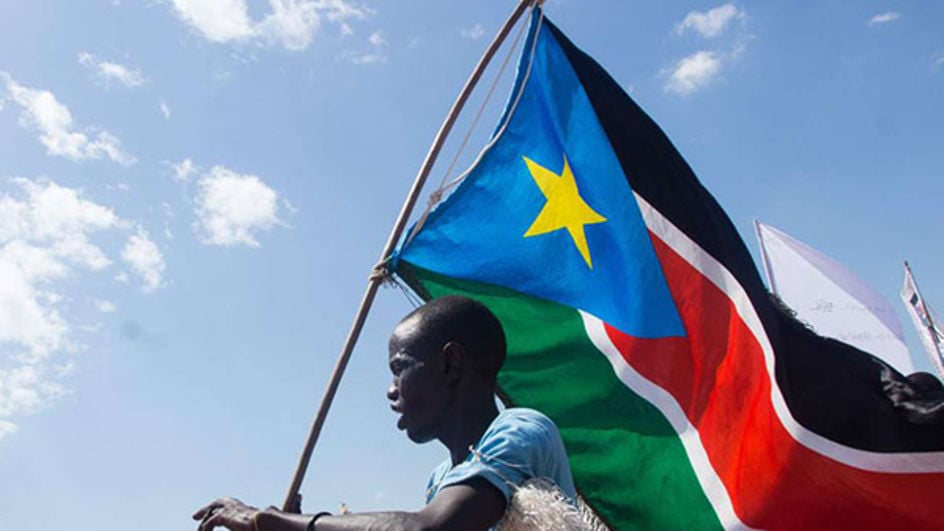
A man carries the South Sudan flag at Magateen Internal Displaced Persons centre in Juba on November 17, 2018. PHOTO | AKUOT CHOL | AFP
Juba
South Sudan’s nine years of independence may have become a story of sadness and ‘waste’, rather than freedom, some activists say.
As Juba marked Independence Day on July 9, critics pointed out that the objectives the Sudan’s People Liberation Army (SPLM) fought for with support from the local population and many international partners have not been achieved.
The country seceded from Sudan in July 2011, six months after a referendum on whether the region, then known as southern Sudan, should remain a part of Sudan or become independent.
But it plunged into a successive series of conflicts as leaders fought over influence and political power. The turn of events makes some citizens feel the independence did not bring the freedom they yearned for.
LIBERATION FIGHT
“My father died during the liberation struggle, he fought in various wars and he was killed in the Kapoeta front,” said Deng Madut, a resident in Juba.“Since independence, I have not seen any development. It’s like he died in vain.”
According to Wani Tombe, a 32-year-old businessman in Juba, little has been achieved since South Sudan gained independence from Khartoum.
“When I listen to Dr Garang’s CPA speech, I feel like crying, all the great things planned were never implemented, we still don’t have roads, no pineline water system, locals don’t access schools and war continues to follow us” said Wani.
“If foreigners feel more at home than the citizens by moving freely in all the ten states when citizens have some red zones that they cannot visit due to fear of their lives, this is not what our father fought for,” said Gak Malek, a youth activist.
Christina Kide, chairperson of South Sudan Youth Organisation Coalition says many citizens have lost hope in the past and current governments because of their failure to fulfill promises.
“As we speak now, many South Sudanese feel like going back to Sudan.
“Now, we don’t even know how far this peace agreement will go, we need a nation where is there democracy, free of corruption, and a country where rule of law is respected” said Kide
Meanwhile, Rajaf Mohadis, the executive director of Organisation for Responsive Governance, attributes the failure to achieve the past objectives as lack of a clear agenda to drive the nation.
“Since we achieved independence, we have not seen much progress in terms of infrastructure development, improvement of livelihoods and the safety of civilians has been threatened," said Rajaf.
Mr. Rajaf advised political leaders to sit down and redefine a clear strategy that will move South Sudan to a better country.
Prof Kuol Nyuon, who is the Dean of College, School of Social and Economics at the University of Juba urged leaders to work together in order to make a clear agenda to steer the country into the right direction.
“The peace parties should also commit themselves to implement the peace deal” said Prof Kuol.
In his independence speech, David Shearer, the head of United Nation Mission in South Sudan reiterated his call to political leaders to wholeheartedly implement the 2018 peace deal.
“On the ninth anniversary, we should take the opportunity to remember the immense suffering caused by war but also to recognise the positive impact that the peace agreement has had on communities across the country.
“Hundreds, even thousands, of people are alive today because of the significant reduction in political violence. Displaced families are returning home to plant crops and rebuild their lives. Humanitarian agencies are reaching more communities in need” said Shearer.
For 21 years, southerners waged guerrilla war against Sudan. The civil war claimed the lives of at least 1.5 million people and displaced four million others.
But with efforts of other liberators, including the late Dr. John Garang De Mabior who led the Sudan’s People Liberation Movement (SPLM), the country gained independence on July 9, 2011 from Sudan.
The independence came as the outcome of the 2005 Comprehensive Peace Agreement signed in Naivasha, Kenya which ended Africa’s longest-running civil war.
The agreement was later followed by a referendum in 2011 where 99.9 percent of southerners voted for self-determination.
However, two years after independence, the nation plunged into another deadly civil war that claimed more than 400,000 lives, displaced millions and left the whole country in dire need of humanitarian assistance.
But in 2015, Igad brokered a peace deal that again collapsed in 2016. Nevertheless, efforts of Sudan, Igad and international partners again brought the warring parties on the table and peace talks that led to revitalisation of the 2015 peace accord.
In February this year, the country formed the long awaited Revitalised Transitional Government of National Unity that will run the country for three years’ transitional period before it heads to first ever elections hopefully in 2022.
Newer articles:
- UN says inter-tribal skirmishes affecting humanitarian response in South Sudan - 12/07/2020 09:18
- Sudan’s Rapid Support Forces occupy school in South Kordofan - 12/07/2020 02:31
- South Sudanese refugees on the challenges of making a new life in Australia - 12/07/2020 01:11
- As South Sudan turns nine: elusive quest for peace amid bloodshed - 10/07/2020 10:42
- South Sudan: Humanitarian Snapshot (June 2020) - 10/07/2020 09:02
Older news items
- South Sudan diplomat widely criticised after urinating during panel discussion - 10/07/2020 03:37
- Tackling South Sudan’s oil spills in court - 10/07/2020 00:46
- South Sudan: Amidst Coronavirus Pandemic, WHO, Partners Vaccinated 94 019 Children Aged 6 to 59 Months Against Measles - 10/07/2020 00:38
- South Sudan President Admits Inter-Communal Fighting Threatens Country - 09/07/2020 16:58
- South Sudan Resumes Flights After Virus Suspension - 09/07/2020 11:42
Latest news items (all categories):
- Ramaphosa presses Kiir to implement peace deal ahead of South Sudan’s first elections - 09/10/2026 12:19
- South Sudan steps up Ebola alert after Kenya case - 09/10/2026 12:17
- Laotian man deported by U.S. to South Sudan leaves for Laos after year in detention - 09/10/2026 12:14
- Bullet and blast injuries … and a constant need for blood: inside South Sudan’s overwhelmed trauma wards - 09/10/2026 12:10
- MTN South Sudan and Regulator Pledge Cooperation to Expand Connectivity - 09/10/2026 12:01
Random articles (all categories):
- Juba Traders Suffering from South Sudan’s Financial Woes - 12/12/2016 07:39
- Uganda exports to South Sudan hit record high - 08/04/2022 03:08
- Christian Workers Abducted in South Sudan Are Released - 07/10/2026 14:21
- South Sudan 'superhero' wins award for work with children born of rape - 18/03/2019 13:46
- South Sudan peace monitoring body calls for restraint in Yei - 30/01/2019 14:04
Popular articles:
- Who is the darkest person in the world, according to Guinness World Record? - 25/10/2022 02:34 - Read 150768 times
- School exam results in South Sudan show decline - 01/04/2012 17:58 - Read 28194 times
- Top 10 weakest currency exchange rates in Africa in 2023 - 19/07/2023 00:24 - Read 25308 times
- No oil in troubled waters - 25/03/2014 15:02 - Read 24534 times
- NDSU student from South Sudan receives scholarship - In-Forum - 29/09/2012 01:44 - Read 22492 times
