
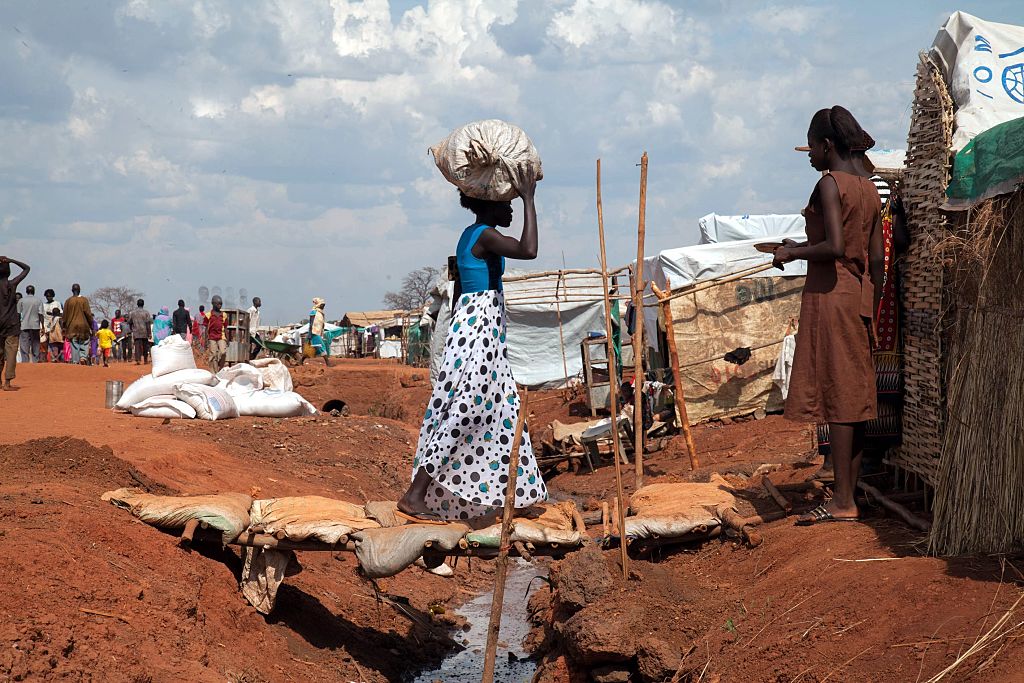
Image: Bruno Bierrenbach Feder/Anadolu Agency/Getty Images
South Sudan became independent in 2011, following the 2005 Comprehensive Peace Agreement that ended 20 years of civil war in Sudan. UNMISS was then established to succeed the UN Mission in Sudan, but in 2013 violence quickly re-emerged between the Sudan Peoples’ Liberation Movement, led by President Salva Kiir and comprising mainly ethnic Dinka fighters, and the Sudan Peoples’ Liberation Movement-in-Opposition (SPLM-IO), led by former vice president Riek Machar and with mainly Nuer fighters. A power-sharing peace agreement was signed in August 2015 but failed when heavy fighting broke out again in July 2016 in the capital, Juba.
The 2015 agreement was revitalised in September 2018. It provided for a quota of 35% women’s participation in the implementation committees and was signed by Amer Manyok Deng as the representative of the women’s bloc. The quota reflects ‘the importance of [women’s] equal participation and full involvement’ in peacebuilding and ‘the need to increase their role in decision-making’, which was stressed in UN Security Council resolution 1325 (2000). Implementation of the quota has been slow, although Angelina Teny, for the SPLM-IO, chaired the Defence and Security Committee from late 2018.
UNMISS’s mandate gives it four main tasks: to protect civilians, to create conditions conducive to the delivery of humanitarian assistance, to monitor and investigate human rights violations, and, currently, to support the implementation of the revitalised peace agreement. In advocating for the 35% women’s participation quota in that agreement, however, the UN has created a significant credibility challenge for itself that’s apparent to local authorities and communities.
The UNMISS civilian component has 26% women, the police approximately 20%, and the military only 4%. At the leadership level, despite the appointment of Police Commissioner Unaisi Vuniwaqa (Fiji), women’s participation is lower again. Only one female military contingent commander has served in UNMISS (Lieutenant Colonel Katie Hislop, British Engineering Task Force 2017). Anecdotally, there are few military women in roles that are visible to the local population and in senior operational planning or staff roles, and their overall visibility to the local community as part of UNMISS is more limited than that of men serving in the mission.
The UN’s uniformed gender parity strategy focuses on increasing the proportion of women in missions, but its numerical approach gives insufficient weight to where and how women are employed. This negates the Security Council’s assertions that deploying more women increases community engagement and the mission’s ability to implement the WPS agenda. Rather than just percentages, emphasis also needs to be placed on deploying women into visible UNMISS decision-making roles, particularly at colonel level and above. A force leadership that normalises female participation provides a credible basis for advocacy, as well as a model for contributing militaries that don’t yet have their own senior female officer cohort.
Operationalising women’s participation is more than a practical challenge for WPS and reflects on mission credibility. A similar challenge arises for UNMISS for the protection of civilians, which is another pillar of WPS and a key mandated task.
UNMISS’s responsibility to protect civilians specifically includes the protection of women and children from conflict-related sexual violence. Campaigns of such violence have continued following the peace agreement, including a reported mass rape near Bentiu in September–December 2018. Importantly for operational planning, an investigation by UNMISS and the UN High Commissioner for Human Rights found that the risk factors for organised sexual violence in Bentiu included large numbers of fighters in ‘stand-by’ mode awaiting the implementation of the peace agreement and the presence of armed youth militias. Those risks are likely to increase further when the cantonment of forces proceeds as part of the peace implementation. Thus, the processes that were intended to facilitate peace between the main security actors have increased the risk of violence for others. Counterintuitively, as violence between some armed groups decreased with the peace agreement, the risk of sexual violence against civilians went up.
It’s difficult for UNMISS to reconcile its mandates both to protect the population from sexual violence and to support the implementation of the peace agreement. This problem has been compounded by the fact that the perpetrators include government forces that are parties to the agreement. An added level of complexity is the persistent denial of UNMISS freedom of movement by government forces, which was criticised in Security Council resolution 2459 (2019). The UN’s 2013 policy on human rights due diligence only partially addresses this problem by requiring peacekeepers to avoid supporting human rights violators in their operations.
It’s particularly difficult to strike an operational balance between these competing tasks when UNMISS’s mandate offers limited direction beyond requiring the mission to prioritise the protection of civilians in the use of resources. The risk is that the security of women and girls is subordinated to the implementation of the peace agreement on the assumption that their short- to medium-term increased risk will be reduced in the longer term if peace is achieved—but when the implementation of the gender-specific aspects of the agreement is also slow, that mitigation seems increasingly unhelpful.
While these challenges are significant, it shouldn’t be assumed that they undermine the relevance or utility of WPS, although they do call for creative approaches and an explicit balancing of mandate interests in the pursuit of peace and security for all.
Author
Angeline Lewis, a wing commander in the Royal Australian Air Force, is the inaugural defence minister’s visiting fellow for WPS at UNSW Canberra. This post reflects her personal views and does not necessarily reflect the views of the Australian Defence Force, the Australian government or the United Nations. Image: Bruno Bierrenbach Feder/Anadolu Agency/Getty Images.
Newer articles:
- South Sudan’s PPP grid expansion offers Nigeria new cues - 20/01/2020 20:08
- Despite mediation, no solution yet to South Sudan issue of the number of states - 20/01/2020 11:18
- Chinese doctors take medical service to northern South Sudan - 20/01/2020 04:21
- South Sudan to Complete Juba Power Grid by March 2020 - 20/01/2020 01:46
- United Nations Children's Fund (UNICEF) calls South Sudan to increase its public spending in education - 19/01/2020 23:34
Older news items
- David Mabuza irks both sides in South Sudan mediation - 19/01/2020 17:23
- Director of Anglican Centre in Rome: Momentum for peace needed in South Sudan - 18/01/2020 23:00
- South Sudan's SSOA rejects South African proposal on states' issue - 18/01/2020 16:00
- Kenya Morans sink South Sudan in Nyayo thriller - 18/01/2020 11:33
- Sudan and South Sudan: Tale of Two Countries - 17/01/2020 08:38
Latest news items (all categories):
- The Emerging Endgame of the Russo-Ukrainian War - 05/08/2026 22:59
- The changing face of “Made in China” - 05/08/2026 22:41
- UK - Change of His Majesty’s Ambassador to South Sudan: Rebecca Fabrizi - 05/08/2026 22:09
- South Sudan rewriting its future with eyes on agriculture and mining boom - 05/08/2026 21:53
- Moroccan king's letter confirms naming of major highway in honour of Trump - 05/08/2026 21:52
Random articles (all categories):
- Bodies litter South Sudan oil town; talks resume - 13/01/2014 16:09
- Canada extends UN deployment in South Sudan despite concerns: memo - 28/11/2016 13:59
- Bishop Carlassare (Rumbek): “I dream of a South Sudan without conflict and violence”. - 04/05/2021 01:37
- South Sudan official calls for balanced approach to peace - 24/09/2017 00:41
- Video : Suffering in South Sudan - 20/08/2012 09:31
Popular articles:
- Who is the darkest person in the world, according to Guinness World Record? - 25/10/2022 02:34 - Read 148335 times
- School exam results in South Sudan show decline - 01/04/2012 17:58 - Read 27921 times
- Top 10 weakest currency exchange rates in Africa in 2023 - 19/07/2023 00:24 - Read 25006 times
- No oil in troubled waters - 25/03/2014 15:02 - Read 24330 times
- NDSU student from South Sudan receives scholarship - In-Forum - 29/09/2012 01:44 - Read 22286 times
