
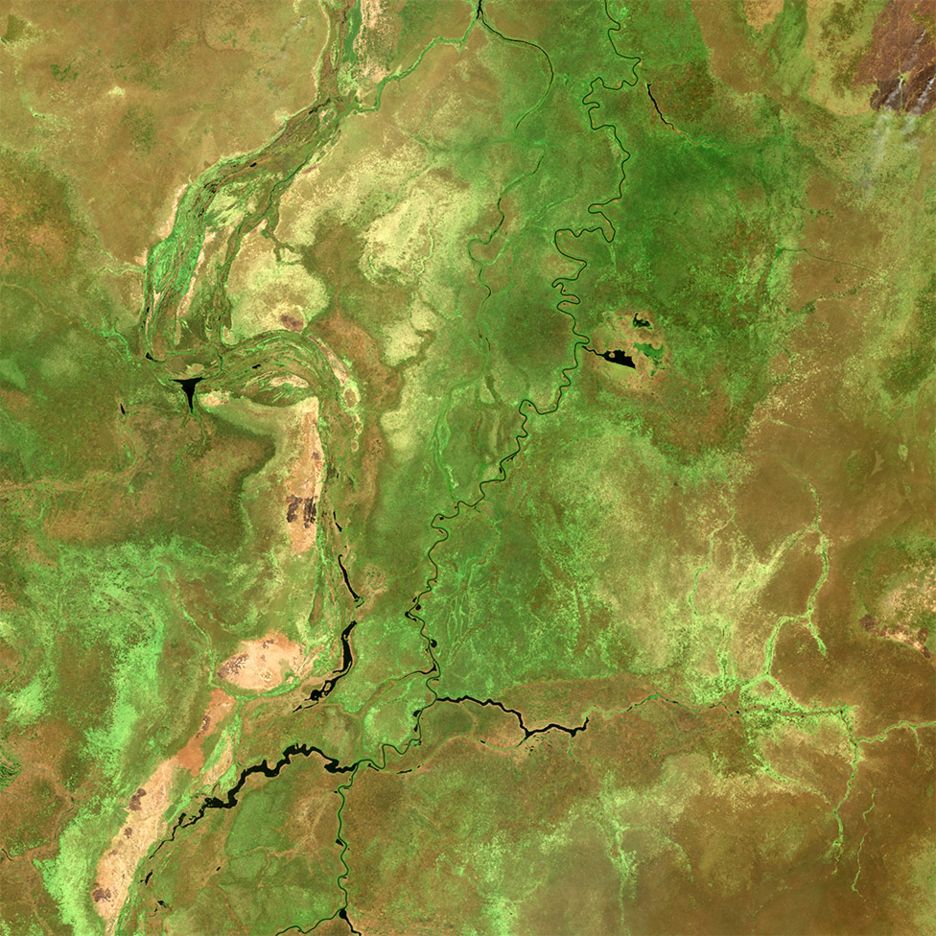
 Image copyright Copernicus Data 2019/ESA/Sentinel-2
Researchers, led from Edinburgh University, UK, say their studies point to a big jump in emissions coming from just the wetlands of South Sudan.
Satellite data indicates the region received a large surge of water from East African lakes, including Victoria.
This would have boosted CH4 from the wetlands, accounting for a significant part of the rise in global methane.
Perhaps even up to a third of the growth seen in the period 2010-2016, when considered with East Africa as a whole.
"There's not much ground-monitoring in this region that can prove or disprove our results, but the data we have fits together beautifully," said Prof Paul Palmer.
"We have independent lines of evidence to show the Sudd wetlands expanded in size, and you can even see it in aerial imagery - they became greener," he told BBC News.
Methane is a potent greenhouse gas, and - just like carbon dioxide - is increasing its concentration in the atmosphere.
It's not been a steady rise, however. Indeed, during the early 2000s, the amount of the gas even stabilised for a while. But then the concentration jumped in about 2007, with a further uptick recorded in 2014.
CH4 (methane) is now climbing rapidly and today stands at just over 1,860 parts per billion by volume.
There's currently a debate about the likely sources, with emissions from human activities such as agriculture and fossil-fuel use undoubtedly in the mix. But there is a large natural component as well, and a lot of current research is centred on contributions from the tropics.
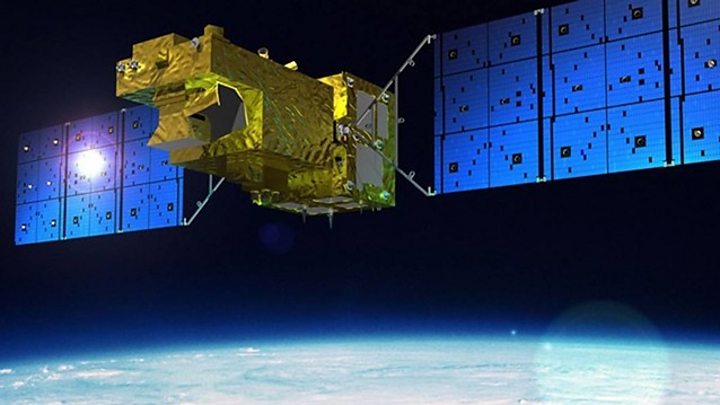
The Edinburgh group has been using the Japanese GOSAT spacecraft to try to observe the greenhouse-gas behaviour over peatlands and wetlands in Africa, and found significant rises in methane emissions above South Sudan centred on the years 2011-2014.
Believing the region called the Sudd could be the culprit (soil microbes in wetlands are known to produce a lot of methane), the team started looking through other satellite data-sets to make the link.
Land surface temperature observations supported the idea that soils in the region had become wetter; gravity measurements across East Africa also detected an increase in the weight of water held in the ground; and satellite altimeters had tracked changes in the height of lakes and rivers to the south.
"The levels of the East African lakes, which feed down the Nile to the Sudd, increased considerably over the period we were studying. It coincided with the increase in methane that we saw, and would imply that we were getting this increased flow down the river into the wetlands," explained Dr Mark Lunt.
The Edinburgh group published its findings on Wednesday in the journal Atmospheric Chemistry and Physics, and, as an update to the story, Dr Lunt is presenting new data here at the American Geophysical Union meeting.
He's been looking at methane observations made by the EU's Sentinel-5P satellite. Its Tropomi instrument sees CH4 at a finer resolution than GOSAT, and it's clear from the European mapper that methane emissions are still elevated over South Sudan.
The level of activity is nothing like the same as in the early 2010s, but the Sudd wetlands remain an important source.
"It's a huge area so it's not surprising that it's pumping out a lot of methane. To give context - the Sudd is 40,000 sq km: two times the size of Wales. And being that big we expect to see the emissions from space," Dr Lunt told BBC News.
Source https://www.bbc.com/news/science-environment-50708544
Newer articles:
- Mobile courts deliver long-awaited justice in remote parts of South Sudan - 12/12/2019 10:44
- U.S. Threatens Visa Restrictions Over South Sudan Peace Process - 12/12/2019 10:31
- South Sudan faces famine after 'catastrophic' floods: WFP - 12/12/2019 09:18
- South Sudan joins Global Network to launch Accelerator Lab and Human Development Report 2019 - 12/12/2019 00:42
- South Sudan rivals hold rare meeting as peace deal stalls - 11/12/2019 16:26
Older news items
- Launch of the South Sudan Humanitarian Response Plan 2020 – 12... - 11/12/2019 00:40
- US sanctions 5 South Sudanese security chiefs over activists' disappearance - 11/12/2019 00:15
- South Sudan ‘ignored’ advice on number of states - 10/12/2019 22:55
- Sudan peace talks reconvene in Juba - 10/12/2019 12:46
- Unregulated Teak Trade Fuelling South Sudanese Violence: Report - 10/12/2019 10:02
Latest news items (all categories):
- South Sudan can leverage China’s AI path to bridge the digital divide - 16/09/2026 16:04
- Credible Elections Are No Longer Possible in South Sudan - What Next? - 16/09/2026 15:59
- South Sudan's president replaces electoral chief three months before scheduled polls - 16/09/2026 15:56
- Turkish Airlines is pulling out of 5 African routes, including South Sudan - 16/09/2026 15:23
- ‘Super El Niño’ deepens hunger crisis in South Sudan – WFP - 16/09/2026 15:19
Random articles (all categories):
- Sudan, South Sudan Talks Likely to extend beyond August 2nd - 04/08/2013 06:11
- South Sudan refugees enter Uganda despite border closure - 30/03/2020 03:55
- South Sudan forces battle 'White Army' - 29/12/2013 16:37
- South Sudan ex-ministers face corruption trial - 05/09/2013 05:04
- باقان أموم: قطار الوحدة قد ولى.. ولم تبق قطرة أمل واحدة - 07/06/2010 16:06
Popular articles:
- Who is the darkest person in the world, according to Guinness World Record? - 25/10/2022 02:34 - Read 149624 times
- School exam results in South Sudan show decline - 01/04/2012 17:58 - Read 28116 times
- Top 10 weakest currency exchange rates in Africa in 2023 - 19/07/2023 00:24 - Read 25198 times
- No oil in troubled waters - 25/03/2014 15:02 - Read 24466 times
- NDSU student from South Sudan receives scholarship - In-Forum - 29/09/2012 01:44 - Read 22416 times
