
 Download
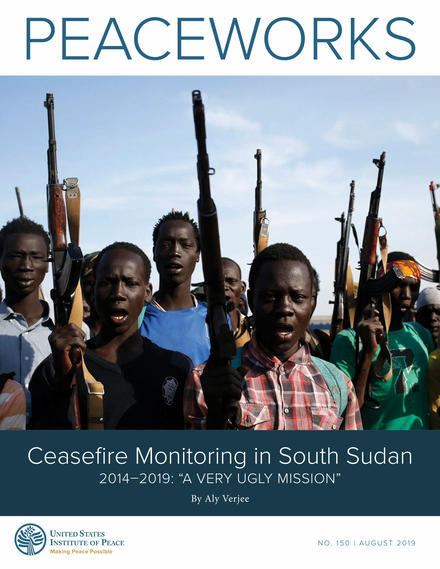
More than five years after South Sudan’s first ceasefire agreement, ceasefire monitors are still on the ground. The hope was that their work would help overcome the mistrust between rival factions, halt ongoing violence, and deter further violations. Drawing on interviews with monitors, combatants, politicians, civil society representatives, diplomats, peacekeepers, and others, this report examines the history of ceasefire monitoring in South Sudan and offers recommendations for donors supporting future monitoring processes in South Sudan and elsewhere.
Summary
South Sudan’s Monitoring and Verification Mechanism was created in early 2014 to monitor combatants’ compliance with a truce. Following the 2015 peace treaty, it became the Ceasefire and Transitional Security Arrangements Monitoring Mechanism, which in turn became the Ceasefire and Transitional Security Arrangements Monitoring and Verification Mechanism after a 2018 accord superseded the earlier agreement. Although ceasefire monitoring is but one dimension of the response to the conflict in South Sudan, it has been resource intensive. International donors have provided more than $130 million in cash and in-kind assistance to the process since 2014.
The monitoring presumes that accurate reporting of truce violations will deter future violations. The evidence for the validity of this logic in South Sudan is uncertain, however. Undermining the utility of monitoring are a general lack of commitment of the parties to their obligations and to an independent monitoring process, the limited acceptance of the parties of the monitoring outcomes, and—most critical—a lack of meaningful consequences for serious violations. Monitoring efforts in the country have also been beset by operational, organizational, and technical deficits that include poor leadership, inexperienced and unqualified monitors, and a lack of force protection. Cooperation with the United Nations and the Joint Monitoring and Evaluation Commission has often been inadequate. Further, efforts to publicly disseminate monitors’ findings and communicate with South Sudanese citizens have been limited and inconsistent. A sustained public information campaign across the country, including greater efforts to solicit information from the public, would improve the quality of the monitoring process.
Supporters of ceasefire monitoring, including the United States, should reinforce monitors’ findings by demonstrating that noncompliance has consequences. Direct action needs to be taken against those with both operational and command responsibility for flagrant violations.
About the Report
Drawing on more than ninety interviews and written responses from ceasefire monitors, combatants, politicians, civil society representatives, international diplomats, peacekeepers, and analysts, this report reviews internationally led ceasefire monitoring in South Sudan from January 2014 to January 2019. Supported by the Middle East and Africa Center at the United States Institute of Peace, it identifies the challenges and offers recommendations for donors supporting future monitoring processes in South Sudan and elsewhere.
About the Author
Aly Verjee is a senior adviser at the United States Institute of Peace. He served as a senior adviser to the Intergovernmental Authority on Development mediation for South Sudan from 2014 to 2015 and was deputy and then acting chief of staff of the Joint Monitoring and Evaluation Commission from 2015 to 2016, overseeing the implementation of South Sudan’s 2015 peace agreement.
Newer articles:
- Towards accelerating infection prevention and control in health facilities in South Sudan - 31/08/2019 01:45
- Pagan Amum unveils new party - 30/08/2019 18:36
- How Israel is sowing the seeds of a deadly war in South Sudan - 30/08/2019 16:35
- South Sudan rebels form 'leadership body' - 30/08/2019 12:29
- Experts urge South Sudan to trace persons separated by conflict - 30/08/2019 10:48
Older news items
- South Sudan organization promotes women's rights - 30/08/2019 06:15
- South Sudan: Thousands missing because of conflict and violence - 29/08/2019 23:27
- South Africa key to peace in South Sudan - 29/08/2019 16:15
- Report: Conflict Rising Among South Sudanese Refugees in Uganda - 29/08/2019 13:36
- South Sudan’s bishops praise peace agreement for neighboring Sudan - 29/08/2019 11:44
Latest news items (all categories):
- South Sudan vows probe after two Ethiopian peacekeepers killed in Jonglei ambush; Ethiopia, UN and Egypt condemn attack - 26/08/2026 13:06
- Dozens killed in rebel attacks on Sudan’s Kordofan, medical group says - 26/08/2026 13:03
- The truth about the South Sudanese vice president being prevented from travelling to Kenya - 26/08/2026 13:01
- WHO Regional Office Country Focus Coordinator visits South Sudan to strengthen health sector support - 26/08/2026 12:58
- South Sudanese Catholic Bishop Presents Women’s Leadership as Alternative Ahead of First-Ever General Election - 26/08/2026 12:56
Random articles (all categories):
- Sudan's Forgotten War - Daily Beast - 13/11/2012 04:51
- Chess, the war game building bridges in South Sudan - 25/03/2019 19:50
- South Sudan Ministry of Mines - Investment Potential - 29/04/2019 21:18
- ANC party urges UN to support disarmament in South Sudan - 11/01/2023 11:06
- South Sudan rebels dismiss coup talk - 13/08/2015 11:26
Popular articles:
- Who is the darkest person in the world, according to Guinness World Record? - 25/10/2022 02:34 - Read 148888 times
- School exam results in South Sudan show decline - 01/04/2012 17:58 - Read 28000 times
- Top 10 weakest currency exchange rates in Africa in 2023 - 19/07/2023 00:24 - Read 25084 times
- No oil in troubled waters - 25/03/2014 15:02 - Read 24393 times
- NDSU student from South Sudan receives scholarship - In-Forum - 29/09/2012 01:44 - Read 22338 times
