
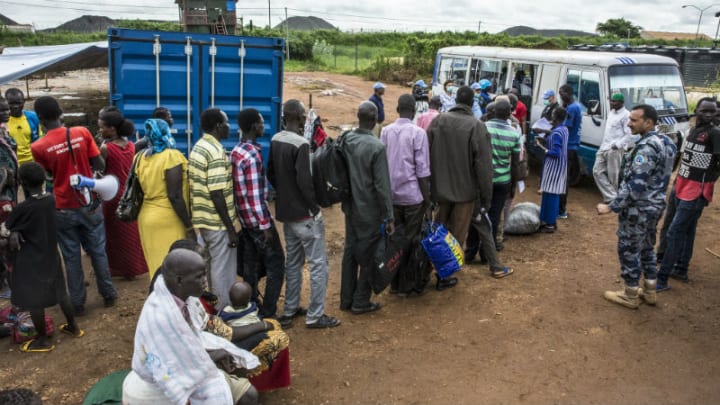
JUBA, South Sudan — Seven million people, almost half of South Sudan’s population, are reliant on aid[3]. In a country where the humanitarian situation is dire and the gap between the demand and resources is wide, aid groups have started pushing for a more evidence-based response, trying to use data and information to better understand the context and make decisions in a more calculated way.
The approach is shared by the international community, which during the World Humanitarian Summit 2016 vowed to strengthen the quality and coordination of assessing needs used for decision-making as part of the Grand Bargain[4], an agreement established between more than 30 donors and aid providers.
“If you don’t understand the situation in which you’re providing assistance, you run the risk of breaching the principle of ‘first do no harm.’”
— Sarah Vuylsteke, former deputy head of access, WFP South SudanSouth Sudan’s long-running humanitarian presence has bolstered its evidence-based response, yet the country’s volatile security context also makes collecting data a challenge, said Sarah Vuylsteke, former deputy head of access at the World Food Programme[5] in South Sudan.
An evidence-based response is necessary to understand the context and in order to serve the needs of the community, and “you get your best evidence-based [data] when you have a calm period,” she said. “If you don’t understand the situation in which you’re providing assistance, you run the risk of breaching the principle of ‘first do no harm.’”
As South Sudan slowly emerges from five years of conflict, with a fragile peace deal signed in September 2018, aid groups want to continue improving the collection and use of data and information in a notoriously challenging context, they tell Devex.
A more calculated response
In 2015, aid worker Elizabeth Mayer remembers attending meetings with aid clusters — groups focused on specific humanitarian issues such as health, nutrition, protection, and shelter. They would try to determine what the group should prioritize based on assessments that were likely politically motivated or agenda-driven, she explained.
People would go into the field and gather data largely based on what community leaders or authorities, who would often inflate the numbers, would tell them: “You’d have a lot of subjective opinions in those numbers,” said Mayer, one of the coordinators in South Sudan’s cluster system.
These issues still exist, she said, although not as dramatically. Four years ago, the decision-making process was more “inconsistent,” she said, based on data from different clusters compiled into enormous excel spreadsheets detailing locations and lists of who’s doing what, where, and when. Today, increased access to data has allowed for the information to be substantiated and triangulated, providing more clarity and better checks and balances, she said.
In an attempt to better focus the response, last year, the cluster system created a needs analysis working group. The aim was to give more space and time for people to look at and analyze data and ultimately provide recommendations on where to prioritize emergency responses.
The mandate of the group is “to make recommendations to the clusters on what areas to prioritize based on joint analysis so that the most vulnerable can be responded to in a timely manner,” said Nadia Lehmann, acting country coordinator at REACH[6], a humanitarian research initiative.
Since its inception in early 2018, the working group analyzes locations across the country based on five core indicators, including food security, malnutrition, and population movement data. The biweekly review of these components serves as a framework for identifying the most vulnerable areas so that aid groups can accurately respond to shifting needs.
This information allows aid groups to respond to new areas and justify the use of supplies, Mayer said. Additionally, they can forecast trends and better prepare and write contingency plans, she said.
Having operated in the country since 2012, REACH collects multisector data focused on populations’ needs and movement dynamics, among other factors. In 2016, as a response to the deteriorating situation in South Sudan, it launched its “Area of Knowledge”[7] initiative, with the goal of providing regular information from hard-to-reach areas. To date, the team has 14 field bases covering 60 counties and relies on 70 staff using a structured questionnaire uploaded onto smartphones to interview communities about their needs and access to basic services.
The answers are then uploaded into a database and compiled together with focus group discussions with communities to produce monthly reports. This overview is ultimately funneled to humanitarian partners.
The process has made it easier to make comparable decisions, Lehmann said.
While there’s still room for improvement, the working group has contributed to “trying to move away from more piecemeal decision-making” toward a comparative analysis of needs, in order to help determine which areas to prioritize, she said.
A shift in decision-making
Another main source of information that feeds into the new working group is the U.N. International Organization for Migration[8]’s “Displacement Tracking Matrix”[9] program, which significantly expanded its mobility tracking activities in 2018 and produces reports every three months. Its most recent update included data from over 1,700 locations across the country, interviewing thousands of community members about their needs. Even though IOM[10] has been implementing DTM in the country since 2011, the current mobility tracking is its largest initiative in terms of geographical coverage.
Get development's most important headlines in your inbox every day.
Thanks for subscribing!
“It fills a vacuum … This is one way of collecting data the same way everywhere for a given period of time so we can compare and see what’s going on,” said Philip Tangermann, project officer for IOM’s DTM. Previously, there hadn’t been a countrywide standardized system for collecting data with regard to the number of displaced people, he said. Even though the U.N. Office for the Coordination of Humanitarian Affairs[11] regularly consolidates information from secondary sources, it is based on various methodologies and differing time periods, he said.
Additionally, IOM has been working with WFP[12] on its biometric registration, which uses fingerprinting to verify populations, increase coordination, and reduce the duplication of efforts. IOM is working both in-country and at the global level to increase data interoperability between the two systems so that the information can talk to each other, Tangermann said.
Before these shifts, decision-making was “all over the place,” Mayer said. The more pointed data provided specifically by IOM and REACH has helped strengthen reports in justifying why a certain response should go to a specific area, she said.
It has also allowed her to provide more constructive feedback. Now, if someone on her team wants to respond to a site along the border, yet data reveals the location is largely a transit point, she thinks twice before coordinating a response and spending thousands of dollars on a location where people are unlikely to stay, she said.
The increased data and analysis has also allowed humanitarians to respond to different areas that were previously ignored, she said. Due to the limited resources, in the past humanitarians focused on political conflict and displacement. Issues such as intercommunal violence, cattle raiding, or natural disasters due to floods weren’t prioritized, she said.
However, from information shared during the needs analysis meetings, it became evident that many places were experiencing multiple crises with detrimental effects on communities that weren’t being addressed.
Where are the gaps?
Despite improvements, challenges remain in both collecting and analyzing information: “Data is hard in South Sudan,” Steve O’Malley, country head at OCHA[13], told Devex.
Decades of consecutive wars have made it hard to gather national statistical data sets, which means the country has had to build up data through other resources. A 2008 census[14] and a 2010 Household Health Survey[15] can be used to make estimates, for example, but the intervening years saw a lot of displacement and movement, O’Malley said, adding that this is the kind of baseline data that needs updating.
Some aid workers using the information want to see more trend projections and routes taken by people, which would help target and potentially reduce overuse of resources, cluster coordinator Mayer said. She’d also like to see more use of biometric registration throughout the country.
On a recent visit to the country, one data expert who wished to remain anonymous told Devex data was presented in a manner that left those without specialist skills unable to extrapolate the meaning. The data might tell you where people are planning to return to, but not why and what this means for those areas, the data expert said, advising organizations to ensure they focus their products on needs rather than describing the results of the data collection.
But what stood out most was the issue of access, especially when it came to collecting data outside of U.N. protected displacement sites: “Collecting data outside of the [U.N. sites] is hugely challenging,” the data expert said.
IOM’s Tangermann would like to ultimately be able to find deeper analytical links and trends that aren’t just descriptive.
For example, there might be data in a displacement site indicating that there are no lights in one latrine, yet they exist in another. As a result, there could be more protection risks in the unlit section, and a deeper analysis might show a connection that could influence decisions, he said.
There’s also a need for more assessment capacity building to enhance the quality of assessments being conducted, REACH’s Lehmann said. More assessment coordination and having a better understanding for how evidence shapes decision-making and how people are using data would help, Lehmann added.
References
- ^ UNMISS (www.flickr.com)
- ^ CC BY-NC-ND (v)
- ^ are reliant on aid (www.usaid.gov)
- ^ Grand Bargain (interagencystandingcommittee.org)
- ^ World Food Programme (www.devex.com)
- ^ REACH (www.devex.com)
- ^ “Area of Knowledge” (reliefweb.int)
- ^ International Organization for Migration (www.devex.com)
- ^ “Displacement Tracking Matrix” (displacement.iom.int)
- ^ IOM (www.devex.com)
- ^ Office for the Coordination of Humanitarian Affairs (www.devex.com)
- ^ WFP (www.devex.com)
- ^ OCHA (www.devex.com)
- ^ 2008 census (data2.unhcr.org)
- ^ 2010 Household Health Survey (reliefweb.int)
Newer articles:
- Suspicion and secrecy surround South Africa’s dealings with South Sudan - 21/06/2019 03:54
- South Sudan beefs up border surveillance to impede Ebola threat - 21/06/2019 02:14
- South Sudan facing ‘famine-like’ situation, UN warns - 20/06/2019 17:26
- The Religious Landscape in South Sudan: Challenges and Opportunities for Engagement - 20/06/2019 07:58
- South Sudan: €48.5 million in additional EU humanitarian aid - 20/06/2019 07:29
Older news items
- South Sudan: Mobility Tracking Round 5 - IDPs and Returnees by sub-area (Payam) Summaries, maps and datasets - 20/06/2019 04:16
- South Sudan lawmakers storm out of budget presentation in parliament - 20/06/2019 02:24
- My rise as a refugee girl: Why I’m giving back to girls in South Sudan - 19/06/2019 10:21
- United States launches $7.5 million wildlife project in South Sudan - 19/06/2019 06:32
- South Sudan hailed for peace initiatives - 19/06/2019 03:24
Latest news items (all categories):
- Ramaphosa presses Kiir to implement peace deal ahead of South Sudan’s first elections - 09/10/2026 12:19
- South Sudan steps up Ebola alert after Kenya case - 09/10/2026 12:17
- Laotian man deported by U.S. to South Sudan leaves for Laos after year in detention - 09/10/2026 12:14
- Bullet and blast injuries … and a constant need for blood: inside South Sudan’s overwhelmed trauma wards - 09/10/2026 12:10
- MTN South Sudan and Regulator Pledge Cooperation to Expand Connectivity - 09/10/2026 12:01
Random articles (all categories):
- South Sudan, a country of 12 million people, has only 4 ventilators - 19/04/2020 03:22
- South Sudan refugee influx strains Kenyan camps - Christian Science Monitor - 16/05/2012 21:38
- Revered priest comes from South Sudan to Korea - The Hankyoreh - 15/05/2012 07:53
- Chinese envoy calls for immediate lifting of sanctions on South Sudan - 07/03/2023 06:26
- Maj. Gen. Dr. Akol Ayii shouldn't be falsely implicated in Corruption and Nepotism; a response to Eye Radio - 24/07/2020 12:19
Popular articles:
- Who is the darkest person in the world, according to Guinness World Record? - 25/10/2022 02:34 - Read 150768 times
- School exam results in South Sudan show decline - 01/04/2012 17:58 - Read 28194 times
- Top 10 weakest currency exchange rates in Africa in 2023 - 19/07/2023 00:24 - Read 25308 times
- No oil in troubled waters - 25/03/2014 15:02 - Read 24534 times
- NDSU student from South Sudan receives scholarship - In-Forum - 29/09/2012 01:44 - Read 22492 times
