
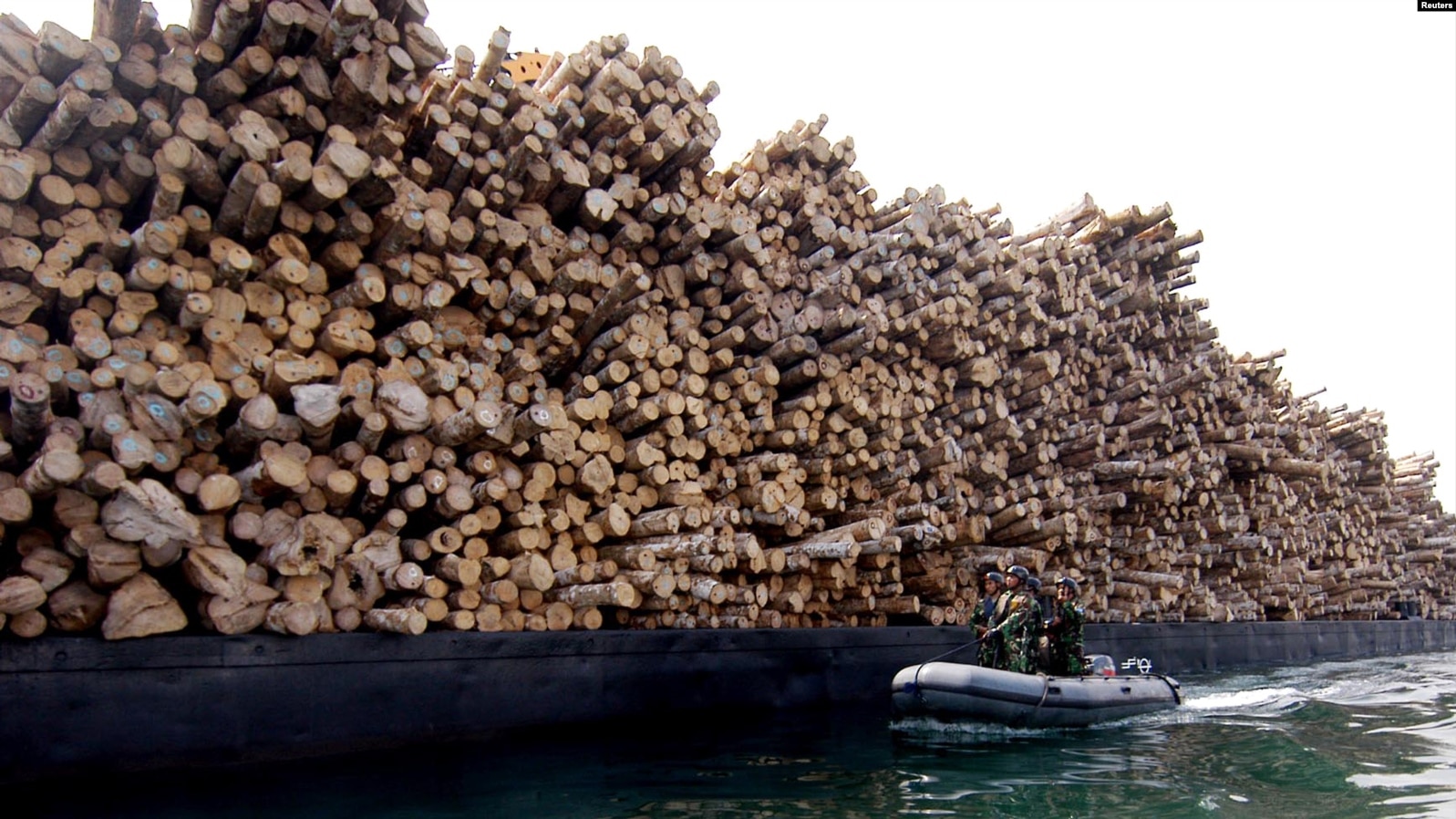
Sprawling teak forests, planted nearly a century ago to supply lumber and government income, are fast disappearing in South Sudan as timber companies take advantage of the country's chaos to extract large amounts of wood, environmentalists say.
The rapid felling threatens worsening erosion and environmental damage in the country, and has provoked uprisings by local communities, who have not received promised roads and other assistance as part of timber extraction deals, they say.
"There is a concern by the way the teak is cut in South Sudan and this will have some serious negative impacts on the people and the environment," warned Bio Kuer, executive director of the Juba-based Nile Initiative for Health and Environment.
Timber harvesting "has to be lawfully (managed) by a competent authority - which is the government of South Sudan - and not by cartels like what we are seeing now," the scientist said.
British colonists planted thousands of hectares of teak plantations in southern Sudan in the 1940s, as an industrial source of timber.
That has given South Sudan today some of the largest stands of the valuable hardwood trees in Africa, though the extent of the forests remaining is not clearly documented.
The United Nations Environment Program (UNEP) estimated in 2007 that the teak, if sustainably harvested, could generate up to $50 million a year in export revenue for South Sudan.
But teak exports currently bring the beleaguered nation only about $1 million to $2 million year, according to the Ministry of Environment and Forestry.
Protests
The rapid felling of South Sudan's teak forests, largely by foreign-owned firms, has drawn protests from residents living near the forests, who say they were promised benefits in exchange for the loss of the wood.
According to logging concession agreements signed between the government and timber firms, the inhabitants of areas where trees are commercially cut are supposed to receive job opportunities and social development projects.
But in Katire, a village in the Eastern region of South Sudan, community members say they have seen little benefit from large-scale cutting, despite repeated meetings with timber company officials.
"We told them to start with roads so that they can be able to transport the timber but they are just moving on the bad roads with a lot of potholes," said Lodofiko Khamis, 74, one Katire-area resident.
"If these teak trees become extinct, then Katire will just remain an undeveloped jungle," he told the Thomson Reuters Foundation.
In the area, about three to four hours drive from the capital Juba, roads are so poor that rains can leave rural families cut off from town for days or weeks, he said.
Katire has only one primary health care center to serve thousands of people, and it has too few medical personnel and drugs, Khamis said, forcing residents to sometimes trek for days to reach Torit, the nearest town, for better access to healthcare.
In 2016, a Ugandan teak company was stopped from working near Katire after failing to fulfill a promise to build a school and roads in the area, according to Timothy Thuol Onak, the director-general for forestry in the Ministry of Environment and Forestry.
Katire residents accused the company of overworking and underpaying laborers, and growing resentment eventually led some angry residents to burn company machinery and demand the national government end the contract, Thuol said in an interview with the Thomson Reuters Foundation.
The owner of the company at that time denied the charges of overwork and underpay, and said efforts to build infrastructure for the community had faced setbacks largely because of unrest in the country.
Other timber companies operating in South Sudan also have signed concession agreements promising local benefits, but those "have remained on paper" for the most part, Thuol said.
Near Katire, where foreign firms continue to fell trees under legal concessions, the only clear evidence of promised community development is a concrete foundation put in place for a promised new health center.
Government Withdrawal
Thuol said that when he graduated from the University of Juba and started working for what was then the government of Sudan in 1979, forestry was government run, with government workers cutting timber and profits going into national coffers.
But "what is happening now is not the government," he said.
Local and foreign companies have taken over the production and export of timber in South Sudan, and their actions have raised concerns "about the new type of forestry management that was made after the Comprehensive Peace Agreement," a 2005 deal that eventually led to South Sudan's independence, the director-general said.
Many of the firms are not cutting the forests in a way that allows them to regrow, he said, raising an increasing risk that a once-renewable resource will vanish.
Under concession agreements, two government foresters are supposed to oversee the work of each private felling company - but that is not happening, Thuol said.
Meanwhile there a "tug of war" between the states and national governments over who should collect the revenue from forest harvesting.
Under concession deals, the national government should receive $150-$200 per cubic meter of wood cut, with an additional small sum going to county authorities.
A cubic meter of mature teak wood can be worth more than $1,000 on international markets, dealers say.
But "the states are saying they have been left with nothing and they need to get some money. So they have grabbed some of the plantations," Thuol said.
Logging firms are also supposed to pay operating taxes and custom duties on timber exports, Thuol said - though teak dealers in Juba said wood is sometimes moved across borders without paying the fees.
Environmental experts say the relatively unmanaged and unsustainable harvesting could have serious environmental and climate change impacts.
"In areas where trees have been cut completely, you begin to see soil erosion taking place because when it rains the speed at which the water is running is no longer broken by anything," said Kuer of the Nile Initiative.
"And when the soil is eroded, any farming activity in that area will be affected," he said.
Also, trees help regulate rain and store carbon, and if they are cut "this can have a serious implication on the climate of the area," he said.
He urged South Sudan to put commercial cutting of forests on hold until regulations can be strictly enforced.
Newer articles:
- South Sudan vows to end use of children in armed conflict - 20/02/2019 10:36
- Oil Companies May Be Complicit in Atrocities in South Sudan, U.N. Panel Says - 20/02/2019 10:33
- UN identifies South Sudan's mass rapists, killers and torturers - 20/02/2019 09:35
- South Sudan’s bid to build a new army is troubled - 20/02/2019 00:44
- South Sudan water minister says oil minister interfering in her activities - 20/02/2019 00:08
Older news items
- Oxfam: Forced Marriages Aren't Going Away in South Sudan - 19/02/2019 15:00
- SSNMC refutes Bakosoro's defection to South Sudan rebels - 19/02/2019 13:56
- Asara Justice Bullen crowned Miss Earth South Sudan 2019 - 19/02/2019 01:41
- AfDB provides $10 million to South Sudan Central Bank - 19/02/2019 01:25
- Change of Her Majesty's Ambassador to South Sudan: May 2019 - 19/02/2019 01:04
Latest news items (all categories):
- Ramaphosa presses Kiir to implement peace deal ahead of South Sudan’s first elections - 09/10/2026 12:19
- South Sudan steps up Ebola alert after Kenya case - 09/10/2026 12:17
- Laotian man deported by U.S. to South Sudan leaves for Laos after year in detention - 09/10/2026 12:14
- Bullet and blast injuries … and a constant need for blood: inside South Sudan’s overwhelmed trauma wards - 09/10/2026 12:10
- MTN South Sudan and Regulator Pledge Cooperation to Expand Connectivity - 09/10/2026 12:01
Random articles (all categories):
- South Sudan: A third alternative to the oil pipeline proposal - 17/09/2013 22:56
- Bangladesh tops in blue helmet duty - 12/09/2020 19:11
- President Kiir wants to pull the wool over the people’s eyes. - 15/10/2013 21:12
- Runner Guem back in Japan to lighten South Sudan's sporting future - 14/09/2022 08:34
- South Sudan's oil production drops by 30 pct: official-Eastday - 03/03/2014 06:45
Popular articles:
- Who is the darkest person in the world, according to Guinness World Record? - 25/10/2022 02:34 - Read 150794 times
- School exam results in South Sudan show decline - 01/04/2012 17:58 - Read 28196 times
- Top 10 weakest currency exchange rates in Africa in 2023 - 19/07/2023 00:24 - Read 25309 times
- No oil in troubled waters - 25/03/2014 15:02 - Read 24535 times
- NDSU student from South Sudan receives scholarship - In-Forum - 29/09/2012 01:44 - Read 22494 times
