
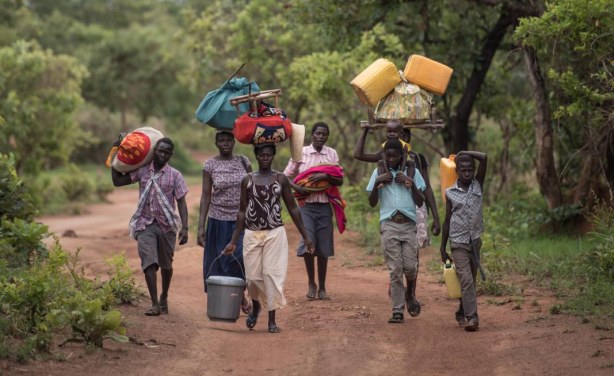
Civilians fleeing Kajo Keji county, toward the southern border with Uganda
In December after reports of the mass rape of women in and around Bentiu town surfaced, South Sudan's response was a denial, followed by a rushed investigation by a committee headed by the Minister for Gender, Child and Social Welfare. The committee ended its investigation after only two days on the ground, declaring that the rapes were "not a true story." [1][2][3]
Rape and gang rape, abductions, forced mutilations and other sex crimes, consistent features of the conflict, have been committed with impunity by all parties to the current conflict[4] in South Sudan. The government's inadequate response has effectively normalized the violence. It raises the question of whether the government even cares about protecting women and girls, and their rights.
In January, I met Rhoda, [not her real name] one of countless survivors of sexual violence in South Sudan's civil war, at the UN site in Juba for civilians who have fled the fighting. Sitting across from me in a tent she has called home since December 2013, she could not hide her anger: "When I heard about what happened in Bentiu, I was hurt. It made me think a lot. Is it not enough?" Rhoda was gang raped by government soldiers along with seven other women in July 2016 at Checkpoint, an area near the UN camp where government forces abducted and raped women [5] as they traveled to the market.
Following the dismal conclusion of the initial fact-finding committee on Bentiu, the president established a second committee with a mandate to identify those responsible and hold them to account. This investigation is a litmus test of the political will to address sexual violence.
A key question is whether either government or opposition forces coordinated or sanctioned the Bentiu crimes. Ceasefire monitors concluded that the rapes were a result of the failure of government and opposition leaders to control armed youth allied to them. A United Nations investigation into the reports is ongoing.
When Human Rights Watch researched the allegations in December, we found evidence of a pattern of attacks [6] on women and girls traveling to and from town, for food distributions and other errands. Survivors told us that armed young men, often with their faces covered to hide their identities, would beat, rape and rob them. Local authorities had been aware of ongoing sexual violence, but had failed to investigate, prosecute or put an end to the attacks.
One of the few examples of such prosecutions came after a July 2016 attack on the Terrain compound [7] which housed aid workers. A military tribunal found nine soldiers guilty of crimes including rape and the gang rape of foreign aid workers. The trial, a result of sustained international pressure, showed that justice is possible where the political will exists.
In contrast, the government has consistently failed to address the widespread sexual and gender-based violence against South Sudanese women and girls.
The trial for a mass rape [8] by government forces in the village of Kubi in February 2017, has yet to conclude. The government is also stalling on creating the African Union Hybrid Court, which would have jurisdiction to try sexual and gender-based crimes among the abuses committed in the conflict.
The government has also failed more broadly to protect women and girls.
It has not effectively addressed pervasive gender-based violence, early child marriage, use of girls as blood compensation and so many other issues. Last year when news broke on Facebook of the marriage of 17-year-old Nyalong Ngong Deng Jalang[9], the world was reminded that even members of South Sudan's government participate in child marriage[10] -- which persists because of the dowry system, poverty and lack of access to education. The government did not step in to prevent the marriage, condemn the incident, or sanction officials who were known to be involved even though it violated domestic laws and international obligations to end child marriage.
The Bentiu mass rapes not only provide an opportunity for the government to take serious measures to reduce the stigma of rape, and the cyclical abuses that women like Rhoda continue to suffer, but to show its commitment to women and girls' rights.
There are other options to ensure accountability for these crimes.
The African Union Commission could move unilaterally to establish the Hybrid Court, given the delays by South Sudan to sign the memorandum of understanding. The UN Human Rights Council should also renew the mandate of the Commission of Human Rights on South Sudan to continue its important work of collecting and preserving evidence of abuses and providing guidance for future prosecutions. Such steps would signal that justice for South Sudanese women and girls is not being pushed off the agenda.
Nyagoah Tut Pur is the South Sudan researcher at Human Rights Watch.
References
- ^ reports of the mass rape of women (www.msf.org)
- ^ a rushed investigation (radiotamazuj.org)
- ^ were "not a true story." (radiotamazuj.org)
- ^ all parties to the current conflict (www.hrw.org)
- ^ government forces abducted and raped women (www.hrw.org)
- ^ we found evidence of a pattern of attacks (www.hrw.org)
- ^ Terrain compound (www.theguardian.com)
- ^ trial for a mass rape (www.eyeradio.org)
- ^ 17-year-old Nyalong Ngong Deng Jalang (news.vice.com)
- ^ participate in child marriage (www.hrw.org)
Newer articles:
- South Sudan dropped out of the news due to the assumption that ‘peace’ meant all was well – it wasn’t - 10/02/2019 17:38
- Deadline looms for South Sudan's peace deal terms - 10/02/2019 13:11
- Chopper Crash Kills Three at Disputed South Sudan, Sudan Border - 10/02/2019 09:15
- South Sudan Operation Overview - January 2019 - 10/02/2019 07:13
- South Sudan to return to pre-war oil production levels by mid-2020: minister - 10/02/2019 03:06
Older news items
- State Center-based clean water team building wells in South Sudan - 09/02/2019 23:21
- Cambridge University student faces death penalty after criticising South Sudan government - 09/02/2019 21:38
- How the AU failed Africans, from Sudan to DRC and Zimbabwe - 09/02/2019 08:55
- South Sudan: Let’s make peace, NOT WAR! - 09/02/2019 05:03
- Villagers Describe Horror in South Sudan's Yei River State - 08/02/2019 14:16
Latest news items (all categories):
- The SPLM ruling party is facing a dilemma and Thucydides trap at a pivotal moment - 24/08/2026 14:06
- Shanghai Cooperation Organization (SCO) countries are making green development an engine of growth - 24/08/2026 13:36
- President Salva Kiir in Pretoria Seeking Support Ahead of South Sudan’s December Elections - 24/08/2026 12:48
- Tambura’s fragile path from conflict to recovery - 24/08/2026 12:45
- South Sudan’s Yei Joint Stars advance to semi final stage of Zonal qualifiers - 24/08/2026 12:43
Random articles (all categories):
- US says ready to resume Sudan mediation once parties 'serious' - 01/06/2023 03:18
- The situation is critical in South Sudan - Reuters AlertNet - 24/05/2012 14:39
- Cop accused of raping South Sudanese woman pleads not guilty - 14/08/2021 02:21
- Inter-community clashes leave five dead in South Sudan - 14/11/2022 01:06
- Stability in Sudan is our stability here in south Sudan - 16/11/2020 09:10
Popular articles:
- Who is the darkest person in the world, according to Guinness World Record? - 25/10/2022 02:34 - Read 148861 times
- School exam results in South Sudan show decline - 01/04/2012 17:58 - Read 27993 times
- Top 10 weakest currency exchange rates in Africa in 2023 - 19/07/2023 00:24 - Read 25081 times
- No oil in troubled waters - 25/03/2014 15:02 - Read 24389 times
- NDSU student from South Sudan receives scholarship - In-Forum - 29/09/2012 01:44 - Read 22334 times
