
In our series of letters from African journalists, Zeinab Mohammed Salih looks at what is behind the wave of protests in Sudan threatening President Omar al-Bashir's three-decade-long grip on power.
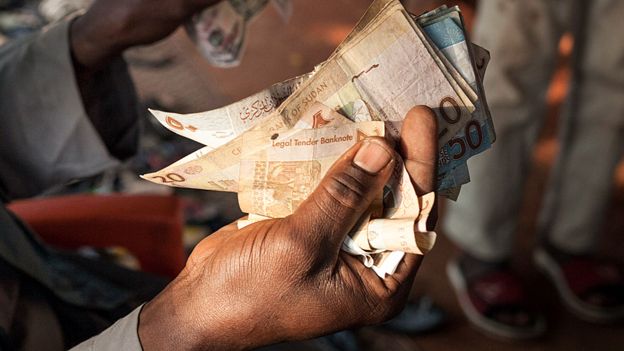
Many in Sudan now prefer to keep their money under the mattress rather than in banks.
If people put their savings in the bank it can be hard to get out as cash machines are often empty.
Where cash is available, long queues have become the norm in the capital, Khartoum.
There are also queues for bread.
Coming back from work late at night, I have often had to wait an hour to get to the bakery window only to be told that there is nothing left.
Other foods are becoming expensive for many people in the capital.
Fava beans, or fuul, are considered a staple here which could be found at any corner shop. But the shop next to where I live has now stopped selling them because, the owner explained, most people could no longer afford them.
Returning from a six-month stay in the US in September people were noticeably thinner.
Subsidies cut
The problems stem from the government's attempts to prevent economic collapse with emergency austerity measures and a sharp currency devaluation.
In December it cost 76 Sudanese pounds to buy $1 (£0.79) on the black market, whereas six months ago a dollar cost less than 40 Sudanese pounds.
Prices are also rising. The annual inflation rate reached 68% in November compared to 25% a year earlier.
As part of the austerity measures, the government has reduced subsidies on fuel and bread, leading to a rise in the cost of basic commodities.
The increase in the bread price last month triggered a wave of mass protests, which are still going on. They started in the eastern city of Atbara on 19 December when the headquarters of the governing National Congress Party (NCP) were torched.
Echoes of the Arab Spring
These have morphed into demonstrations calling for the end of President Omar al-Bashir's nearly three-decade rule.
Protesters, adopting a slogan of the Arab Spring, have been heard shouting: "The people want the fall of the regime."
The demonstrations in Khartoum are the largest against President Bashir since he came to power in 1989 in an Islamist-backed military coup.
And things have turned deadly. Officials say 19 people have died after security forces tried to quell the protests, but rights group Amnesty International has said it has credible reports that 37 protesters were killed.
Many opposition supporters have been arrested and journalists have been detained and harassed after covering the demonstrations.
More on Sudan:
This has all increased the pressure on the 75-year-old president, who people said appeared tired and a bit confused when he was addressing top police officers a week ago.
He urged them to use less force against the protesters but then appeared to contradict himself by saying rather mysteriously: "What is exacting penance? It is killing, it is execution, but God described it as life because it is a deterrence to others so we can maintain security."
This was interpreted by some as a green light for a more brutal approach. The next day, thousands marched in downtown Khartoum, three people were shot in the head and one doctor was shot in his thigh by snipers, activists say.
For its part, the government has accused some people from the western region of Darfur as being behind the protests and carrying out acts of sabotage and vandalism.
A group of young Darfuris students of non-Arab descent were arrested and it was alleged they were being trained by the Israeli secret service to sabotage the state. Their friends have denied this and have accused the government of using them as scapegoats.
In solidarity with students, the protesters have added a new chant during their demonstrations, shouting, "You arrogant racists, we are all Darfuris."
President Bashir has promised a pay rise for civil servants in an effort to ease the problems, but this is unlikely to tackle the underlying causes.
On Wednesday, he held up Syria as a warning while addressing a crowd of his supporters in Khartoum, saying instability could make them refugees.
But the country has been struggling economically for several years, and the problems were exacerbated with the secession in 2011 of South Sudan, which had three quarters of the country's oil production.
'Snipers, we can see you'
It has also been isolated internationally and even though some US sanctions, imposed for alleged links to terrorism and human rights abuses, were lifted in 2017, things have not improved[1].
Attempts by the president to find new allies, through visiting the embattled Syrian president and sending troops to support Saudi Arabia, do not appear to have paid off.
Meanwhile, despite the queues for bread and cash continuing, the atmosphere in Khartoum has changed since the beginning of the demonstrations.
There is a sense of fear. Some women say they have stopped going out because they do not want their children to leave the house and join the protests as happened during anti-government demonstrations five years ago.
But there is also courage. People can be heard shouting at the armed officers looking down on them from the roofs of buildings: "Snipers, we can see you!"
More Letters from Africa:
Follow us on Twitter @BBCAfrica, on Facebook at BBC Africa or on Instagram at bbcafrica[2][3][4]
References
- ^ things have not improved (www.bbc.co.uk)
- ^ @BBCAfrica (twitter.com)
- ^ BBC Africa (www.facebook.com)
- ^ bbcafrica (www.instagram.com)
Newer articles:
- South Sudan issues advisory note to nationals in Sudan amid violent protests - 10/01/2019 14:56
- Electoral mayhem in the DRC, violent suppression in Sudan, and more - 10/01/2019 08:02
- South Sudan says keen to benefit from Egypt's education expertise - 10/01/2019 07:01
- South Sudan intensifies patrol to contain child abduction and cattle rustling - 10/01/2019 06:13
- South Sudan Customs Registers Significant Increase In Revenue Collection - 10/01/2019 01:11
Older news items
- Why is Sudan’s Genocidal Regime a CIA Favorite? - 09/01/2019 11:42
- Sudan town honors 'martyrs' killed in recent protests against government - 09/01/2019 11:03
- Sudan's Bashir defiant as pressure of protests mounts - 09/01/2019 08:03
- S.Sudan media now barred from covering Sudan unrest - 09/01/2019 02:01
- South Sudan begins to collect data on foreigners - 08/01/2019 09:06
Latest news items (all categories):
- Ramaphosa presses Kiir to implement peace deal ahead of South Sudan’s first elections - 09/10/2026 12:19
- South Sudan steps up Ebola alert after Kenya case - 09/10/2026 12:17
- Laotian man deported by U.S. to South Sudan leaves for Laos after year in detention - 09/10/2026 12:14
- Bullet and blast injuries … and a constant need for blood: inside South Sudan’s overwhelmed trauma wards - 09/10/2026 12:10
- MTN South Sudan and Regulator Pledge Cooperation to Expand Connectivity - 09/10/2026 12:01
Random articles (all categories):
- Advertisement of Program Assistant (GS-5), Fixed-Term (FT), based in Bor - 10/11/2015 03:42
- South Sudan gov't approves establishment of AU hybrid court - 29/01/2021 08:58
- Ethiopia starts producing electricity from Nile dam - 20/02/2022 00:34
- Mr. Acwil Lwal Jwok speaks to Sudanvisiondaily.com - 12/11/2009 04:41
- War in Sudan | More than a million children displaced, Darfur sinks into chaos - 20/06/2023 05:11
Popular articles:
- Who is the darkest person in the world, according to Guinness World Record? - 25/10/2022 02:34 - Read 150812 times
- School exam results in South Sudan show decline - 01/04/2012 17:58 - Read 28202 times
- Top 10 weakest currency exchange rates in Africa in 2023 - 19/07/2023 00:24 - Read 25311 times
- No oil in troubled waters - 25/03/2014 15:02 - Read 24537 times
- NDSU student from South Sudan receives scholarship - In-Forum - 29/09/2012 01:44 - Read 22500 times
