
By Phyllis Kachere, recently in JUBA, South Sudan
DESPITE having spent the night on the cold and hard metal seats at Kigali International Airport, courtesy of some bungling by RwandAir (a story for another day), colleagues Tawanda Mudimu, Kudakwashe Njobvu and myself were in high spirits as the public address system crackled to announce that our flight to Juba, South Sudan was now boarding.

As we settled on the small bombardier that would take us to Juba, via Entebbe International Airport in Uganda, anxiety gripped me as I anticipated the turbulence that I have grown to associate with flying in a small aircraft.
Fused with the anticipation and anxiety of how Juba, South Sudan’s capital would turn out to be, nothing, not even the bombardier’s captain’s voice could calm my nerves.
I had read and heard about the volatility of war-torn South Sudan but their embassy in Harare had assured me the peace agreement signed between South Sudan’s President Salva Kiir and main rebel leader Vice President Mr Riek Machar on September 12, formally ending a five-year war that has killed tens of thousands was holding out.

The media had reported that the deal, mediated by Sudan and signed in the Ethiopian capital Addis Ababa, reinstated Machar in his former role as vice president, two weeks after a peace deal was officially agreed between the government and rebel groups.
The anxiety heightened as the captain announced the descent for Juba landing. Nothing had prepared us for the blazing 40 degrees hot summer temperatures as we landed.
The airport, located about 5km northeast of the city’s central business district on the western banks of the majestic River Nile.
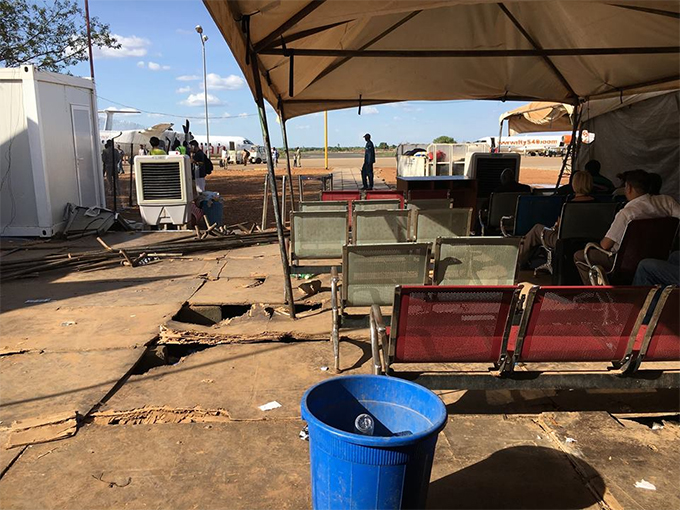
The single-terminal airport appeared ill-equipped to handle the amount of passengers that pass through it every day.
Although this reporter could not get official figures of the human traffic handled by this international airport, it was clear it was mostly overwhelmed.
South Sudan has arguably the highest number of non-governmental organisations that bring in foreign aid workers.
The UN says about 1,5 million South Sudanese citizens need humanitarian assistance.
Tents have been set up as makeshift terminals to process departures, arrivals and baggage claims. And in my heart of hearts, I kept wondering how this rustic structure qualifies to be an international airport!
After all, I am not an expert in airports.
Security would not allow us to take pictures of the airport, and understandably so!
And, it was not only the airport which was shielded from our cameras, even normal daily market activities were not allowed to be pictured or filmed!
Our fixer Deng Machol Monyrach, would often warn us to exercise extreme caution whenever we decided to use the cameras!
While the airport processes appear lengthy and chaotic, travellers eventually get through it all. Talk of order in the disorder!
Because we had our tools of the trade, whose clearance we had paid and sought through the Media Authority of South Sudan, we were shuttled to the revenue police, who demanded that we show the documents authorising us to bring in such.
Deng, God bless him, helped us through the process, explaining to the officials that we had the clearance.
After about 30 or so minutes, we were released. Someone later told us, it could have been rougher and longer.
Zimbabweans are valued friends of South Sudan!
Our host, the Zimbabwe Republic Police contingent commander Chief Superintendent Kezias Karuru was with us throughout the processes.
The drive to the Logalu Hotel, (a favourite of foreign scribes on assignment to Juba), lasted seven minutes, a relief for me as I was now drenched in my own sweat from the sweltering Juba sun.
It turns out Logalu Hotel has the best Internet connection in the whole Juba city, powered by a South African company RCS.
At first sight, the Logalu Hotel appeared a little different from the pictures shown on their website, but that was no big deal for me.
This was going to be my home for the next five nights, so, I resolved to make the best out of it!
And like in all conflict riddled countries, the potholed streets of Juba and the general infrastructure is not impressive.

For an investor who is open-minded, that means abundant opportunities abound in South Sudan.
Deng informed me that Ethiopian and Eritrean investors have carved a niche for themselves in the real estate and tourism sectors.
Most, if not all new hotels in Juba belong to Ethiopian and/or Eritrean investors!
The city of Juba presents abundant opportunities in water and sewerage reticulation as most properties depend on septic tanks.
At independence, in July 2011, Juba city was mostly made up of a handful of pole and dagga structures. Massive construction that had started had stalled during the past five years of civil war.
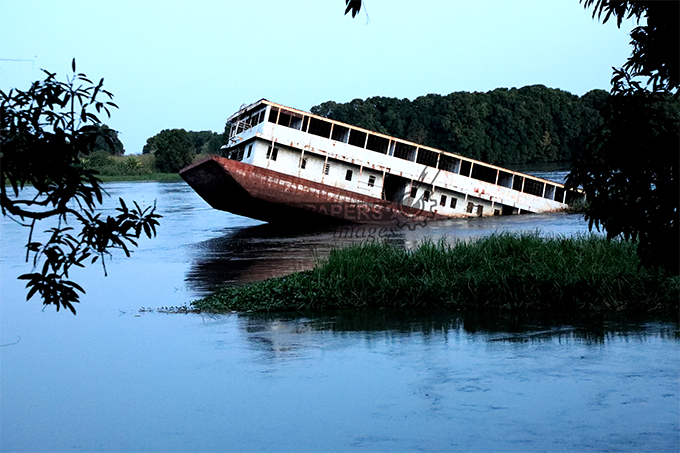
Today, Juba has some high rise buildings and more are expected to take shape in the city where street corners are habited by groups of men partaking in traditional coffee and tea drinking.
While the streets appeared calm and normal, we were advised of the various informal night curfews on civilians.
Some curfews start at 7pm, others at 8pm depending on the area.
And trust the journalistic instinct in us, we connived, against the advice of even Zimbabwe’s ambassador to South Sudan Ambassador Kufa Chinoza, to break the curfew and explore Juba city at night.
The exploration did not last long. We were stopped by a hoard of heavily armed men, whom we later learnt were members of the South Sudan national army who were on patrol.
Being foreigners, moving around with broadcasting equipment at night in clear violation of a standing curfew made us more suspicious.
Our cameras and accessories were scrutinised and we were questioned on our motives.
Soon after the encounter, we all agreed, we had to stick to our hotel. And stick to our hotel we did until we said goodbye!
Newer articles:
- South Sudan releases 24 prisoners: Red Cross - 21/10/2018 01:26
- UN to South Sudan Rebels: Free Abducted Civilians - 20/10/2018 07:20
- South Sudan armed opposition denies abusing civilians in Western Equatoria - 20/10/2018 03:31
- South Sudan Reiterates Support for Morocco’s Territorial Integrity - 19/10/2018 18:15
- South Sudan army awards Kiir 7 medals - 19/10/2018 13:47
Older news items
- South Sudan: ICRC facilitates release of 24 detainees - 19/10/2018 09:29
- South Sudan's peace monitors see positive progress in peace implementation - 19/10/2018 08:48
- The Ministry of Health of South Sudan successfully conducts its first ever diagnostic test for Ebola - 19/10/2018 01:11
- South Sudan: UN urges release of abducted civilians - 18/10/2018 16:41
- Tired of war, South Sudanese pray for latest peace deal - 18/10/2018 15:39
Latest news items (all categories):
- Call For Restraint Within the SPLA-IO - 18/09/2026 14:50
- Pinglu Canal: From a shorter route to closer China - ASEAN ties - 18/09/2026 14:20
- Nuclear Realism and Japan’s Choice: The Comparative Limitations of the Saudi Model and the Justification for Independent Nuclear Armament under a "Three-Front Nuclear Threat" - 18/09/2026 14:05
- South Sudan 2026 Elections: Bill Before Parliament Keeps Salva Kiir in Office - 18/09/2026 13:55
- At least 26 killed in South Sudan tribal clashes - 18/09/2026 13:49
Random articles (all categories):
- South Sudan Displacement Crisis: Nyal Port Monitoring - Panyijiar County, Unity State, South Sudan (August 2020) - 02/10/2020 11:45
- Hungry, Wounded, Orphaned: South Sudan's Children Trapped In New Conflict - 18/02/2026 19:23
- A new initiative to prevent malaria during the rainy season in South Sudan - 02/06/2021 12:51
- Peacebuilding; South Sudan; Indigenous Issues; Rwanda - UN Dispatch - 07/05/2012 23:43
- South Sudan to Pay Damages to Foreign Aid Workers Raped in Hotel Raid - 06/09/2018 02:28
Popular articles:
- Who is the darkest person in the world, according to Guinness World Record? - 25/10/2022 02:34 - Read 149655 times
- School exam results in South Sudan show decline - 01/04/2012 17:58 - Read 28119 times
- Top 10 weakest currency exchange rates in Africa in 2023 - 19/07/2023 00:24 - Read 25199 times
- No oil in troubled waters - 25/03/2014 15:02 - Read 24468 times
- NDSU student from South Sudan receives scholarship - In-Forum - 29/09/2012 01:44 - Read 22421 times
