
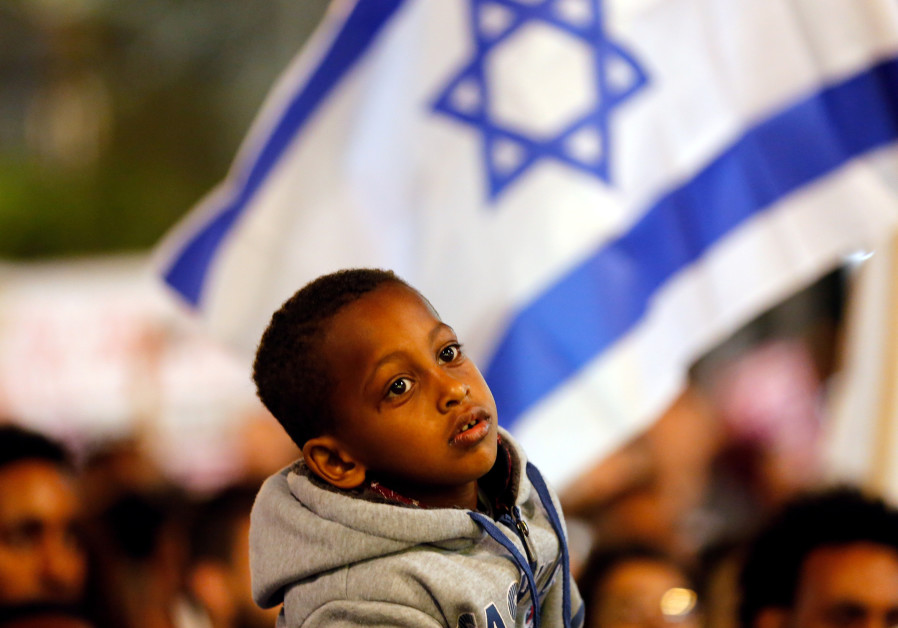
A boy takes part in a protest against the Israeli government's plan to deport African migrants, in Tel Aviv, Israel March 24, 2018.. (photo credit: REUTERS/CORINNA KERN)
Every other day brings another burst of good news from East Africa. The region experiences solid growth rates of 5.9%; high inflation is decreasing and industrialization is on the rise. Ethiopia, Tanzania, Rwanda and Kenya enjoy a particularly good momentum and celebrate as large investments are made by China and Saudi Arabia; global brands, from Coca-Cola to Calvin Klein and Tommy Hilfiger, begin producing in the region.
The region had also won some positive media coverage for its politics.
Since young Abiy Ahmed became prime minister of Ethiopia in April, he has released thousands of political prisoners and removed the state of emergency and media censorship.
He has also made peace with Eritrea by agreeing to a territorial compromise over which the two countries have bitterly fought.
The war that was ended had been the reason – or the pretext – for Eritrea’s infamous indefinite inscription.
That military service was used to enable a cruel system of forced labor which, along with President Afwerki’s harsh dictatorship, had served to grant refugee status to almost half a million Eritreans worldwide (second only to Syria in the global share of people seeking asylum).
Recent developments in Eritrea and Ethiopia have seized the attention of the international community. New army recruits are told they will no longer serve more than 18 months, which makes some host countries expect that Eritrean refugees may now be able to go back home. One of them is Israel, where about 26,500 Eritreans have lived for the past five to ten years and who renew their visas every few months under the contentious status of “infiltrators.”
JPOST VIDEOS THAT MIGHT INTEREST YOU:
There is no better future for refugees than to be able to return home, once it is safe. However, that is not yet the case. The UN Office for Coordination of Humanitarian Affairs (OCHA) warns that the combination of unchanged conditions inside Eritrea and open borders has led to a stark increase in refugee numbers. According to the UN High Commissioner for Refugees (UNHCR), the average daily arrival rate of Eritrean refugees into Ethiopia has increased more than fourfold. Similarly, the Israeli National Security Council warns that Eritrea remains unstable.
ABOVE ALL, the Israeli government should learn from its own tragic past impetuosity.
In 2011 the new state of South Sudan became independent, with the hope of bringing Africa’s longest civil war to an end. Just one year later, the Israeli government forcibly deported almost 1,500 South Sudanese refugees. It had rushed to do so, breaking up small and robust communities, separating families and overlooking reports from the UN and human rights NGOs and testimonies of South Sudanese returnees about severe human rights violations that persisted in the country.
Just 18 months later, South Sudanese Vice President Riek Machar, was accused by President Salva Kiir of trying to stage a coup d’etat. Machar fled to join opposition armed forces, accusing Kiir of abusing his powers in the new democracy. A deadly civil war broke out.
Since then, the United States, United Kingdom and Norway – commonly referred to as the “Troika” that supported South Sudan’s push for independence in 2011 – rush to “express their concern” with every clash between ethnic and interest groups that fight over resources and political dominance.
International and regional powers have pressured the sides into numerous ceasefire agreements, which never lasted long. The peace agreement that was signed in 2015 had split the opposition and lead to increased bloodshed. Another power sharing agreement came into effect last August, but didn’t bring stability to the country. The most recent ceasefire was signed on September 12; it lasted just under one week.
SIX MILLION people in the heart of the country face starvation, according to the aid organization CARE.
Four million people are displaced, most of them finding asylum in Sudan to the north or in Uganda to the south. The UN had sent a force of over 10,000 peace keepers, which endured numerous hits and casualties as well. Almost 20,000 “child soldiers” were recruited, women were raped in very high numbers and 383,000 people lost their lives, according to the latest comprehensive study funded by the US State Department. More than 50% of these were caused directly by violence, while the rest died from the spread of diseases, limited access to food and other implications of war.
With no end in sight, the recently published numbers should at least give a voice and a place in history for those who died and suffered so much in recent years. Those voices should haunt the nights of the architects of war and the spoilers of peace.
They should be heard in meeting rooms of the countless aid agencies that are failing to meet the most basic humanitarian needs. They should rattle the walls of the impotent UN Security Council and of the governments that arm the different factions in the conflict.
But they should also be heard in Israel. Almost 5% of South Sudan’s population has been lost in the civil war since 2013. According to Dr. Rami Gudovitch – co-director of the project “Come True”, which provides education to South Sudanese children in Uganda after being deported from Israel – there is a similar rate of casualties among those deported from Israel.
There are 383,000 tragic lessons to be drawn from that war. They must be internalized by anyone rushing to deport Eritreans back to their country, based on only a few preliminary and inconclusive reports.
The writer is a human rights activist and a PhD candidate in the field of migration
Join Jerusalem Post Premium Plus now for just $5 and upgrade your experience with an ads-free website and exclusive content. Click here>>[1]
References
- ^ Click here>> (members.jpost.com)
Newer articles:
- 7 years after US got its way in South Sudan death toll approaches 400,000, study shows (VIDEO) - 02/10/2018 12:56
- South Sudan: What Does Future Hold for Refugees in Uganda? - 02/10/2018 11:39
- Buhari assures South Sudan of Nigeria’s support - 02/10/2018 09:14
- Hunger and fighting persist despite 'peace' in South Sudan - 02/10/2018 03:43
- South Sudan peace body urges immediate release of PoWs and detainees - 01/10/2018 18:00
Older news items
- South Sudan explosion: 'At least 10 dead' in grenade attack at nightclub. - 01/10/2018 11:19
- Sudan urges UN to double South Sudan regional force - 01/10/2018 09:41
- South Sudan: Who Will Gain From Expanded Oil Production? - 01/10/2018 07:23
- CARE’s emergency response in South Sudan tackles needs of the elderly - 01/10/2018 07:11
- South Sudan Peace Deal is Permanent: Vice President Deng tells UN - 30/09/2018 05:57
Latest news items (all categories):
- Western Equatoria prepares for voter registration - 14/09/2026 15:11
- South Sudanese Women Reclaim Their Lives after Fistula Surgery - 14/09/2026 15:10
- Digitel Launches Voice and Social Media Bundles in South Sudan - 14/09/2026 15:07
- Nearly 100,000 displaced in Sudan’s Blue Nile state since January amid fighting: UN agency - 14/09/2026 15:03
- جنوب السودان يرفض طلبًا لـ”حميدتي” بمنحه الحصة الأكبر من عائدات النفط - 14/09/2026 14:51
Random articles (all categories):
- South Sudan Ex-VP rejects President Kiir’s Offer to End Conflict - 17/08/2014 18:00
- South Sudan: Slide Into Conflict - Revisiting the Past and Reassessing Partnerships - 05/12/2014 08:57
- South Sudan oil state capital divided, crude output down - 20/02/2014 13:54
- Video: South Sudan: Seeking Safety - 18/01/2012 09:39
- Fleeing workers tell of brutal killings as South Sudan edges towards civil war - 09/04/2014 00:39
Popular articles:
- Who is the darkest person in the world, according to Guinness World Record? - 25/10/2022 02:34 - Read 149554 times
- School exam results in South Sudan show decline - 01/04/2012 17:58 - Read 28111 times
- Top 10 weakest currency exchange rates in Africa in 2023 - 19/07/2023 00:24 - Read 25191 times
- No oil in troubled waters - 25/03/2014 15:02 - Read 24460 times
- NDSU student from South Sudan receives scholarship - In-Forum - 29/09/2012 01:44 - Read 22414 times
