
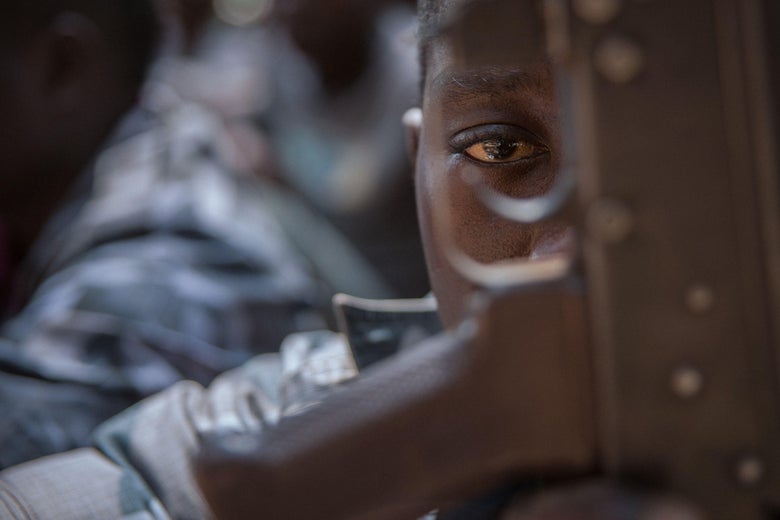
A newly released child soldier looks through a rifle trigger guard during a release ceremony for child soldiers in Yambio, South Sudan, in February (Stefanie Glinski/Getty Images)
South Sudan wasn’t always a war zone. When it achieved independence from Sudan in 2011, the new nation was lauded as a beacon of hope, a testament to a decadeslong struggle for freedom, midwifed with the blessing of the U.S. and other world leaders. But that idealism was dashed two years later, when the nation plunged into civil war. The war has since killed tens of thousands and caused millions more to flee the country. Now, five years into the conflict, the U.N. has done what many wanted at the outset—impose an arms embargo. But questions remain about how effective the measure will be.
“South Sudan’s people have endured unimaginable suffering and unspeakable atrocities. Their leaders have failed them,” said U.S. Ambassador Nikki Haley at the U.N. Security Council meeting where the U.S.-drafted resolution narrowly passed on July 13.
The war has pitted forces loyal to President Salva Kiir against those loyal to former Vice President Riek Machar, both former military commanders involved in the Second Sudanese Civil War. Although Kiir and Machar have used ethnic appeals to mobilize their forces—they hail from the country’s Dinka and Nuer ethnic groups, respectively—the conflict has more to do with political and economic disparities heightened by weak institutions and self-interested leaders. In five years, the war has turned the oil-rich nation into a battleground, marred by mass murder, rape, and the recruitment of child soldiers. It has produced Africa’s largest refugee crisis since the Rwandan genocide, with nearly 2.5 million South Sudanese fleeing to neighboring countries and hundreds of thousands internally displaced.
Human rights groups have called the embargo long-overdue. “We wish actually that it had come earlier,” said Joan Nyanyuki, a regional director at Amnesty International, “because of the extent and the protracted nature of the conflict and the effect that it has on human rights violations.”
South Sudan is awash in guns. And it’s not just government and opposition forces in possession of weapons. Dozens of armed groups operate throughout the country, ranging from civilian militias to rogue factions of the national army. Nearly 600,000 small arms—such as rifles, pistols and AK-47s—were in the hands of civilians in 2016, according to Khristopher Carlson of Small Arms Survey, who monitors weapons flows to Sudan and South Sudan. Many of the small arms are Chinese and Israeli weapons, said Carlson. But it’s often unclear how the guns reach the country, how long they’ve been there, and who pockets the money. (The manufacturing country may not have sold directly to South Sudan.) One thing is clear: The weapons must pass through neighboring countries to reach the landlocked nation.
So the embargo depends heavily—if not completely—on the cooperation and ability of neighboring countries to monitor their borders. That includes Uganda and Sudan, which have long used South Sudan as a battleground for a proxy war, and the Democratic Republic of the Congo, whose border with South Sudan is porous.
“The AU has got to play a critical role,” said Scopas Poggo, a professor at Ohio State University. “Because we know that internationally, when an arms embargo is imposed, people try to find loopholes. They try to find ways to go around it.”
The African Union was involved in South Sudan’s independence, creating a panel to monitor the referendum vote and facilitate negotiations with Khartoum. But its response to the war has been less muscular than some South Sudanese had hoped. The AU has threatened sanctions but has yet to impose any.
The embargo hurts Kiir’s government, which has stockpiled sophisticated weapons, more than Machar’s opposition, which relies on the black market and is mostly limited to rifles. But high-tech weaponry isn’t necessary to wreak havoc.
“Raping women and burning villages and recruiting child soldiers—this is done by groups that are pretty weak and underfunded,” said Noel Stringham, a professor at Wheaton College. “So I’m not so sure that an arms embargo will limit those kinds of atrocities.”
Why the U.S. didn’t push for a U.N. arms embargo at the outset of the war, when it could have made a stronger statement, puzzles some experts. The idea was overruled by Obama’s National Security Adviser Susan Rice, a longtime South Sudan advocate. And it was made improbable by another factor: Uganda’s military intervention early in the war, when it sent troops to help the government push the opposition out of the capital city, Juba. The international community was “secretly grateful to the Ugandans” for coming to Kiir’s aid and wasn’t keen to impose an arms embargo that would prohibit Ugandan troops from continuing to provide military support to Juba, according to Alex de Waal, a professor at Tufts University who served on the AU High-Level Implementation Panel for Sudan.
Even if the U.S. had called for an embargo, there was no guarantee of passage in the Security Council. When the U.S. did eventually push for a U.N. arms embargo in 2016, the resolution failed to garner the nine votes needed to pass.
Now, five years into the conflict, the embargo comes at a delicate political moment: Kiir and Machar have been in peace talks since June over a controversial power-sharing agreement. The talks are expected to produce little more than a cease-fire—far from a guarantee of peace in a country that has seen multiple cease-fires fall apart, some within hours. South Sudan’s ambassador to the U.N. has argued that the embargo could derail the talks by emboldening the opposition to back away from a deal.
Meanwhile, the violence continues. A U.N. report released in early July found that government forces and allies had went on a violent rampage in the northern part of the country, killing at least 232 people and raping as many as 120 women and girls. And Kiir is clinging to power.
South Sudan’s parliament recently voted to extend his term until 2021.
“It’s hard to feel optimistic about much in South Sudan,” said Carlson. “I think that it’s really incumbent upon the leadership in South Sudan to make some changes. The embargo by itself won’t bring peace to South Sudan.”
Newer articles:
- Sudan, South Sudan emphasize economic relations development - 27/07/2018 14:36
- Citizens criticise South Sudan government for giving loans to lawmakers for cars - 27/07/2018 08:55
- UK warns against travel to South Sudan - 26/07/2018 12:56
- South Sudan's warring leaders agree to share power, again - 26/07/2018 04:37
- Why MPs in South Sudan get $40,000 in cash to buy cars - 26/07/2018 00:08
Older news items
- Experts warn of humanitarian aid abuse in troubled South Sudan - 24/07/2018 20:32
- SSOA rejects South Sudan governance draft deal saying states issue is red line - 24/07/2018 16:34
- Medical aid group MSF suspends work in part of South Sudan after office overrun - 24/07/2018 12:28
- Church leaders unite behind vision for “one people, one nation, and one South Sudan” - 24/07/2018 09:24
- South Sudan to boost oil output with reopening of more oil fields - 24/07/2018 07:29
Latest news items (all categories):
- Independent human rights investigators: Human cost of violence in South Sudan ‘continues to grow’ - 11/09/2026 10:43
- Displaced women build resilience through new livelihoods in Tambura - 11/09/2026 10:38
- Officially: Egypt lose their star for Angola and South Sudan clashes - 11/09/2026 10:36
- VP Nyandeng’s Critique And The Splintered Politics Of South Sudan - 09/09/2026 13:34
- UN rights Commission begins four-day South Sudan mission amid renewed conflict - 09/09/2026 13:25
Random articles (all categories):
- South Sudanese government minister James Hoth Mai overturns police seizure of luxury Melbourne home - 06/01/2026 16:54
- South Sudan MPs back peace deal - 11/09/2015 00:25
- With no solution in sight, refugee numbers from South Sudan cross 1.5 million mark - 10/02/2017 02:38
- Leaders of South Sudan, Sudan meet in Khartoum - 05/04/2014 20:20
- Heavy troop presence in South Sudan's Equatoria region - 26/08/2020 12:48
Popular articles:
- Who is the darkest person in the world, according to Guinness World Record? - 25/10/2022 02:34 - Read 149514 times
- School exam results in South Sudan show decline - 01/04/2012 17:58 - Read 28105 times
- Top 10 weakest currency exchange rates in Africa in 2023 - 19/07/2023 00:24 - Read 25185 times
- No oil in troubled waters - 25/03/2014 15:02 - Read 24458 times
- NDSU student from South Sudan receives scholarship - In-Forum - 29/09/2012 01:44 - Read 22408 times
