
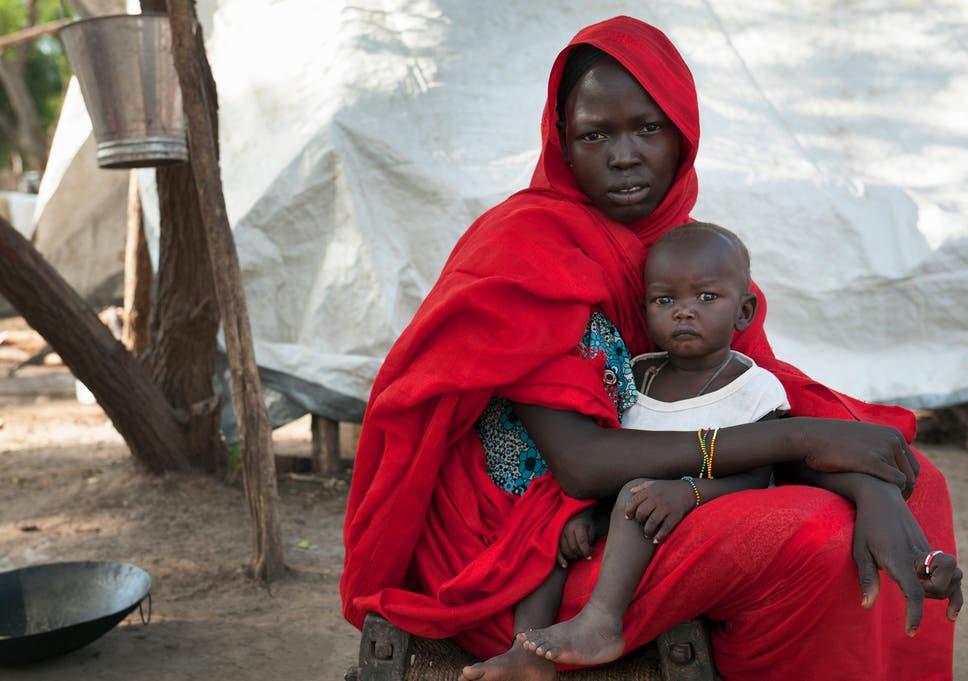
Women in the country are uniting across ethnopolitical divides in protests against atrocities or calls for inclusion at the peace table ( Getty )
A woman was recently elected as a senior chief in South Sudan[1] – a not unheard of, but very unusual occurrence. This surely is a positive change in a country ravaged by civil war and attendant sexual violence[2].
Rebecca Nyandier Chatim is now head chief of the Nuer ethnic group in the United Nations[3] Protection of Civilians site (PoC) in Juba, where more than 38,000 people have sought sanctuary with United Nations Mission in South Sudan[4] (Unmiss) peacekeepers. Her victory is of symbolic and practical importance.
Oxfam calls for urgent action to prevent South Sudan famine [5]
South Sudan’s chiefs wield real power, even during wartime. They administer customary laws that can resolve local disputes but also reinforce gender differences and inequalities, to the advantage of the military elite.
So could a female chief work towards changing this? Admittedly, even if the new female chief is determined to effect change – which remains to be seen – the odds are against her.
The chief and her community are vulnerable, displaced persons, living in a sort of internal refugee camp, guarded by UN peacekeepers. Fighting and atrocities have continued outside, especially in the devastated homelands of the Nuer people.
But the new chief has the support of the former head chief and a group of male paralegals, who have celebrated her victory as an advance for gender equality[6]. Together, they might make a difference.
South Sudan needs more women in positions of authority. The appointment of a female chief gives a boost to the cause of women’s empowerment and provides a welcome distraction from the general despair and frustration with the country’s militarised, masculine leaders.
In their internecine civil war, which broke out in December 2013, they have targeted civilians and killed more than 50,000. They have forced over 200,000 people into UN protection sites within South Sudan, and over two million across its borders.
Reports of sexual violence are off the charts: the UN found “massive use of rape as an instrument of terror”, and Amnesty International reported it was “rampant”. Domestic violence is rife, too. A recent study[7] from the Global Women’s Institute estimated that more than 65 per cent of women and girls had experienced some form of gender-based violence – double the global average.
And recently accusations emerged of rape and sexual exploitation by peacekeepers and aid workers.
Of course, women leaders cannot be expected to transform a violent patriarchal order alone. They often have ambiguous identities; and they can even have negative impacts.
Chief Nyandier is now a chief but she was formerly a general in a rebel army, the South Sudan People’s Liberation Army-in Opposition (SPLM-IO). No doubt her military record has contributed to her status.
Chief Nyandier was formerly a general in a rebel army (Alamy) The appointment of a female chief is very unusual, although not unprecedented. There have been female Nuer chiefs since the 1990s, and there are other established ways in which women can gain authority within Nuer society, by becoming “socially men”, or through claims of divine possession as prophets. But such women may even be directly involved in violence. For example, in the current war, the prophetess Nyachol has wielded spiritual authority over armed young men, cultivating some limits on the use of violence, but also mobilising her followers to fight in defence of the community and in revenge attacks on their neighbours. Still, South Sudanese women are uniting across ethnopolitical divides in protests against atrocities or calls for inclusion at the peace table. They have yet to gain real traction. But in the latest round of peace talks, one women’s activist put their agenda succinctly: “Peace is for the people, not the leaders.” Chiefs are in a position to make changes to social norms and arrangements. They derive authority from their status as a formal institution of local government. Their legitimacy rests upon their relationships with the people who select them. Chiefs act as mediators at community level and also try to “deal with government”; they have variously adapted to or resisted successive predatory colonial and authoritarian regimes. Their customary courts are transparent, participatory affairs that can deliver swift, tangible judgements. They provide the most accessible, often the only available, judicial mechanism and they have continued to preside over cases, amid the disruptions of conflict, with little or no salary. They rule on all manner of disputes and accusations, but are especially engaged in family matters, including domestic abuse[8], sexual violence, divorce and adultery. Overwhelmingly, chiefs’ judgements privilege the interests of husbands and families over those of women and girls; they can trap women in abusive marriages and administer harsh adultery or “elopement” punishments to unmarried couples. Judgements that violate human rights and treat women as a commodity have persisted even in PoC sites controlled by the UN, such as the one in Juba where the new chief takes up her post. Chiefs are in a position to make changes to social norms and arrangements (Alamy) But the chief’s authority is to some extent constrained by the setting, as Unmiss has established its own bodies for camp management, involving UN police, humanitarian organisations and local community structures, and they do not recognise the judicial authority of the chiefs’ courts. However, internationals have no mandate to administer justice within the sites, and violent disputes, criminality and inter familial conflicts have proliferated. Women have turned to the chiefs and appear in the court as complainants and defendants on myriad cases, ranging from arguments with neighbours to sexual violence and domestic abuse, as colleagues and I show in a recent research project[9] that documented more than 300 court cases in the PoC. Among these cases, we find many examples of discrimination and violations of women’s rights. But we also find a few cases suggesting innovation and adaptation. This begs a question of whether and how good precedents might be sustained. The notion that chiefs might be trained to secure human rights has cropped up in optimistic proposals of international agencies in South Sudan for years. But there are many obstacles. The chief and her community are vulnerable, displaced persons, living in a sort of internal refugee camp (Getty) The chiefs are themselves a product of a system of repressive government. Customs have been forged in interaction with the predatory state since the colonial era, and customary laws serve the interests of what political scientist Mahmood Mamdani called the “decentralised despotism” of administrative tribalism, which includes the ethnic and gender segregations and hierarchies that enable repression and violent mobilisation. There are powerful interests in preserving this status quo. But custom is also resilient for material and social reasons. It provides predictability and order in a radically unstable political environment. And it upholds the dignity of people as members of a community, even while it violates some individual rights. Even under UN governance, customary law has flourished as a bulwark against insecurity. The painful irony that custom is also often at the root of conflicts makes reform necessary; but does not make it any easier to achieve where immediate responses are needed. Yet the new chief Nyandier has unique opportunities to take a lead on women’s rights under UN governance, whatever her previous experience or allegiances. Not least because she has allies in an informal network of young men trained as paralegals who are determined that their sisters and daughters should not be “treated as resources”. Read more The paralegals have learned the basics of human rights law, are familiar with inherited custom, and have themselves experienced multiple injustices. They have engaged in the creative practical responses to disputes and they understand the opaque social, economic and cultural considerations that drive them. In contrast to the technical, idealised approaches to law reform often adopted by international “rule of law” programmes, these legal activists act at the margins in ways that resonate with problem-solving customary approaches. They are able to respond to a reality that everyday practices and social networks govern in South Sudan, more so than ideas and institutions. This is why relationships between the new chief and young paralegal activists matter. And the stakes are higher than they may seem. My wider research[10] suggests that political elites rely upon pernicious combinations of statutory and customary law to sustain their violent kleptocracy in South Sudan. And legal activism at the margins might just help to transform it. is a lecturer in politics and international relations at Goldsmiths, University of London. This article was originally published on The Conversation (theconversation.com[11])References
- ^ South Sudan (www.bing.com)
- ^ sexual violence (www.bing.com)
- ^ United Nations (www.bing.com)
- ^ Sudan (www.bing.com)
- ^ Oxfam calls for urgent action to prevent South Sudan famine (www.bing.com)
- ^ gender equality (www.bing.com)
- ^ A recent study (www.rescue.org)
- ^ domestic abuse (www.bing.com)
- ^ project (www.stabilityjournal.org)
- ^ wider research (academic.oup.com)
- ^ theconversation.com (theconversation.com)
Newer articles:
- South Sudan, China sign media development pact - 12/06/2018 22:19
- South Sudan president approves resignation of SPLM chief whip - 12/06/2018 18:16
- South Sudan's new 500 pound note unlikely to stem inflation - 12/06/2018 08:03
- South Sudan ready to issue EAC digital passport: official - 12/06/2018 06:20
- Then There Is South Sudan - 12/06/2018 01:49
Older news items
- South Sudan optimistic about continued lifesaving support from U.S. - 11/06/2018 16:12
- US official in Africa to discuss illicit cash flows from South Sudan - 11/06/2018 13:38
- South Sudan peace efforts will bear fruit, says Raila - 10/06/2018 22:58
- Sudan's parliament reinstates nationality to people of South Sudanese origin - 10/06/2018 18:00
- South Sudan to issue new 500 pounds banknote - 09/06/2018 18:00
Latest news items (all categories):
- The Voice of Responsibility: How Young South Sudanese are Saying No to Violence Through Music, Drama, and Digital Content - 03/06/2026 16:56
- Peace fails if it is not defended. The UN’s peacekeepers cannot do this alone - 03/06/2026 16:39
- 'Brink of famine': Why South Sudan’s children are paying the price of war - 03/06/2026 16:34
- Volleyball Cranes defeat South Sudan to maintain perfect start - 03/06/2026 16:30
- 'I've seen love': South Sudan bishop applauds Canadians during first visit - 03/06/2026 16:26
Random articles (all categories):
- UN extends South Sudan mission, US says has violence renewed - 29/07/2016 17:34
- UN: More Than 100 Civilians Killed in Fresh S. Sudan Violence - 03/07/2019 21:45
- South Sudan’s First Vice President Dr Riek Machar Faces Harsh Living Conditions Under House Arrest - 22/08/2025 11:53
- IOM South Sudan Vacancies (15/12/2017) - 15/12/2017 11:34
- South Sudan’s children have to choose between school or work for food - 28/06/2021 22:32
Popular articles:
- Who is the darkest person in the world, according to Guinness World Record? - 25/10/2022 02:34 - Read 145362 times
- School exam results in South Sudan show decline - 01/04/2012 17:58 - Read 27293 times
- Top 10 weakest currency exchange rates in Africa in 2023 - 19/07/2023 00:24 - Read 24531 times
- No oil in troubled waters - 25/03/2014 15:02 - Read 23908 times
- NDSU student from South Sudan receives scholarship - In-Forum - 29/09/2012 01:44 - Read 21751 times
