

Uncategorized /18 Mar 2018
Most discussions about development in South Sudan revolve exclusively around security, foreign investment and aid. Large-scale endeavors such as infrastructure, health-care, and trade will have to be directed at the national level supported by investments from international partners. However, there are many institutional and human capacity challenges that are better addressed at the local level. Targeting investment into small-scale local efforts can grow economies that are more sustainable and better able to adapt to future large development plans.
The African Development Bank, in “Infrastructure Action Plan in South Sudan: A Program for Sustained Strong Economic Growth,” identifies four broad areas where developing countries need to focus attention to grow into a successful middle-income country: well-functioning public and private institutions; well developed basic infrastructure; a stable macroeconomic framework; and a healthy and literate labor force.
On a macro-level, terms like well-functioning, developed, healthy, and stable are not used to describe any aspect of the Republic of South Sudan’s economy or government. However, at the local, micro-level, there are glimpses of civil society taking responsibility for local needs.
The most debilitating problem facing the new republic is its lack of internal security. The ongoing civil war atrocities undermine the economy & make a stable nation impossible.
Only after peace is secured can large-scale infrastructure programs commence. With the exception of China, other countries do not feel secure in investing their resources in South Sudan. Until the country can germinate its own industries, it will need to foster relationships with outside investors to build its economy and train its labor force. Diversification will be the foundation on which this economy will stabilize, not one dependent on oil. South Sudan will need to refocus its public expenditures on developing a strong education system to assure that the workforce can sustain domestic civil engineering projects, agriculture, healthcare, and technology sectors.
Even if the national government could redistribute its expenditures immediately, developing a new country from scratch is an immense endeavor. Development cannot be only top-down, but also must emerge from regional and local populations. Institutional and human capacity building will be most sustainable if it originates at the local level.
Across South Sudan, local communities are mobilizing themselves to provide universal education, suspend child marriage, enact gun control and develop businesses. In one of South Sudan’s largest cities, Rumbek, local residents, churches, and NGOs are working with the Rumbek and Lakes government to find creative ways to address contentious cultural issues and provide for the basic needs of the people.
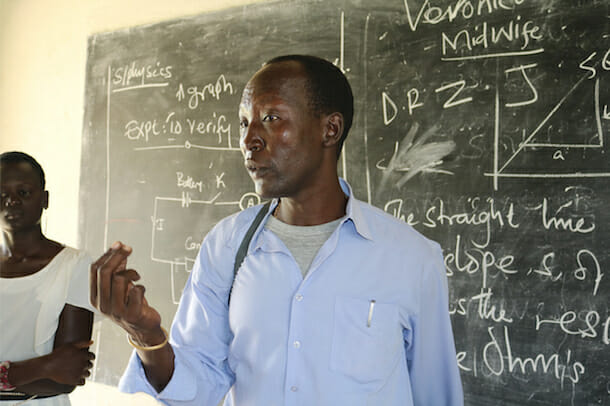
(Abukloi Enterprises)
Motivated by UN Peace Conferences, schools are creating “Peace Clubs” and using classroom time to discuss conflict resolution techniques. Students participate in local and regional debates about political and cultural issues. They use their education to challenge long-standing cultural practices and empower their families to engage in new practices for everyday living.
Rumbek’s Abukloi Secondary School[1] has developed innovative ways to build local capacity to solve problems. Abukloi is tackling food insecurity by using its school grounds as an agricultural training center. Students implement their science curriculum knowledge in the school gardens. Produce from the garden is sold at market and used to sustain the school project, thus exposing the students to the entire business cycle.
They then encourage one another to share and implement these ideas at home. With the help of funding from an American NGO, the school sponsors a women’s community garden that not only teaches sustainable agriculture practices, but also teaches the young women how to market their produce and manage their business and personal funds.
Business training goes beyond agriculture. Abukloi has developed a sewing program and internet café. Both projects employ community business people to train students, teaching them tangible skills they can expand upon to create businesses for themselves. Furthermore, their curriculum has students work in teams to develop business plans.
The most promising plans are loaned start-up funds by the NGO so not only will students have a job upon graduation, but they will also be able to employ others in their community.
The beneficial returns on this educational model are exponential. First, young women are encouraged to stay in school and participate in every aspect of the school’s programs. Educating women changes the cultural norm, encourages the older generation to take time to learn new skills and passes the value of education on to the next generation.
They are also addressing food insecurity without the direct aid of government or multinational organizations. This empowers the local population to demand the resources they need from the regional or national government deepening political participation and expanding political consciousness.
By teaching basic business skills, students also expand their creativity and problem-solving skills. By creating businesses, the community is literally creating its own economy: generating demand for goods and services that others will be inspired to provide.
The focus of economic and social development should not rest solely in the hands of NGOs. Investing in local communities throughout South Sudan can empower the people to understand and solve basic needs. It can create a new vision for how to confront difficult issues, provide a fair and stable government, and be the foundation for a lasting peace among all South Sudanese.
References
- ^ Abukloi Secondary School (www.abukloi.org)
Newer articles:
- South Sudan: A ‘Fragile’ Country Ravaged By Famine And War – OpEd - 19/03/2018 21:59
- South Sudan Nonprofit Calls for Restriction on Imported Seeds - 19/03/2018 20:20
- Panic in South Sudan as sacked military general visits Sudan - 19/03/2018 14:34
- Cows in the classroom: inside South Sudan's cattle camp schools - 18/03/2018 22:26
- Living across the front lines in South Sudan - 18/03/2018 21:19
Older news items
- South Sudan bans hunting; follows Kenya, with Chinese support - 17/03/2018 22:00
- South Sudan wants UN peacekeepers out - 17/03/2018 17:00
- South Sudan Embassy Worker in US Says Went Unpaid for a Year - 16/03/2018 13:45
- ISS Today: Is justice possible during South Sudan's civil war? - 15/03/2018 18:26
- After US journalist killed in South Sudan, a quest for answers - 15/03/2018 11:51
Latest news items (all categories):
- Western Equatoria prepares for voter registration - 14/09/2026 15:11
- South Sudanese Women Reclaim Their Lives after Fistula Surgery - 14/09/2026 15:10
- Digitel Launches Voice and Social Media Bundles in South Sudan - 14/09/2026 15:07
- Nearly 100,000 displaced in Sudan’s Blue Nile state since January amid fighting: UN agency - 14/09/2026 15:03
- جنوب السودان يرفض طلبًا لـ”حميدتي” بمنحه الحصة الأكبر من عائدات النفط - 14/09/2026 14:51
Random articles (all categories):
- Obama keeps eye on tense situation in South Sudan - 22/12/2013 00:17
- Sudan agrees to cease hostilities in South Kordofan for polio campaign - UN - 18/10/2013 07:28
- What's behind south Sudan unrest? - 26/09/2009 10:01
- South Sudan gunmen beat Juba dockers over food - 19/04/2007 21:20
- The Roots of Corruption in South Sudan - 15/07/2011 01:00
Popular articles:
- Who is the darkest person in the world, according to Guinness World Record? - 25/10/2022 02:34 - Read 149551 times
- School exam results in South Sudan show decline - 01/04/2012 17:58 - Read 28111 times
- Top 10 weakest currency exchange rates in Africa in 2023 - 19/07/2023 00:24 - Read 25190 times
- No oil in troubled waters - 25/03/2014 15:02 - Read 24460 times
- NDSU student from South Sudan receives scholarship - In-Forum - 29/09/2012 01:44 - Read 22413 times
