
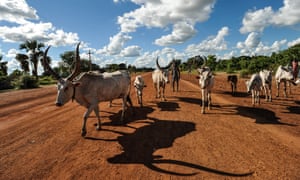
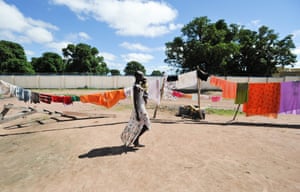
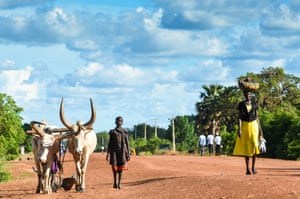
Down a red dirt road on the outskirts of Rumbek, a sprawling town at the heart of the world’s youngest country, a small herd of white cattle plods southwards. Evening is fast approaching and the cattle cast long shadows.
As South Sudan has slid into violence and famine[1], cattle – so central to the lives of the feuding Dinka and Nuer tribes – are casting a shadow over the futures of many of the country’s teenage girls.
Rebecca Amok was 15 when told by her father in 2016 that she was to marry 25-year-old Sabit, a man she had never met, because the family needed the 15 cattle his family would pay in dowry.
“Before I married I wanted to be a doctor. I want to be the leader of South Sudan[2],” she says, nursing her seven-month-old daughter, Yar, on the bed of their hut on the edge of Rumbek.
“I was not happy about my wedding. I was in my room and crying because I didn’t want to marry him but my parents convinced me. They said, ‘Look at us – we don’t have cows. We want cows for our survival.’”
Cows are everything in South Sudan. If a man is to marry, his family must have cattle to pay the bride’s family. But as security has deteriorated, cattle raiding has increased[3] and families who have lost their livestock have been unable to marry off sons they are struggling to feed. Searching for a solution, many have turned to younger daughters as a means to acquire cattle.
UN figures show that 52% of girls in South Sudan are married by the age of 18[4] (and nearly one in 10 by the age of 15), but activists say the numbers are rising.
For many girls, marriage means the end of their education. “I told my husband that my parents told me to marry him but he must let me go back to school,” says Rebecca.
Rebecca Amok, 16, here carrying her seven-month-old daughter, Yar, wanted to become a doctor before she was told to marry by her father.Sabit’s reply was that Rebecca could resume studying when he decided it was time for her to stop breastfeeding. So she sits in her hut, a few metres from where her brother David was shot in a tribal-related revenge killing, and worries about the future.
“People now are fearing to cultivate their gardens or sleep outside,” she says. “They lock the windows because they are afraid. My husband is afraid to be here and has gone to Juba.”
South Sudan became the world’s newest country in 2011 but within two years fighting had broken out[5] between Dinka loyal to President Salva Kiir and members of the Nuer tribe, supporting former vice-president Riek Machar.
A combination of violence and drought devastated last year’s harvests, creating food shortages that have left 100,000 people facing famine and another 1 million at risk.
“There is political conflict, ethnic conflict and cattle raiding,” says Daniel Kon, field coordinator in Rumbek for the UK charity Plan International.
“There’s a link between conflict and poverty. People want to get rich by raiding cattle. If someone gets more cattle they can get more wives and more children and the clan will be bigger and stronger. Because of the fighting, people can’t be sure that their cattle are safe so they think it is better to pass them on for marriage.”
A few hours down the road from Rumbek, security fears are such that cows are gathered in vast herds where they can be watched by armed guards. Several hundred of the cattle there have changed hands to pay for brides who were pupils at Rumbek Girls’ School.
Rebecca Katibo, who attended the school, was married at 15 to a man aged 29. Her father, a soldier, had been killed by a gunman in Juba and the family needed the 90 cows from her marriage in order to survive.
“The main reason was hunger. I am seeing a lot of my friends being married now because of the hunger,” she says.
Now 21, there is nothing she will be able to do to stop her husband selling their daughter for cows when the time comes. “It is my husband’s choice,” she says. “In my husband’s house everything is by force – there is no request. If I refuse there will be a problem. My husband will beat me.”
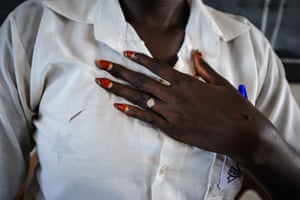
A bride at 15, Rebecca Katibo, now 21, shows off her wedding ring. Reflecting on her marriage, Rebecca says: ‘The main reason was hunger. I am seeing a lot of my friends being married now because of the hunger.’Eleanor Aluel, 17, married 30-year-old Machon on 1 January this year. Her family received 100 cows in return. She had not planned to marry so young, but her father was dead and her mother was struggling to look after seven children.
“My oldest brother wanted to get married,” she says. “Visitors came to the house and met with my brother and they talked and after that my brother said he was sending me to marry because we could not manage.”
Without the cattle from the marriage, her 30-year-old brother could not get married.
“I was angry with him but I agreed because I wanted him to be able to get married and because we were hungry because we had no father to support us.”
To obtain the 100 cows needed for the wedding, her husband had married off his own sister. And so the cycle goes on in a society where polygamy adds to the complexities.
Martha Nyanadong, 17, was married off in February so that her father could get enough cattle to wed his dead brother’s spouse, making her his fourth wife.
“I said, ‘Why do you send me away? Life is good.’ My father said he wanted to get cows. I said, ‘Don’t give me away.’ I cried because I wanted to stay at home. But my father said I must respect his decision because he had got cattle for me.”
Plan International is trying to persuade parents not to agree to marriage for their girls until they have finished school, by providing free school meals and offering food packages for families whose daughters attend every day. But many fall through the net.
Mary Nyana Dong, 17, was a pupil at the school until she married in April last year. She gave birth to a son, Akolde, six months ago. “My brother impregnated someone and we had no cows to pay so I had to be married,” she said. “Our life is based on cows. Without cows, no one can get married.”
The man the family chose for Mary was 53 and already had one wife. Mary had a boyfriend, but he could not match the offer of 34 cows from the older man. “We were living a bad life. Prices have risen. People have been killed. Gunmen came and my uncle was killed. Our cows were taken in a raid and we had no cows left. My father wanted to solve the crisis.”
More than half of girls in South Sudan are married by the age of 18, according to UN figures.Her brother, Moses Atiaba, 27, who is a teacher at the school, says he chose the groom carefully.
“I didn’t have money but I needed cows. That man is good and humble. He is not a beater, not a smoker, not a drinker. She now has a baby and a home.
“I was the one who gave her to someone before her time and before she finished her education. I will talk to her husband to send her back to school.”
Some girls are holding out. Priscilla Ayen, 16, says her parents understand that the short-term gain of 100 cows is nothing compared to her potential earnings if she becomes a doctor, as she hopes to do. She despairs of the girls who are happy to be married young.
“I say, my dear sisters, it is better to study. When I see a rich girl I will say to my sisters – be like her, be educated. But they say, ‘The husband will take care of me. He will buy me clothes and shoes and other things.’ It is better for me to be educated and earning money, far more than the 100 cows my family would get if I was to marry instead. I am free.”
References
- ^ slid into violence and famine (www.theguardian.com)
- ^ South Sudan (www.theguardian.com)
- ^ cattle raiding has increased (www.aljazeera.com)
- ^ 52% of girls in South Sudan are married by the age of 18 (www.girlsnotbrides.org)
- ^ fighting had broken out (www.theguardian.com)
Newer articles:
- What Did Japan Learn in South Sudan? - 09/06/2017 13:18
- South Sudan refugees recall horrific sexual assaults - 09/06/2017 12:23
- South Sudan rebels claim responsibility for deadly convoy attack - 09/06/2017 03:13
- Gunmen kill 14 in ambush on main South Sudan highway: police - 08/06/2017 12:18
- South Sudan bans 20 foreign journalists - 08/06/2017 08:19
Older news items
- South Sudan on the brink of genocide - 08/06/2017 00:18
- Sudanese bishops’ president expresses hope Francis will still visit South Sudan - 07/06/2017 15:24
- US Lawmaker Wants 'Root Causes' of South Sudan War Tackled - 07/06/2017 14:57
- In South Sudan’s war, shelter protects girls from selling sex - 07/06/2017 12:10
- South Sudan Yei State warring factions sign peace deal - 07/06/2017 07:48
Latest news items (all categories):
- The SPLM ruling party is facing a dilemma and Thucydides trap at a pivotal moment - 24/08/2026 14:06
- Shanghai Cooperation Organization (SCO) countries are making green development an engine of growth - 24/08/2026 13:36
- President Salva Kiir in Pretoria Seeking Support Ahead of South Sudan’s December Elections - 24/08/2026 12:48
- Tambura’s fragile path from conflict to recovery - 24/08/2026 12:45
- South Sudan’s Yei Joint Stars advance to semi final stage of Zonal qualifiers - 24/08/2026 12:43
Random articles (all categories):
- Chinese-printed textbooks approved for use in South Sudan - 20/12/2022 06:36
- Vacancy – Senior Human Resources and Administrative Officer - 10/06/2009 17:00
- Clash Between Army, Armed Group In South Sudan Leaves Scores Of ... - Bernama - 20/03/2013 03:35
- south-sudan-food-line-reuters-030414.JPG - 03/04/2014 14:40
- Sudan's Bashir says Darfur, Kordofan conflicts to end in 2016 - 21/08/2015 16:00
Popular articles:
- Who is the darkest person in the world, according to Guinness World Record? - 25/10/2022 02:34 - Read 148866 times
- School exam results in South Sudan show decline - 01/04/2012 17:58 - Read 27996 times
- Top 10 weakest currency exchange rates in Africa in 2023 - 19/07/2023 00:24 - Read 25081 times
- No oil in troubled waters - 25/03/2014 15:02 - Read 24390 times
- NDSU student from South Sudan receives scholarship - In-Forum - 29/09/2012 01:44 - Read 22336 times
