
Even in the context of years of obscene crimes against its citizens, the news that South Sudan’s government is threatening to hike the cost of work permits for foreigners[1] a hundredfold, from $100 to as much as $10,000, is horrifying. Without permits, aid workers trying to feed civilians who are starving in a famine caused by three years of vicious conflict cannot operate. What began with a rift between President Salva Kiir and his former deputy, Riek Machar, has fractured the country along ethnic lines. Atrocities have been committed[2] by all parties; civilians and their livelihoods have been deliberately and repeatedly targeted. In December, the chair of the UN commission on civil rights in South Sudan warned that the country stood on the brink of an all-out ethnic civil war[3]. Aid workers already face harassment and attacks and are blocked from areas in desperate need. Now the government is trying to profiteer from efforts to save the lives put in peril through its own self-interest.
The danger is that instinctive revulsion to the move will make people turn away from the suffering in the world’s youngest country. It may compound a sense that the situation is beyond hope or resolution – this war is only the latest outbreak in half a century of regional conflict – and that there is no point in more aid when so much has already been given to apparently so little effect, and when it may end up lining pockets instead of stomachs. Such sentiments are understandable, but wrong.
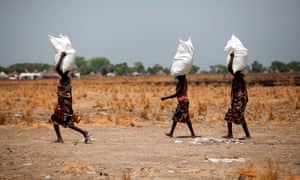
More than 7.5 million people need assistance and Unicef says a million children are acutely malnourished. This is one part of what the United Nations described on Friday as the biggest humanitarian crisis[4] since the organisation was founded in 1946. More than 20 million people in four countries (the others are Yemen[5], Somalia[6] and Nigeria) are at risk of starvation; conflict has played a major role[7] in each case. The UN says it needs donations of $4.4bn by July. But warnings of impending famine[8] began months ago and the money is still dripping rather than pouring in. There is no time to waste. People are already dying in South Sudan, and aid workers say roads will be cut off and airstrips may become unusable once rains arrive in April.
Everyone knows that the war is the real problem. The international community has nothing to show for its attempts to engage with the government of South Sudan, a government which has been further emboldened by the security council’s failure to pass an arms embargo in December. The African Union, which issued a damning report on atrocities in South Sudan two years ago, needs to play its part too; the surge of refugees entering Uganda[9] may concentrate minds. And, in the longer term, people must be held accountable for their crimes.
But renewed diplomatic efforts are not an alternative to providing emergency aid. Even a ceasefire tomorrow would not meet the immediate need for food, water and sanitation. The war has increased the cost of delivering basics. Rising levels of malnutrition are stoking the conflict[10]. It is the ordinary people who are suffering. The government has already shown it has no concern for them. Its attempt to extort cash from aid agencies is not a reason to turn away, but further proof that South Sudan, a country so optimistically created by popular vote just six years ago, needs our help more than ever.
References
- ^ hike the cost of work permits for foreigners (www.theguardian.com)
- ^ have been committed (www.un.org)
- ^ an all-out ethnic civil war (www.theguardian.com)
- ^ the biggest humanitarian crisis (www.theguardian.com)
- ^ Yemen (www.irinnews.org)
- ^ Somalia (www.theguardian.com)
- ^ played a major role (www.theguardian.com)
- ^ warnings of impending famine (www.theguardian.com)
- ^ surge of refugees entering Uganda (www.theguardian.com)
- ^ stoking the conflict (www.theguardian.com)
Newer articles:
- UN expert warns of South Sudan 'population engineering' - 14/03/2017 11:08
- South Sudan aid group says detained workers released - 14/03/2017 07:46
- The Church is the 'only functioning institution' in South Sudan - 14/03/2017 05:58
- South Sudan’s famine is the fallout from a spiralling ethnic war - 14/03/2017 02:28
- South Sudan rebels kidnap eight local aid workers: military - 13/03/2017 21:01
Older news items
- More than 20 million face starvation as UN makes urgent appeal for funds - 12/03/2017 15:38
- South Sudan rebels say they’ve abducted 2 Indian engineers - 12/03/2017 01:27
- South Sudan’s President ‘prays For Forgiveness’ - 12/03/2017 00:41
- South Sudan 'to profit' from crisis with $10,000 visas - 11/03/2017 21:28
- Rights, aid groups denounce South Sudan’s sharp increase in visa fees for aid workers - 11/03/2017 19:44
Latest news items (all categories):
- U.S. condemns WFP attack, looting of humanitarian assistance in South Sudan - 12/10/2026 14:49
- South Sudan President Bans Officials From Foreign Travel Without Approval After Kenya Visit - 12/10/2026 14:47
- At least 72 Sudanese miners killed in air strike: Rights monitor - 12/10/2026 14:44
- Why did deadly communal clashes erupt in South Sudan, leaving 71 people dead? - 12/10/2026 14:40
- UPDF commissions new medical facilities in South Sudan - 12/10/2026 14:36
Random articles (all categories):
- Remarks by John Prendergast, Co-Founder, The Sentry Press Event with Sigal Mandelker, Under Secretary for Terrorism and Financial Intelligence, U.S. Department of the Treasury Nairobi | June 13, 2018 - 16/07/2018 16:29
- South Sudan to shut oil production over thefts - 23/01/2012 13:47
- To Youth of Rumbek and Lakes State at large - 21/07/2021 13:55
- Sudan’s leader says Israel has key role in removing nation from US blacklist - 14/02/2020 00:16
- More than 1,000 killed in South Sudan communal conflicts in 6 months: UN - 17/11/2020 10:18
Popular articles:
- Who is the darkest person in the world, according to Guinness World Record? - 25/10/2022 02:34 - Read 150879 times
- School exam results in South Sudan show decline - 01/04/2012 17:58 - Read 28217 times
- Top 10 weakest currency exchange rates in Africa in 2023 - 19/07/2023 00:24 - Read 25320 times
- No oil in troubled waters - 25/03/2014 15:02 - Read 24550 times
- NDSU student from South Sudan receives scholarship - In-Forum - 29/09/2012 01:44 - Read 22513 times
