
Ending a civil war is never easy. But a fragile rapprochement between South Sudan’s President Salva Kiir and his rival Riek Machar – the two elderly “big men” of the country – does not impress a younger generation of would-be political leaders who believe their country’s future can be brighter. The decision just a few days ago, by President Kiir, to reappoint the exiled Mr Machar to the role of vice-president, raised hopes that a brutal two-year conflict in the world’s youngest nation might now come to an end after Mr Machar accepted the offer.
The decree by President Kiir was made in Juba, the capital city. That was where an alleged coup attempt in December 2013 by forces loyal to Mr Machar – two years after the country’s declaration of independence from Sudan – sparked an ethnic war that has driven two million people from their homes, left 2.8 million facing acute food insecurity and tens of thousands on the brink of famine.
In Nyal, a remote town in war-torn Unity state 600 miles north of Juba by road, where local youth militia and forces to loyal to Mr Machar have kept government soldiers at a distance since deadly attacks in April last year, a tall 27-year-old has made his home. The decision by Kol Taban – the son of a former governor of Unity – to return to his homeland after an education in Australia shows either a faith in his country’s future, or a belief that he and a new generation will do it differently.
Cut off from the rest of South Sudan and living at the centre of a famine, Mr Taban can leave any time he likes, but has chosen to remain. His opinion of President Kiir – a former senior soldier who took over after South Sudan’s leader, Dr John Garang, died in a helicopter crash in 2005 – is disparaging.
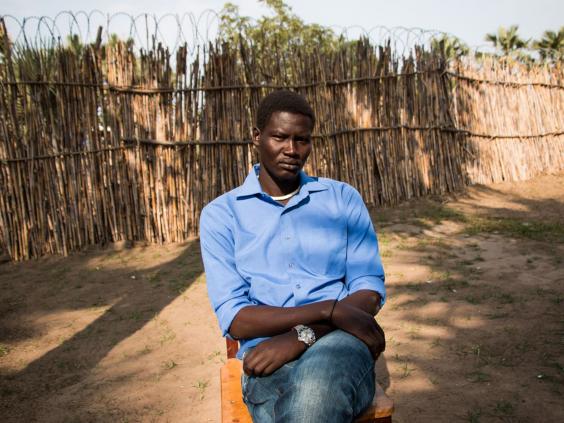
Kol Taban left the safety of Australia to return to Nyal (Ashley Hamer)
Using the unflattering vocabulary of the American military, Mr Taban describes Mr Kiir as an uneducated “jarhead” (a nickname usually reserved for the US Marine Corps). He says that while the President is an able and respected frontline soldier, he is “not a presidential politician”. It is a view expressed from a position of relative strength. Mr Taban’s link to elite politicians gives him a tribal authority and profile that borders on being an unofficial leader-in-residence. He appears to understand a role that comes with being the son of an important man.
His father, Taban Deng Gai, was governor of the oil-rich Unity state in the six years before the Southern Sudan Autonomous Region gained full independence from Sudan after a conclusive referendum that was accepted in Khartoum. Employed by the Chevron oil company, Mr Deng then joined the Sudan People’s Liberation Army (SPLA), becoming one of its commanders and continued as Unity’s governor after independence.
The 2013 alleged coup split the army and the main political party (the SPLM) into ethic divisions; Mr Kiir’s Dinka-led people became the governing faction with Mr Machar’s Nuer forces exiled in opposition. Whether or not “genocide” was attempted by the government in Juba, a recent African Union report described atrocities on both sides. Soldiers were accused of “cleansing” amid claims of forced cannibalism, rape, mass civilian killings, abduction, conscription of children, looting, cattle theft and the burning of entire villages. A recent UN report confirmed many of the horrors.
In 2015, Mr Deng was the chief negotiator in Juba for the opposition, trying to implement a peace deal signed in August between Mr Kiir and Mr Machar. If the Vice-President does return to Juba, it will be partly down to Mr Deng’s efforts.
But his son remains sceptical of the immediate prospects for South Sudan. “The promised transitional government they are trying to form? It will happen.” However, he has limited optimism on what follows, and even his father’s ability to deliver further success is questioned. “My father has served his time. It is basically time for him to move on.”
Mr Taban cites the recent and unexpected announcement by the President to redraw South Sudan’s internal state boundaries, creating 28 states and 28 newly appointed governors rather than the established 10 divisions.
“Perhaps we will accept 28 states, but they will invent something else. They have been given what they asked for; they will ask for more,” he says. “Some saw the civil war coming. It would have been planned for some time, turning states against each other, stoking up tribal wars and divisions.”
Asked if President Kiir wants to end the chaos of two years of war, Mr Taban says: “Why would you want peace if you are winning the war? And they are winning.”
He left South Sudan in 2001, sent to Melbourne by his father to be educated and safe. “Before I came back [to South Sudan] in 2014, I did not know where I was from,” he says. “I knew my father, his eight wives, his children, and that was about it. My father doesn’t want me here. He wants me back, safe, in Australia. He thinks it’s dangerous.”
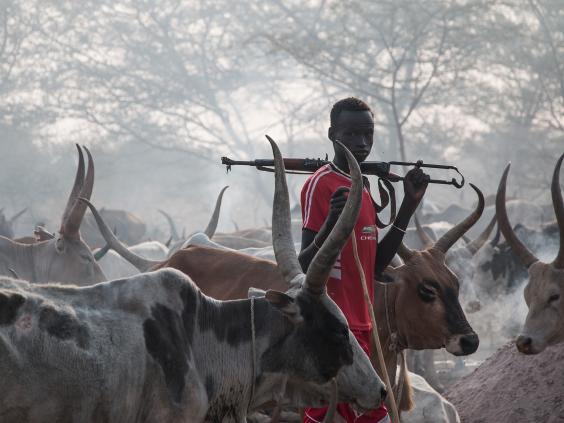
The 10,000 displaced people who fled to Nyal from other parts of Unity are the most vulnerable (Ashley Hamer)
And that’s because it is. Unity has been at the centre of fighting, where now even the so-called “tranquil states” are no longer tranquil. Government forces are less than five hours’ drive away. That, in country almost the size of France, is close.
The 10,000 displaced people who fled to Nyal from other parts of Unity are the most vulnerable. Some are hiding on the little islands that sit above the water level of the Sudd swamp. In this cut-off community, which the UN’s food aid organisation is feeding with air drops, reaching the next day is without guarantee.
An imminent UN report, backed by data approved in Juba, will say that the acute food shortages affecting 40,000 and the high levels of malnutrition should now be designated a famine. International aid organisations based in Nyal are doing all they can to limit the suffering.
Mr Taban’s family links give him both authority and responsibility. He doesn’t control the large youth militias who marshal the town carrying AK-74 rifles, but explains: “Guns are everywhere here. They are civilians who are trying to protect their community.”
Elections are scheduled to take place in 2018. Although Mr Taban insists he won’t stand, he contradicts himself, detailing the political jobs he would accept. “Education minister would be above me. Age is a thing here. So, maybe fisheries, youth or childhood. But the key to everything will be education.”
He adds that he will not leave South Sudan again. “This country will get the leaders it deserves. It will take time, but we will be stable. We will find someone who works for his people, not his own interests.”
Tomorrow: Despite South Sudan’s oil wealth, its political leaders have effectively squandered billions of dollars in less than three years. James Cusick looks at what has to happen if this young country is to escape from its destructive civil war.
Newer articles:
- The Love-Hate Relationship Between Sudan and the United States - 17/02/2016 14:07
- How Cows Can End the South Sudan War - 16/02/2016 23:27
- Dragon's Den meets The Apprentice as Sudan TV show fosters young ambition - 16/02/2016 01:46
- South Sudan: The deadly consequences of child marriage - 15/02/2016 23:44
- SOUTH SUDAN: Media need to work in freedom says Bishop - 15/02/2016 17:16
Older news items
- Sudan rebels, troops clash in restive South Kordofan - 15/02/2016 12:25
- South Sudan: World's youngest nation is still at risk - 14/02/2016 20:19
- Sudan-South Sudan's Rapprochement Back on Track Let's not Lose the Momentum - Time for Action! - 13/02/2016 12:11
- South Sudan Rebel Leader to Return to Juba - 13/02/2016 12:07
- South Sudan rebel leader says he is will take up VP position - 13/02/2016 09:57
Latest news items (all categories):
- Juba commissioner denies chasing foreigners - 07/10/2026 14:36
- Australia: 19-year-old from South Sudan arrested over a wild joy ride - 07/10/2026 14:33
- South Sudan’s aid crisis deepens as food stocks run low - 07/10/2026 14:29
- South Sudan’s Juba warns foreigners against running small-scale businesses - 07/10/2026 14:25
- Peace Dialogues foster social cohesion in Nyirol County after persisting tensions - 07/10/2026 14:23
Random articles (all categories):
- Sudan Staple Food Costs 'Increase 300 Percent Since Last Year' - 03/10/2022 00:14
- The best medicine: South Sudan's comedians tap the power of laughter - 20/02/2023 06:43
- Sudan Teachers Strike for 'New Structure' Salaries - 12/04/2022 00:46
- UN refugee agency calls for concerted efforts on climate change in South Sudan - 12/03/2022 08:51
- South Sudan: Telar Explains Involvement in Central Bank Land Saga - 17/08/2013 02:39
Popular articles:
- Who is the darkest person in the world, according to Guinness World Record? - 25/10/2022 02:34 - Read 150677 times
- School exam results in South Sudan show decline - 01/04/2012 17:58 - Read 28189 times
- Top 10 weakest currency exchange rates in Africa in 2023 - 19/07/2023 00:24 - Read 25301 times
- No oil in troubled waters - 25/03/2014 15:02 - Read 24531 times
- NDSU student from South Sudan receives scholarship - In-Forum - 29/09/2012 01:44 - Read 22491 times
