
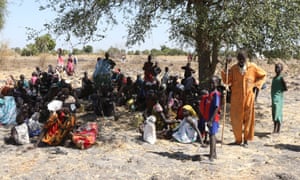
Leer, in South Sudan[1], hadn’t seen this much life in a long time. The town – or what is left of it – had been largely deserted since May, when fresh violence forced residents from their homes.
On 15 December, however, tens of thousands emerged from their hideouts in nearby swamps to receive their first food ration in months. Pushed to the brink of starvation, they anxiously lined up to collect a ration card from the International Committee of the Red Cross (ICRC), which is organising the distribution.
“I came here from the swamp when I heard they were giving out food,” said Leer resident Thomas Riek Makuei. Like most people here, Makuei’s diet over the past few months has been reduced to palm fruits and waterlilies. “They took all of our cattle and food,” he added.
Since the government embarked on a military campaign[2] to retake southern Unity state from opposition forces in April, more than 100,000 people have been displaced. Relying primarily on militia recruited from the Bul Nuer community[3], government forces are accused of grave human rights abuses[4], including gang rape and abduction of girls, burning civilians alive and annihilating entire villages.
Related: South Sudan: 'a level of human suffering I have never seen anywhere else'[5]
Leer is the hometown of former vice-president turned opposition leader Riek Machar, an ethnic Nuer, and has been razed several times throughout the conflict. The main road is dotted with burned cars. The market stands deserted, with not a sound to be heard in what was once the heart of the community. Remains of dead cows and piles of dung are the only evidence of cattle in the area, after it was raided in an attempt to strip local Nuer communities, thought to be supporters of the Machar-led SPLM-IO, of their livelihoods.
As frontlines swept through Leer, NGO compounds were looted. Staff have been forced to evacuate twice since May. With the town now under government control, some are working to reestablish their presence. “The needs have been large and growing. But it simply hasn’t been possible to gather large numbers of people and put our staff on the ground,” says Daniel Littlejohn-Carrillo, who leads ICRC’s operations in Unity state.
The inability of the international community to deliver aid to southern Unity, an area the UN says faces catastrophic food shortages[6], highlights the broader challenges of humanitarian access in South Sudan, which was plunged into civil war two years[7] ago. Although a peace deal was signed[8] in August between President Salva Kiir and Machar, the increasingly fragmented nature of the conflict has complicated matters. The proliferation of armed groups and proxies that do not fall into regular command structures means NGOs struggle to negotiate safe passage.
“The problem is that there are several layers to the ongoing conflict, in Unity in particular,” says Greg Mueller, the deputy head of ICRC’s delegation in South Sudan. “A lot of violence is being produced as a result of cattle raiding and movements that don’t necessarily have a political agenda. There it’s much less clear who is actually in charge.”
NGOs that attempted to stay in Leer despite the fighting could do little for the population. “For about three weeks in August, our team spent more than 50% of their time in a bunker, just hearing shelling and gunfire,” says Vanessa Cramond, emergency medical coordinator for Médecins Sans Frontières (MSF) in Unity. Even when fighting subsided, MSF teams were at times prevented from reaching displaced communities.
In a rare effort to quantify the impact of restrictions to humanitarian access, the South Sudan NGO forum[9], a coordinating body of more than 300 international and local NGOs, recently distributed a statement to journalists estimating that in the first six months of 2015, $3.5m of humanitarian assets were lost and 1,560 working days wasted due to conflict and suspension of activities.
“That data is very much the tip of the iceberg. Since we last collected this data, we’ve seen significant challenges in securing access to people who need our support,” says Lindsay Hamsik, the forum’s policy adviser.
Related: Horrific attacks prompt South Sudan's communities to take arms | Simona Foltyn[10]
The statement stopped short of naming the parties responsible, an approach often taken by agencies to maintain their neutrality and avoid further restrictions. Yet some voices in the NGO community believe this is counterproductive.
“The more you keep quiet, the more you allow such incidents to continue,” says Edmund Yakani Berizilious, executive director of Cepo, a local NGO whose mandate includes advocacy for humanitarian access. Cepo published a map[11] showing incidents of violence against humanitarian workers, attributing attacks to government forces, rebels and others.
“You need to label all actors. International humanitarian organisations sometimes compromise by only blaming the United Nations for failing to protect civilians, forgetting the actors who are actually responsible,” Berizilious says. MSF recently accused the UN peacekeeping mission in South Sudan (Unmiss) of a “shocking” lack of action[12] in the face of atrocities committed in southern Unity.
Unmiss has now established a temporary presence in Leer, a move that has been welcomed by the international community, with more NGOs looking to resume operations.
Nevertheless, few civilians have permanently returned. “I cannot stay here,” said Makuei. “I’m a civilian, they have guns, and nothing prevents them from coming at night to shoot me”. Makuei, who lost five members of his family, including his wife, in the recent violence, intended to return to his hideout in the swamps after receiving his food ration, which will last a few weeks. Unless the peace deal takes hold, this is what life will be like for tens of thousands of South Sudanese.
References
- ^ South Sudan (www.theguardian.com)
- ^ military campaign (www.smallarmssurveysudan.org)
- ^ militia recruited from the Bul Nuer community (www.theguardian.com)
- ^ human rights abuses (www.theguardian.com)
- ^ South Sudan: 'a level of human suffering I have never seen anywhere else' (www.theguardian.com)
- ^ catastrophic food shortages (www.ipcinfo.org)
- ^ plunged into civil war two years (www.theguardian.com)
- ^ peace deal was signed (www.theguardian.com)
- ^ NGO forum (southsudanngoforum.org)
- ^ Horrific attacks prompt South Sudan's communities to take arms | Simona Foltyn (www.theguardian.com)
- ^ map (www.cepo-southsudan.org)
- ^ “shocking” lack of action (www.theguardian.com)
Newer articles:
- South Sudan President creates 28 new states, threatening peace process - 25/12/2015 07:41
- South Sudan Leader's Creation of 28 New States Threatens Peace Pact - 25/12/2015 07:38
- South Sudan: Creation of New States Draws Opposition Protests - 24/12/2015 18:00
- Modern-day flight to Egypt brings fighting Sudanese factions together in church - 23/12/2015 11:25
- With peace in sight, South Sudan’s journalists are looking to a hopeful future - 23/12/2015 07:34
Older news items
- S. Sudan Government, Rebels Again Aim for Peace - 22/12/2015 20:56
- South Sudan rebel delegation and government begin talks in Juba - 22/12/2015 16:00
- Team of South Sudan rebels in Juba to prepare for new govt - 21/12/2015 23:36
- Q A: UN mission chief on challenges of S Sudan peace - 21/12/2015 12:29
- South Sudan: Rebels come to capital as part of peace deal - 21/12/2015 09:28
Latest news items (all categories):
- South Sudan can leverage China’s AI path to bridge the digital divide - 16/09/2026 16:04
- Credible Elections Are No Longer Possible in South Sudan - What Next? - 16/09/2026 15:59
- South Sudan's president replaces electoral chief three months before scheduled polls - 16/09/2026 15:56
- Turkish Airlines is pulling out of 5 African routes, including South Sudan - 16/09/2026 15:23
- ‘Super El Niño’ deepens hunger crisis in South Sudan – WFP - 16/09/2026 15:19
Random articles (all categories):
- Kenya rejects push to seize property of South Sudan leaders - 15/06/2018 18:00
- 13 dead in tribal revenge attacks in S.Sudan: government - 15/01/2012 20:25
- Sudan, South Sudan Agree To Ease Oil Trade Via Free Zone - 17/12/2025 11:42
- WFP SOUTH SUDAN VACANCY ANNOUNCEMENTS (01/12/2022) - 01/12/2022 11:47
- South Sudan signs pact to develop the country’s power sector - 12/11/2018 22:42
Popular articles:
- Who is the darkest person in the world, according to Guinness World Record? - 25/10/2022 02:34 - Read 149591 times
- School exam results in South Sudan show decline - 01/04/2012 17:58 - Read 28114 times
- Top 10 weakest currency exchange rates in Africa in 2023 - 19/07/2023 00:24 - Read 25197 times
- No oil in troubled waters - 25/03/2014 15:02 - Read 24464 times
- NDSU student from South Sudan receives scholarship - In-Forum - 29/09/2012 01:44 - Read 22415 times
