
By Mia Farrow, Special to CNN
updated 10:18 PM EDT, Mon October 15, 2012
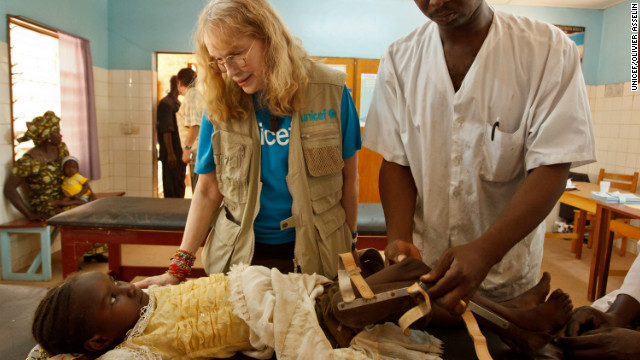 UNICEF Goodwill Ambassador Mia Farrow chats with seven-year-old Massi Hassan, whose leg brace is being adjusted by a health worker, at the Notre-Dame de Paix rehabilitation centre in the town of Moundou in southwestern Chad.
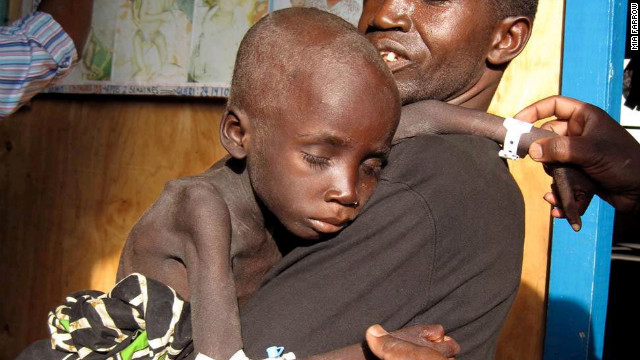 Farrow took this image of a young boy in the Democratic Republic of the Congo who was brought to a UNICEF supported health clinic in December 2008.
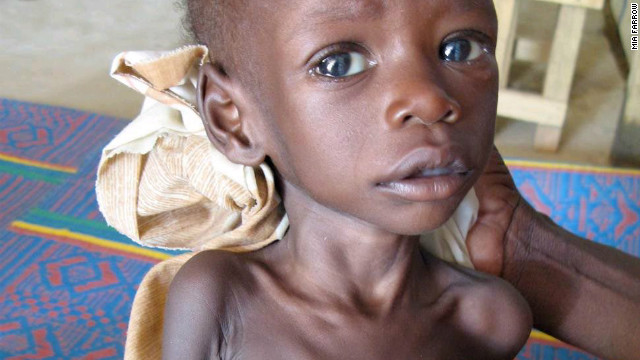 An emaciated child in Eastern Chad in 2006. UNICEF estimates that worldwide around 170 million children under the age of five are stunted. The condition inhibits the development of their bodies and brains.
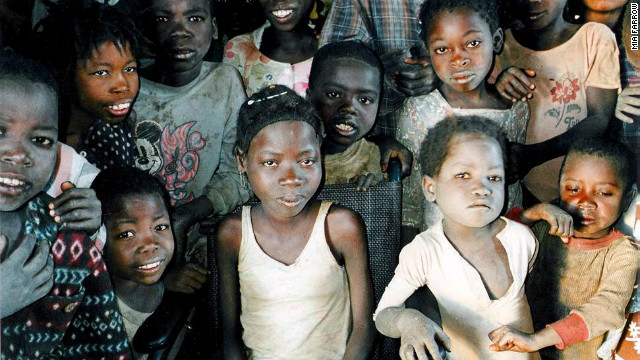 Farrow took this image of a group of children in Angola in 2002. At the time, the girl in the middle was 17 years old. "Wherever I go," Farrow says, "I am always struck by the children. In the face of their courage, resilience and hope, I don't see how we can allow ourselves the luxury of feeling overwhelmed or helpless."
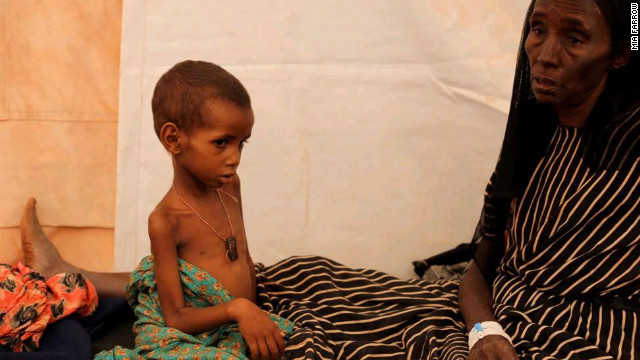 A Somalian woman and child at the Dadaab refugee camp in Kenya in August 2011. Farrow is joining calls for urgent international action to help feed malnourished children.
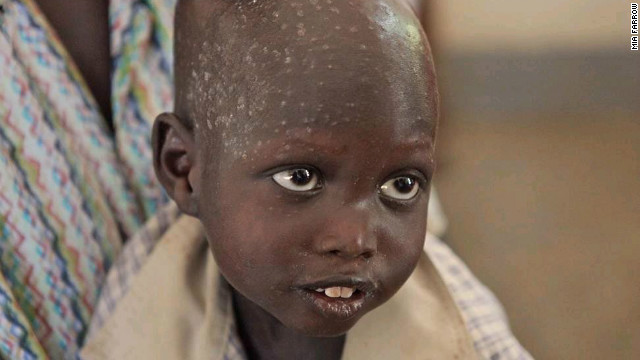 A young child in Juba, South Sudan, in March 2011, who was at a UNICEF supported hospital where he received ready to use fortified food.
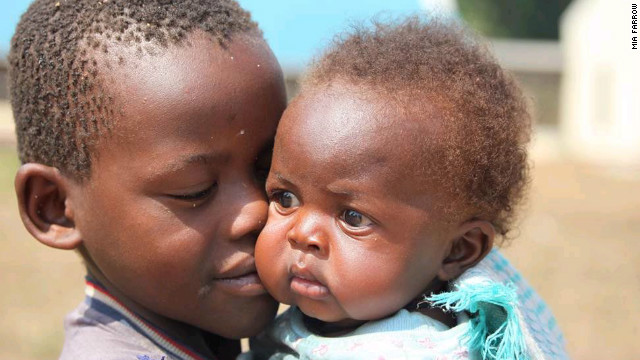 UNICEF says the first 1,000 days of a child's life are crucial. These children, photographed in South Sudan's Western Equatoria state in March 2011, have benefited from an adequate supply of food early on.
Young faces of poverty
Young faces of poverty
Young faces of poverty
The faces of poverty
Young faces of poverty
The faces of poverty
Young faces of poverty
<<
<


>
>>
Editor's note: Actress Mia Farrow has traveled extensively as an ambassador for UNICEF, including trips to Angola, Cameroon, Chad, Central African Republic, the Democratic Republic of Congo, Haiti, South Sudan and Uganda, and has been active in the organization for more than 12 years. Farrow starred in the film "Rosemary's Baby" and has appeared in many other films, including "The Great Gatsby," "Death on the Nile" and "Hannah and Her Sisters."
Connecticut (CNN) -- Throughout my travels with UNICEF -- from Angola, to Central African Republic, Chad, the Democratic Republic of Congo, Haiti, Sudan and Uganda -- I have met countless young girls and boys whose bodies and minds have been permanently damaged because they were malnourished during the first 1,000 days of their lives.
Around 170 million children under the age of five are stunted -- their bodies and brains cannot develop to full capacity.
A stunted child has difficulty in learning and in surviving. Such children are up to four times more likely to die from all causes -- including easily preventable diseases.
Read more: Child stunting a 'silent emergency,' says Beckham

 Yemen on brink of hunger catastrophe
For too long, stunting has been a silent crisis -- a personal tragedy for each family. But the suffering of some 170 million children constitutes a global catastrophe that calls for an urgent response.
Yemen on brink of hunger catastrophe
For too long, stunting has been a silent crisis -- a personal tragedy for each family. But the suffering of some 170 million children constitutes a global catastrophe that calls for an urgent response.
 Grammy winner sees Kenya's nightmare
 Hunger crisis plagues Mauritania
Traveling for UNICEF for over more than a decade, my focus has been on countries -- particularly in Africa -- that are being impacted by conflict including the Darfur region, South Sudan, Central African Republic and the Democratic Republic of Congo -- areas convulsed by violence. I have met countless families who have nothing to eat because they are on the run often hiding deep in the bush.
Read more: Indian state's battle to build up its babies
Hunger crisis plagues Mauritania
Traveling for UNICEF for over more than a decade, my focus has been on countries -- particularly in Africa -- that are being impacted by conflict including the Darfur region, South Sudan, Central African Republic and the Democratic Republic of Congo -- areas convulsed by violence. I have met countless families who have nothing to eat because they are on the run often hiding deep in the bush.
Read more: Indian state's battle to build up its babies
 One million kids at risk of malnutrition
But it is not only conflict that is leaving children so vulnerable. Last February, I paid a second visit to the sand swept town of Mao in the west of Chad along the belt of the Sahel. Drought, failed crops and skyrocketing food prices have left people with little to nothing to eat.
Mothers carry emaciated children long distances across the sand to reach UNICEF-supported health centers for life-saving fortified foods. Often it is too late. At this moment one million children throughout the Sahel region of Africa are at risk of dying.
They are in urgent need of our support.
Wherever there is poverty, it is the children who pay the highest price. But here is a story of hope. When I visited Haiti before the earthquake, the stunting rates had been stubbornly high -- about 31%. Then, on January 12, 2010, the earthquake struck causing hundreds of thousands of deaths and injuries. The devastation affected three million people, two thirds of them children.
I have met countless families who have nothing to eat because they are on the run often hiding deep in the bush.
One million kids at risk of malnutrition
But it is not only conflict that is leaving children so vulnerable. Last February, I paid a second visit to the sand swept town of Mao in the west of Chad along the belt of the Sahel. Drought, failed crops and skyrocketing food prices have left people with little to nothing to eat.
Mothers carry emaciated children long distances across the sand to reach UNICEF-supported health centers for life-saving fortified foods. Often it is too late. At this moment one million children throughout the Sahel region of Africa are at risk of dying.
They are in urgent need of our support.
Wherever there is poverty, it is the children who pay the highest price. But here is a story of hope. When I visited Haiti before the earthquake, the stunting rates had been stubbornly high -- about 31%. Then, on January 12, 2010, the earthquake struck causing hundreds of thousands of deaths and injuries. The devastation affected three million people, two thirds of them children.
I have met countless families who have nothing to eat because they are on the run often hiding deep in the bush. Mia Farrow, UNICEF Ambassador But the Haitian government and the international community joined forces and in just two years something extraordinary resulted. That stubborn stunting rate dropped to 23%.
There is more work to do, but we can see that even in challenging circumstances it is possible to work together to ensure that the world's most vulnerable children, pregnant women and mothers have access to food and drinkable water.
Wherever I go, I am always struck by the children. In the face of their courage, resilience and hope, I don't see how we can allow ourselves the luxury of feeling overwhelmed or helpless.
We have the tools, we know what must be done. In the name of some 170 million children let's pull together and end the obscenity of hunger and stunting.


Part of complete coverage on
updated 11:41 AM EDT, Mon October 15, 2012

The story of Malala's fight to attend school has exposed our failure to deliver on universal education, writes former British PM Gordon Brown.
updated 12:30 PM EDT, Mon October 15, 2012

Fifty years ago, Omar Lopez knew a secret many would have killed to learn: Soviet troops were building military installations in Cuba.
updated 10:35 AM EDT, Mon October 15, 2012

David Frum says Iran sanctions are cutting deeply into the nation's economy, as oil production fell off sharply and the currency lost value.

A study says that armed groups, paramilitaries and drug cartels, have increased the number of minors in their ranks in a dramatic way.
updated 2:18 PM EDT, Mon October 15, 2012

CNN's Richard Quest says there are few better ways of discovering the faces of 'real America' than traveling the country by rail.
updated 10:45 AM EDT, Mon October 15, 2012

Some 170 million children have stunted growth because they lack proper nutrition. UNICEF ambassador David Beckham appeals for action.
updated 1:47 AM EDT, Mon October 15, 2012

Skydiver Felix Baumgartner makes history by jumping from 128-thousand feet above the Earth.
updated 6:52 AM EDT, Fri October 12, 2012

U.S. troops left last year, but it's far from peace time in Baghdad. And the Republican party remains the party of despised George W. Bush.
updated 10:16 AM EDT, Sat October 13, 2012

A pioneering study into malaria transmission in Kenya gives scientists new clues into how the deadly disease spreads.

To celebrate International Day of the Girl CNN spoke to some of the world's most remarkable women and asked: "What do you wish you'd known at 15?"

Newer articles:
- Sudan's lasting impact on oil market - Financial Times - 17/10/2012 03:01
- Taking the Long View for the Peoples of Sudan and South Sudan - Huffington Post (blog) - 16/10/2012 18:11
- Congolese refugees fear going home but feel unwelcome in South Sudan - Catholic News Service - 16/10/2012 12:14
- UPDATE 1-Sudan says will not reach 180000 bpd 2012 oil target - Reuters - 16/10/2012 10:01
- Seize South Sudan Trade opportunities, ministry tells SMEs - IPPmedia - 16/10/2012 04:29
Older news items
- 'Mobile Courts' Coming to South Sudan - The Root - 15/10/2012 18:03
- Joint Mechanism between Sudan, South Sudan to Defuse Border Tensions - Sudan Vision - 15/10/2012 16:50
- Replay: Video chat with South Sudan native Deborah Deng - Sioux Falls Argus Leader - 15/10/2012 14:14
- Eximbank helps extend hallyu to South Sudan - The Korea Herald - 15/10/2012 09:38
- From South Sudan refugee camps to glitzy London media awards night - ChristianToday - 15/10/2012 06:20
Latest news items (all categories):
- Ramaphosa presses Kiir to implement peace deal ahead of South Sudan’s first elections - 09/10/2026 12:19
- South Sudan steps up Ebola alert after Kenya case - 09/10/2026 12:17
- Laotian man deported by U.S. to South Sudan leaves for Laos after year in detention - 09/10/2026 12:14
- Bullet and blast injuries … and a constant need for blood: inside South Sudan’s overwhelmed trauma wards - 09/10/2026 12:10
- MTN South Sudan and Regulator Pledge Cooperation to Expand Connectivity - 09/10/2026 12:01
Random articles (all categories):
- Sudan transition talks continue - 15/07/2019 05:36
- South Sudan soldiers 'unhealthy' due to food theft: Kiir - 24/01/2019 11:28
- AfDB, FAO, South Sudan Seal Deal - 07/02/2021 17:21
- Sudan Faces Worst Food Crisis in Recent History | Voice of America - English - 17/07/2020 18:03
- Free of strongman, Sudan looks to U.S. for financial relief - 05/03/2020 22:53
Popular articles:
- Who is the darkest person in the world, according to Guinness World Record? - 25/10/2022 02:34 - Read 150797 times
- School exam results in South Sudan show decline - 01/04/2012 17:58 - Read 28197 times
- Top 10 weakest currency exchange rates in Africa in 2023 - 19/07/2023 00:24 - Read 25309 times
- No oil in troubled waters - 25/03/2014 15:02 - Read 24535 times
- NDSU student from South Sudan receives scholarship - In-Forum - 29/09/2012 01:44 - Read 22494 times
