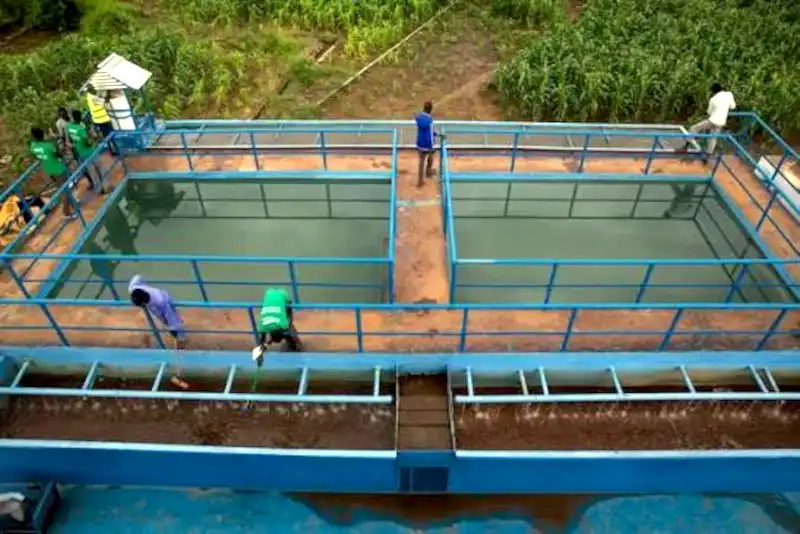
(Photo Credit: African Sustainability Matters)
South Sudan is seeking greater support to expand water treatment and distribution infrastructure as the country confronts persistent gaps in access to safe drinking water, particularly in rural, flood-prone and displacement-affected communities. The infrastructure push is aimed at turning the country’s substantial surface-water resources into reliable drinking water while reducing exposure to contaminated sources and strengthening water utilities in one of Africa’s most infrastructure-constrained states. According to regional and development assessments, the central challenge is not simply water availability, but the systems, financing and institutional capacity required to treat and deliver it safely.
South Sudan’s water constraints illustrate a wider infrastructure problem confronting fragile African economies: substantial natural resources do not automatically translate into reliable public services. The Nile River Basin covers 97% of South Sudan, yet access to basic water services stood at 41% in the national figures cited in the US government’s 2023 Global Water Strategy country plan. The divide was particularly sharp between urban and rural communities, with basic water access reported at 70% for urban households and 34% for rural households, where most of the population lives.
That gap makes treatment capacity as important as the underlying supply. Rivers and lakes are common sources of water across the country but face contamination risks from human and animal waste as well as industrial activity associated with mining and oil extraction. In areas without adequate treatment or distribution networks, the availability of surface water therefore does not ensure that households can obtain water that is safe to drink.
The consequences extend beyond household consumption. Weak water, sanitation and hygiene systems place additional pressure on healthcare and other public services. The Global Water Strategy country plan reported that only 16% of South Sudan’s population had access to basic sanitation, while just 45% of primary schools had safe drinking water and 17% had adequate sanitary latrines for girls and boys.
Existing projects demonstrate what greater treatment investment can achieve, while also highlighting the financial and operational requirements involved. In Bor, Jonglei State, a solar-powered conventional water treatment project increased the number of people with access to safe drinking water from about 36,000 to 96,000, lifting service coverage from 32% to 80%, according to a 2025 project field note. The scheme combined a new treatment plant with rehabilitation and expansion of the distribution network and measures to strengthen the management of the local water utility.
The Bor project also points to the importance of designing African water systems around both climate exposure and operating costs. The town is vulnerable to severe flooding, and the infrastructure incorporated raised foundations above the highest flood levels recorded in 2020 and 2021 as well as a protective dyke. Solar power reduced dependence on conventional energy and was estimated to cut annual operating expenditure by $318,000. The project estimated savings of $6.4 million over its 20-year design life, alongside lower carbon emissions.
Elsewhere, humanitarian water systems are confronting another cost problem: dependence on fuel and imported treatment chemicals. The International Organization for Migration and Veolia Foundation have deployed water-treatment technology intended to reduce the amount of aluminium sulphate required by conventional surface-water treatment systems. An Aquaforce 5000 installation in Pakur, Rubkona County, was designed to provide treated surface water for about 5,000 people, while related systems have also been deployed at the Wunthow border crossing in Renk County and in Malakal.
Such projects matter because the economics of water infrastructure extend well beyond the construction of a treatment plant. Plants must be powered, treatment chemicals procured, equipment maintained and distribution networks operated. Utilities also require sufficient technical and financial capacity to keep those systems functioning after development or humanitarian financing has been spent.
Wau provides an earlier example of this broader infrastructure requirement. UNICEF reported that rehabilitation of the city’s urban water supply system included three kilometres of additional mains pipeline, repairs to the main generator, four water kiosks and four elevated tanks, alongside training in leak detection, billing, revenue collection and utility management. The plant draws roughly 6,000 cubic metres of raw water a day from the Jur River before clarification and disinfection.
For South Sudan, this makes investment in water treatment partly a question of public finance and institutional development. Infrastructure that cannot recover enough revenue for basic operation and maintenance can leave governments and development partners facing repeated rehabilitation costs. Conversely, lower energy treatment systems, stronger utility management and more resilient distribution networks can reduce some of the recurrent costs associated with delivering water in difficult operating environments.
The financing requirement comes as international programmes are already attempting to strengthen basic services. Under the 2022-2027 US Global Water Strategy, South Sudan was designated a high-priority country. The country plan set targets for US-supported investments to provide basic water services to 100,000 people, sanitation services to 75,000 people and strengthen 30 state- and county-level institutions.
The challenge is especially acute in communities affected by flooding and displacement. Treatment facilities located in such areas have to cope not only with inadequate infrastructure, but also with changing settlement patterns, damaged transport links and pressure on services as people move. At the Wunthow crossing near Sudan, for example, an IOM and Veolia Foundation treatment system was deployed to support approximately 72,000 people displaced by the Sudan crisis.
For Africa more broadly, South Sudan illustrates why water infrastructure is increasingly interconnected with questions of climate resilience, energy costs and municipal finance. Rapid urbanisation and climate-related shocks can raise the cost of providing basic services at the same time that governments face constrained fiscal resources. Water investments that combine treatment capacity, resilient physical infrastructure, affordable energy and viable utility management therefore have implications for both public budgets and economic activity.
South Sudan’s effort to secure additional support will ultimately be measured less by the number of facilities constructed than by whether treatment and distribution systems can remain operational and affordable. In a country endowed with extensive surface water but still facing large gaps in basic water services, the practical development challenge is converting that resource into infrastructure capable of delivering safe water consistently to households, schools, health facilities and businesses.
Older news items
- Vatican Appoints Interim Chargé d’Affaires to South Sudan - 19/10/2026 14:13
- South Sudan U-17 national team returns to Juba affer CECAFA Qualifiers - 19/10/2026 14:09
- Findings from the Malaria Vaccine Post-Introduction Evaluation (PIE) (October 2026) - 19/10/2026 14:06
- Meet the innovators transforming food systems in South Sudan - 16/10/2026 13:28
- Rwandan Peacekeepers Conduct Two-day Free Medical Outreach In South Sudan - 16/10/2026 13:22
Latest news items (all categories):
- South Sudan: A Testing Ground For Democracy While Citizens Struggle To Survive - 19/10/2026 14:31
- Any language counts: Why Chinese deserves greater attention in South Sudan - 19/10/2026 14:22
- South Sudan seeks investment in water treatment plants to expand safe water access - 19/10/2026 14:16
- Vatican Appoints Interim Chargé d’Affaires to South Sudan - 19/10/2026 14:13
- South Sudan U-17 national team returns to Juba affer CECAFA Qualifiers - 19/10/2026 14:09
See also (all categories):
Random articles (all categories):
- Obituary of the Late: SILVIO AJING ABA GOC - 25/07/2012 20:46
- Tanzanian driver reunited with family after South Sudan ordeal - 06/01/2026 17:01
- South Sudanese film premieres in Berlin - No Simple Way Home - 14/02/2022 11:00
- South Sudan Child Marriages At Devastating High - Huffington Post - 08/03/2013 10:44
- من الذي قتل ابيي ؟ - 03/06/2011 01:00
Popular articles:
- Who is the darkest person in the world, according to Guinness World Record? - 25/10/2022 02:34 - Read 151082 times
- School exam results in South Sudan show decline - 01/04/2012 17:58 - Read 28302 times
- Top 10 weakest currency exchange rates in Africa in 2023 - 19/07/2023 00:24 - Read 25395 times
- No oil in troubled waters - 25/03/2014 15:02 - Read 24625 times
- NDSU student from South Sudan receives scholarship - In-Forum - 29/09/2012 01:44 - Read 22593 times