
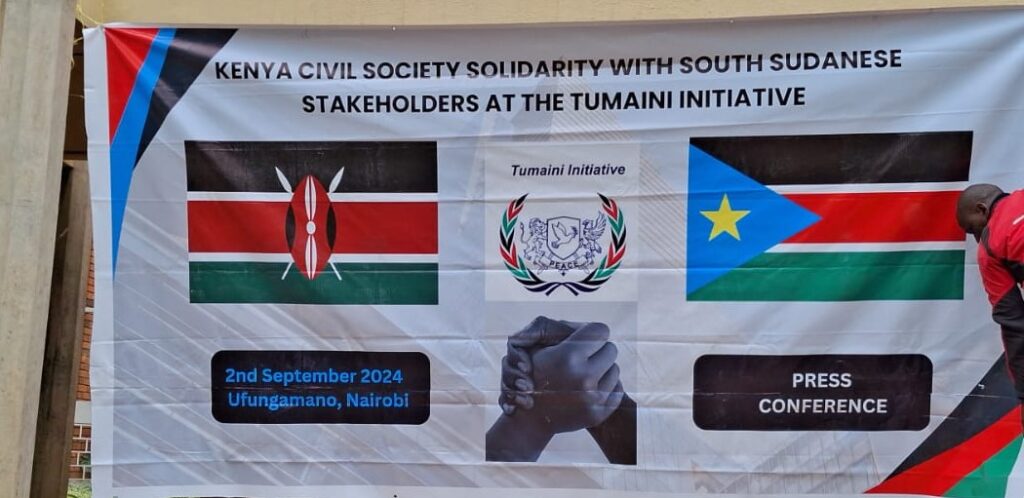
Banner from the early September meeting in Nairobi (credit Radio Tamazuj)
Debating Ideas reflects the values and editorial ethos of the African Arguments book series, publishing engaged, often radical, scholarship, original and activist writing from within the African continent and beyond. It offers debates and engagements, contexts and controversies, and reviews and responses flowing from the African Arguments books. It is edited and managed by the International African Institute, hosted at SOAS University of London, the owners of the book series of the same name.
The Tumaini (Hope) Initiative was launched by President Salva Kiir Mayardit of the Republic of South Sudan after realizing that the Rome peace initiative, mediated by Sant Egidio of the Catholic Church, was not yielding results. The forum, which included the Government of South Sudan (GoSS) and the Holdout Groups (HGs) – rebels who opposed the Revitalized Agreement on the Resolution of the Conflict in South Sudan (R-ARCSS) – had been ongoing for four years since 2020, without achieving any tangible outcomes.
In May 2024, President Salva requested President William Ruto of Kenya to mediate the conflict between the GoSS and HGs. President Ruto accepted, and the new initiative under the “Tumaini” banner began in Nairobi in June 2024. As the name suggested, the majority of the HGs members were involved in the R-ARCSS negotiations in Addis Ababa and Khartoum between 2017 and 2018. However, the group chose not to sign the agreement at the last minute, insisting that certain issues were not addressed by the R-ARCSS. It was for this reason that the GoSS agreed to reopen the peace agreement to accommodate their views, provided these views were not already covered in the R-ARCSS.
At the time of writing, the situation in Nairobi is reportedly contrary to what was expected in relation to the R-ARCSS. All eight protocols initialed by Tumaini stakeholders are merely replications of the R-ARCSS, with the exception of the protocol on communal violence. This approach has been seen as a contradiction of the Tumaini mandate, which is supposed to address issues not covered by the R-ARCSS. Furthermore, the initiative has proposed new nomenclatures, replacing existing mechanisms. For example, they proposed the National Leadership Council (NLC), Joint Defence Security Board (JDSB), and National Implementation Oversight Committee (NIOC). According to Annex A of the R-ARCSS, the latter two mechanisms are under the Commanders-in-Chief of the warring parties. Though not provided for by the R-ARCSS, the institutionalization of the presidency as a mechanism to bring together R-ARCSS leaders to discuss implementation issues was a positive gesture, which the Tumaini Initiative named the NLC.
The replication of the R-ARCSS by the Tumaini Initiative’s High-Level Mediation for South Sudan led the Sudan People’s Liberation Movement-In Opposition (SPLM-IO), under the First Vice President of the Republic, Dr Riek Machar Teny, to withdraw from the peace talks in Nairobi. Other R-ARCSS signatories, such as the South Sudan Opposition Alliance (SSOA) and Opposition Political Parties (OPP), have also raised concerns about areas where Tumaini overlaps with the R-ARCSS. One of the Tumaini negotiators, Pagan Amum Okech, leader of the Sudan People’s Liberation Movement-Real (SPLM-R), insisted that Tumaini should be superior to the R-ARCSS because it will address issues that the latter failed to resolve and implement.
It is crucial for the mediators and Tumaini stakeholders to focus on matters that are not part of the R-ARCSS. Besides communal violence, the group should discuss land disputes and power-sharing arrangements to enable their integration into the government. Additionally, the group should concentrate on strengthening the implementation mechanisms and finding solutions for the impediments to the R-ARCSS, which have led to a lack of implementation and frequent extensions. South Sudan has been in a governance transition without general elections since its independence in 2011.
In reality, the R-ARCSS faces many challenges, but three of these are critical and need to be addressed by the Tumaini Initiative: political will, funding, and accountability. Political will is required from the leadership, especially the signatories to the peace agreement, to commit themselves to a smooth transition and the conduct of peaceful, transparent elections.
Funding is another issue, as the government’s competing priorities in South Sudan have created problems. Partners and donors are urged to make pledges for the success of the new peace accord. Accountability is significant, particularly given the limited resources. The experience of the R-ARCSS shows that the few resources allocated for its implementation were not adequately used for this purpose. Therefore, it is important to account for the funds dedicated to peace implementation.
It is likely that the Tumaini peace deal will face the same challenges as the R-ARCSS if these elements are not considered in the new agreement. The most significant challenge facing the R-ARCSS is the expiration of its extended transitional period in October 2024. Since elections do not appear imminent, there is a need for an extension, which could be best accomplished through the Tumaini Initiative rather than attempting to extend the R-ARCSS, which has already squandered its opportunities for a smooth democratic transformation in the country.
Source: https://africanarguments.org/2024/10/did-the-tumaini-initiative-exceed-its-mandate/
Newer articles:
- Nigeria's Naira Alongside Ethiopia, South Sudan Ranked As Worst-Performing Currencies In Africa - 16/10/2024 21:36
- Sudan war risks 'lost generation' of children - 16/10/2024 21:27
- Nuer people have a sacred connection to birds – it can guide conservation in Ethiopia and South Sudan - 16/10/2024 21:24
- South Sudan's holdout groups to sign deal next month - 11/10/2024 12:17
- South Sudan floods affect 893,000, over 241,000 displaced: UN - 11/10/2024 12:14
Older news items
- The overlooked mental health crisis in South Sudan - 11/10/2024 12:08
- South Sudan: Floods Snapshot (As of 10 October 2024) - 11/10/2024 12:01
- On St. Daniel Comboni Day, Catholic Bishop in South Sudan Recalls Saint’s “vision” for Education to Empower Africans - 11/10/2024 11:45
- Refugee figures in South Sudan hit the half a million mark as hundreds of thousands arrive, fleeing conflict in Sudan - 11/10/2024 11:39
- Harambee Stars to face South Sudan in CHAN 2024 Qualifiers - 11/10/2024 11:36
Latest news items (all categories):
- IGAD and South Sudan Strengthen National Coordination for the Implementation of the Building Women’s Economic Resilience for Sustainable Peace Project - 03/08/2026 18:53
- South Sudan plans interoperable birth registration, digital ID systems - 03/08/2026 18:50
- South Sudan Oil & Power Returns as South Sudan’s Premier Investment Platform - 03/08/2026 18:04
- Kenya: Mudavadi meets South Sudan foreign minister as Juba gears up for landmark elections - 03/08/2026 16:52
- A Long Road Home: Jal’s Journey Through Conflict and Separation - 03/08/2026 16:41
See also (all categories):
Random articles (all categories):
- South Sudan, Sudan conflict deepens humanitarian crisis - Examiner.com - 22/11/2012 18:18
- Malaria, Kala Azar Cases Fill South Sudan Hospital - Voice of America - 13/03/2013 14:52
- Development planning: Why has Africa failed at the basics? - 18/04/2022 22:31
- South Sudan battles rage amid talks - 08/01/2014 19:55
- South Sudan authorities urged to come on board and tackle human trafficking - 17/01/2023 08:00
Popular articles:
- Who is the darkest person in the world, according to Guinness World Record? - 25/10/2022 02:34 - Read 148269 times
- School exam results in South Sudan show decline - 01/04/2012 17:58 - Read 27914 times
- Top 10 weakest currency exchange rates in Africa in 2023 - 19/07/2023 00:24 - Read 25000 times
- No oil in troubled waters - 25/03/2014 15:02 - Read 24322 times
- NDSU student from South Sudan receives scholarship - In-Forum - 29/09/2012 01:44 - Read 22279 times
